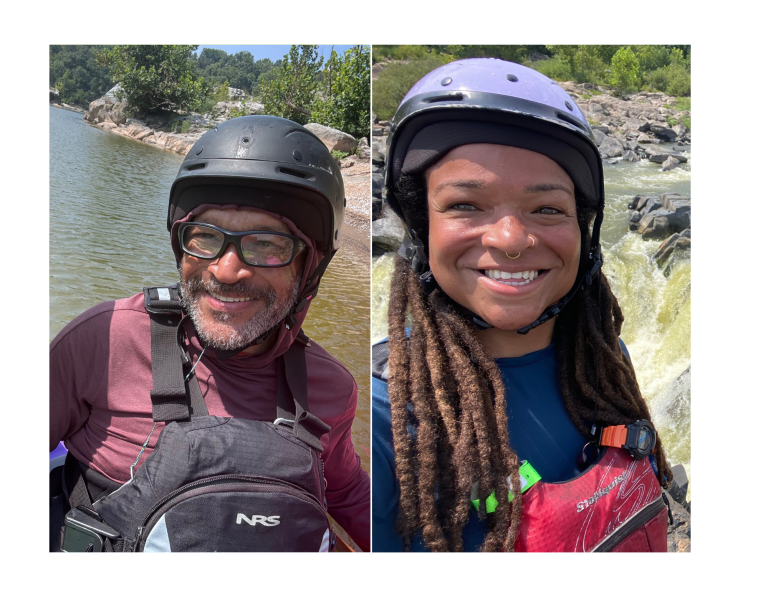
Anna Levesque: I have two guests for you today that I’m very excited about. My first guest is Rolando “Rolo” Arrieta. He is a storyteller, a passionate whitewater kayaker, and an ACA-certified whitewater kayak instructor who is redefining accessibility on the river. This past summer, Rolo launched Breaking Barriers, a two-day whitewater kayaking progression program on the Potomac focused on creating community-centered spaces for people of color. Participants built paddling skills while conquering deep-rooted fears. Based in Washington, D.C., Rolo brings an unwavering commitment to expanding diversity in whitewater paddle sports, with a welcoming, supportive, and safe coaching style that turns river-nervous first-timers into river-confident kayakers.
Courtney Smith has been whitewater kayaking for the past five years and still can’t believe the amazing places and opportunities she’s had since she started at the age of 34. She loves being an example to encourage and inspire folks to get out on the water, and she is always looking for new ways to grow, learn, embrace adventure, and inspire others to do the same. Courtney is going to school for social work and loves spending time with her dog, Coachella.
Thank you for being here, y’all. I’m really excited to chat with both of you.
Rolo Arrieta: Thank you for having us.
Courtney Smith: Excited to be here.
Anna Levesque: I’m going to pose the first question that I ask everyone who comes on the podcast. When I say “discomfort zone,” what does that mean to you, or what comes up for you? Courtney, let’s start with you.
Courtney Smith: When I hear “discomfort zone,” I hear growth, right? Because I feel like that’s where we grow, in that discomfort. And I mean, podcasting is uncomfortable for me. I feel like most of my life is in discomfort, you know? So yeah, when I hear discomfort, I hear growth. I hear, it’s time to put it all forward and get to it.
Anna Levesque: Right on. Thanks for sharing. When you say that most of your life is in the discomfort zone, can you say more about that before I move on to Rolo?
Courtney Smith: Yes. Well, because I’m always looking to grow, right? Especially now, with going to school, with kayaking, with doing different programs like leading and teaching, because I am L4 certified, a lot of my time is in discomfort. I would say these last five years, the majority of it has been in the discomfort zone for sure.
Anna Levesque: Right on. And by the way, we should have had your L4 whitewater kayak instructor certification in your bio, girl. What’s up with that?
Courtney Smith: I don’t know. I guess it’s a big deal, but I don’t look at it like that. I really got it so I can help others get out on the river, so I can make sure I know what I’m talking about when I’m out there giving people instruction. Because in this world we’re in, a lot of people know how to do the thing, and they give out instruction with good intentions. But until you have had that professional teaching around it and learned how to teach it, you might not be doing it right.
Anna Levesque: Amen to that. I’m very biased. That’s awesome. Thanks for sharing. Rolo, what about you? What does the discomfort zone mean to you?
Rolo Arrieta: Discomfort zone to me means growth. No, sorry, that’s taken already. To me, it means opportunity. I think it’s an opportunity to put yourself in a humble place, and then have an opportunity to come out the other end a better person. And I think it speaks to what Courtney was saying about growth. You put yourself in an uncomfortable situation, and even related to this particular program that I’d love to talk a little bit more about, it’s accepting the fact that you may make some mistakes. Accepting the fact that you may identify somebody by a gender or pronouns that weren’t their preferred ones, and seeing that as an opportunity to learn from it. And knowing that while it’s uncomfortable, at the other end of it you’re going to have an opportunity to be a different person, or a better person rather.
Anna Levesque: Thanks for sharing. I love that you used the word humble, and in this context, because y’all have taught together. Courtney talked about teaching and going through the process of becoming an instructor and inspiring others, and then you’re using the word humble and making mistakes. Why I think that’s so important is because as an instructor, and as an Instructor Trainer Educator who’s mentoring instructor trainers and also training instructors, I like to talk a lot about being humble and being a student first.
I know I’ve had experiences in the past with instructors who, for whatever reason, and you don’t know what’s going on with them, were in charge and you had to do it their way, the “right” way. And talking about accessibility, I know for myself, that scared the crap out of me. So there’s that balance of being effective, being humble, and also creating an environment that is inclusive. I put out a lot there, but what are your thoughts on all of that?
Rolo Arrieta: I’m happy to add to that, and I think you’re exactly right. This was a program that wasn’t only about an opportunity to introduce whitewater kayaking to underrepresented communities, particularly people of color. It was also an opportunity to develop leadership within the instructor realm, right? It was really important to me that the instructors who were part of it showed up with similar racial and cultural backgrounds. That we were also people of color.
For a number of reasons, that has so much value in how much one can connect as an instructor, and at the same time be in that space of humility and be a role model. To be that person who says, I am genuinely a whitewater kayaker. I love whitewater kayaking. And to be able to share the knowledge in a way that the person receiving it is getting the full spectrum, including feeling safe and comfortable around the person giving them the coaching. For me, that was one of the highlights of this program. And to bring out more leadership within our instructors of color, of which I can probably name on one hand. To me, if anything, it’s about nurturing and growing more instructors of color so that we can have programs like this.
Courtney Smith: That’s amazing. To piggyback off of that, Rolo had to come get me from the Southeast, you know? Which was so amazing. The opportunity was awesome. But just to add to that, being an instructor, I helped with a Girl Scouts paddle last weekend, right? And there ended up being one girl of color in the group. She said there were more in her pod, but nobody else wanted to come, and she didn’t want to miss out on the opportunity.
And we connected like this. We got to talking about hair. We got to talking about all the things. An instructor who didn’t look like her couldn’t have given her the experience I gave her. And she was keen on that. She said, “I was worried that the instructors were going to be mean.” She said, “I was worried that the instructors were going to be old men.” And she was like, “Old men are creepy.” Especially, they were seventh graders, you know? It just filled my heart to be there for her.
Anna Levesque: That’s awesome. And kudos to her, too, for not wanting to miss out on the opportunity. That takes so much courage.
Courtney Smith: It does. Stepping out on that ledge. And I can connect with her on that, because I told her that’s what I did. I jumped out there by myself.
Anna Levesque: You did. What did it take for you to do that, Courtney?
Courtney Smith: Actually, the first girl I started kayaking with ended up being busy, right? And you have this new kayak… sorry. It’s bad, because when I talk about this stuff, y’all, I start crying.
Anna Levesque: Are you looking for a Kleenex right now? I wish I could hand you one.
Courtney Smith: I am. I got one.
Rolo Arrieta: Let’s cut to commercial.
Anna Levesque: I wish I had commercials, Rolo.
Courtney Smith: I get so filled. On the way home from that paddle, I was in my van crying. Because like I said, no one else could have given that girl that experience, right? No one who looked different from her could have given her the experience I gave her. And I forgot what I was saying.
Anna Levesque: We were talking about what it took for you to jump out there.
Courtney Smith: Jumping out there. Yes. A homegirl of mine and I had started kayaking. We had rented kayaks in Florida, and on the way home we were just so excited because we had such a good time. She was like, “Courtney, I already have a kayak.” It was a recreational kayak, like one you’d get from Dick’s Sporting Goods, right? She said, “I already have a kayak. You should get one too. Then we can get more people like us out on the water and show them how cool it is, how it’s not as scary as they think, and how peaceful it can be.” So I went out and bought a kayak, and she ended up being busy for two or three weeks. I had this brand-new kayak in my apartment, and I was ready to put it on the water. So I just jumped out there on Facebook and found a kayaking group. They welcomed me with open arms, and it’s been history after that.
Anna Levesque: That’s awesome. Was the kayaking group a flatwater group, a whitewater group, or both?
Courtney Smith: It was just a kayaking group. I was in Georgia, so I just put “Georgia” and “kayaking” in there, and ended up finding groups. The majority of it was flat. It was all flat for a long time. Then I started seeing people in different boats. They put me in a crossover boat, and I started seeing different things and getting in different types of kayaks. But the entire time, I was just going out every weekend having fun.
Anna Levesque: Right on. Rolo, how did you get started?
Rolo Arrieta: I told Courtney this story, and she thought she knew the end of it. So, I was a competitive speed skater. You knew this.
Courtney Smith: I love it. His story is so good.
Anna Levesque: Yes, that’s right. From your coverage on NPR, your interview during the Olympics.
Rolo Arrieta: Right, so you saw that. The goal was to try to make the 1998 Olympic team. I knew it was going to be a long shot. I have Panamanian nationality, so I thought maybe I could become the first speed skater representing Panama. That didn’t go well either. And as I was trying to figure out my life at the time, there was a publication that talked about the falling and rising stars of speed skating. And I was listed on the falling stars list.
Anna Levesque: Really?
Rolo Arrieta: And you see, that was the same reaction Courtney had. She was like, “How awful.” And I’m like, actually, no. To me, that was an acknowledgment that I was being recognized as a star, right? Because this was an elite group of people. The other speed skaters on that list were respectable names. In my case it was age. We were competing against a younger cadre of people who were a lot more Olympic hopefuls than we were. Accepting that was what I needed to be able to say, okay, I’m done with this chapter, and I’m going to move on to something else. A friend invited me to go kayaking, and within a week I bought all my kayaking gear and was hooked.
Anna Levesque: Wow.
Rolo Arrieta: Ever since then. So going back to that notion of humility, being recognized as a falling star sort of created “a star is born” for me in a different sport.
Anna Levesque: That’s really cool. Did you start right in whitewater for your first time?
Rolo Arrieta: Yep. On the Potomac. Right there at Old Anglers, and still there.
Anna Levesque: What got y’all hooked on whitewater?
Rolo Arrieta: What got me hooked, I think, was that there were a lot of similarities with balance and full-body sports like speed skating. Hip mobility, using your legs and your thighs and your shoulders, swinging your arms. There was a lot that I felt transferred, particularly starting slow and building. Going back to the instructor hat that I wear, there are so many people who get in a whitewater kayak for the first time and think they can paddle in a straight line. They want to go as fast as they can, and they’re just muscling it. And you’re not going to last very long, right?
Speed skating was very similar. You start really, really slow, you build the speed, and technique allows you to progress. I found that challenging, and I loved it. Then I started running class II rivers, took a lot of courses, and before I knew it, I was running class III, like the Lower Yough and the Nantahala. I went out to NOC a few times, that sort of stuff.
Anna Levesque: That’s cool. Go for it, Courtney.
Courtney Smith: For me, it was the mental thing that got me. The mentality it takes. The way it takes you away from everything and makes you live in the now, right now. And the mental fortitude it takes to make those decisions in those shit moments. It was really the mental that grabbed me. For me, it’s all about the mental with whitewater kayaking.
Anna Levesque: Totally. What’s your favorite or most effective strategy in those shit moments?
Courtney Smith: To concentrate on what I need to be doing.
Anna Levesque: Do you do that with your vision, or with a word or a breath or anything like that?
Courtney Smith: No, it’s just in my mind. Because, you know, a thousand things go through your head in those three seconds that feel like thirty seconds, right? And it’s going down the list of skills that I have that can get me out of this situation. That’s all I need to be focused on. I go straight to: what do I need to do to get out of this in the fastest way possible?
Anna Levesque: That’s awesome. What about you, Rolo? What’s your strategy when things hit the fan?
Rolo Arrieta: I try to breathe as much as I can. I practice a lot of yoga, and I think I’ve learned to understand the power of the breath.
Courtney Smith: What are you doing when you’re upside down, Rolo? What do you do when you’re upside down? Because you’re breathing over here.
Anna Levesque: I was thinking the same thing.
Rolo Arrieta: I hold my breath. What I haven’t figured out is whether I should exhale and be underwater without oxygen, or be underwater with my lungs full of air. I try it two different ways, and for the most part, I’m underwater with my lungs full of air. But when things hit the fan and I’m upright, I try to slow down my breathing, because that tends to slow down my heart rate, and I think I’m able to execute.
A big part of what relaxes me is also getting through that first rapid unscathed, because it kind of sets the tone. And then the company that you’re with, right? Your crew. So many of those things can fall apart during any part of a river run. Those factor in for sure. And then it gets in your head, and yeah, when you’re upside down.
Anna Levesque: I love that you said that about breathing. I’ve recently been playing around with exhaling really, really long. I’ve been paddling on class II and III, where I’m really comfortable, and practicing exhaling as long as possible and then inhaling. I like to play around with my breath when I’m kayaking, and I find it very relaxing.
And on being in the present moment, Courtney, I was paddling the Gauley this past weekend, and sometimes I like to repeat to myself, “Where am I? Here. What time is it? Now.” It’s from Ram Dass, Be Here Now. I repeat that to myself sometimes when I’m going through big rapids. And I focus with my eyes a lot. For some reason, my vision is a big part of me being in the present. What am I looking at that’s right in front of me?
Courtney Smith: Yes. Looking where you want to go, right?
Rolo Arrieta: Where you want to go.
Courtney Smith: It is so huge.
Rolo Arrieta: Don’t look at that undercut on the Gauley.
Anna Levesque: Now we’re making it sound scary. It’s really fun.
Courtney Smith: It’s so fun. I told Anna before we got on that being at the Gauley was better than Christmas. All the people you see. I’ve probably seen seventy-five people I know from all over the U.S. It was so good.
Rolo Arrieta: ’Tis the season. ’Tis the season to be Gauley.
Courtney Smith: They need to put that on a Gauley T-shirt.
Anna Levesque: Yes, exactly. That’s awesome.
If I come back to the theme of the discomfort zone, specifically with teaching and running an event, because I think that’s sometimes underappreciated by people who haven’t run events. With this event y’all recently did in D.C., it was something new for both of you, right? The first time you put it together. Tell us about the discomfort zones that came up around running it, putting it together, and organizing it.
Rolo Arrieta: Courtney, do you want to go first?
Courtney Smith: Rolo, you did all of that by yourself. I just showed up and was me. That’s why, when I posted about it, I let people know Rolo did all that back work. Give Rolo that praise.
Rolo Arrieta: I couldn’t have done it without you, Courtney. Let me just start by saying that I did not know Courtney. I followed Courtney. I friended her and she accepted, but we had not exchanged words at all. I was watching her videos, and I’m like, okay, this is really wonderful to see Courtney, and how comfortable she was running things like the Tallulah and the Chattooga and the Cascades, with a big old smile. And I’m like, that is badass.
Anna Levesque: Badass.
Rolo Arrieta: I also want to give kudos to a couple of local paddlers: Risa Shimoda, who I think many of us know, and David Cunningham, who started a program with a local outdoors organization here, Soul Trak. We did a couple of years of a progression program that was well intentioned, and then that funding went away, and I was able to apply for a grant to put this on.
Like I said, the point of this particular program that was really important to me was representation from the instructional standpoint. In many of the courses I’ve attended, or that are available out there, they’re taught by white men, for the most part. So I’m like, okay, how do I make that work? And I just messaged Courtney. I said, “Courtney, you don’t know me, but I know you. I follow you. I’m putting on this program, and I’d love for you to come up to D.C.” And she said, “Sign me up. I’ve been waiting for your call forever.”
Courtney Smith: That was a win, Rolo. Such a win.
Rolo Arrieta: So we connected that way. Then, fast-forwarding through a lot of planning, I also want to give kudos to Ashley [surname to confirm] from Calleva, who I see as a mentor. She’s a certified instructor trainer, and she’s been teaching for so many years.
Anna Levesque: Instructor trainer. Yes.
Rolo Arrieta: I’ve been able to lean on her and understand a lot of the dynamics of teaching, aside from the racial and cultural aspects of it. It was very helpful to be able to work under her guidance.
One of the things we did before the program: we had an application process, and we made it very clear that there were some physical expectations. We wanted to make sure people felt supported and welcome, so we needed to understand things like how tall they were, so that we were prepared to welcome them and provide them with comfortable and safe gear. Then, a few days leading up to the workshop, we had an icebreaker check-in where we all connected via Zoom. We talked about: What are your fears? What are you worried about? What’s your superpower? What are you hoping to get out of this class? It created a bonding experience.
And sure enough, I was waiting for the one question about the sewage spill on the Potomac. I was like, I can’t believe we’ve gone this far and no one has asked about the status of the water they’re going to be paddling. Finally, somebody did ask. So it allowed us to alleviate questions and anxieties they may have had going into the program, and we hit the ground running with a little bit of an understanding of one another.
And Courtney, if you remember, somebody said, “I have locs. What about a helmet?” And Courtney’s like, “I can answer that question.” Stuff like that really allowed us to go into that Saturday morning with a little bit of knowledge of one another, feeling comfortable around each other. Because what could have been uncomfortable is walking in and not really knowing what you’re getting into.
Anna Levesque: Absolutely. And I love that you reached out to Courtney when you didn’t know her. I think that takes a lot of courage. I do it a lot, inviting podcast guests I may not know. Well, not all the time, because it’s scary. But I want to emphasize that reaching out can be so uncomfortable and scary, and amazing things can happen. And sometimes it doesn’t work out. You don’t get a response. I’ve had that as well. But I think it’s very cool that you reached out and made the invitation.
Courtney Smith: I feel like what’s meant for you is going to be for you. And if you get that no, that wasn’t meant for you, or it wasn’t meant to be at that time. I’m real big on: you’re always where you’re supposed to be, doing what you’re supposed to do. Things always work out. It might not work out the way you thought it was going to, but it works out.
And I can speak to this. A lady named Lisa G and I have been doing the kayaking duo, taking people out together. It’s the same thing. The back part that people don’t see in putting these trips on is crazy. The funding part, getting everything there, all the things. People just see the event, right? But there’s so much work behind the event. And then the event itself is so stressful. What if this goes wrong? What if this is late? What if this doesn’t show up? What if this doesn’t work out? I have a newfound appreciation for any type of event or anything people put together. I can say that for sure.
Rolo Arrieta: And just to add, the other instructor I should mention, Cortez McBride, is also an L4-certified instructor. To have somebody who took the initiative to get to the site an hour, an hour and a half early to start unloading the kayaks…
Courtney Smith: He used those big old muscles he’s got. We were like, okay, thank you for this.
Rolo Arrieta: Cortez is like, “I think I’m here, I’m going to start unloading the boats.” We’re like, “You go do that.” Working with Cortez and Courtney and Ashley, it was such an experience that I would welcome over and over again. And I feel like we accomplished what we wanted throughout those two days.
But to Courtney’s point, it was a lot of work. And I’ll say that, at the end, it’s such a passion project for me that I’m okay with it. It was self-gratifying for me to figure out this and figure out the other. And then, like Courtney said, you don’t know if somebody doesn’t realize they can’t carry a 40-pound kayak on their shoulder, or they trip and scrape their knee. All those things kind of happened, right? We had one participant who was struggling from the very beginning, and it was an effort of encouraging them to paddle a really, really large stretch of the Potomac that could cause a lot of problems, even though it was flat water. I was very fortunate to be working with a team that helped execute in a very effective way throughout the whole weekend.
Anna Levesque: That’s awesome. At the end of the day, it’s really fun. And sometimes it’s type two fun with events. I know with Women’s Paddlefest, sometimes I’m stressed and exhausted, or even with the Ladies on the Lower Gauley trip we just did. Then at the end it’s like running a rapid that you’re nervous about. In the moment, sometimes it’s not “woo-hoo, fun,” but sometimes it is. And at the end you’re like, yeah, that was worth it, like you’re saying. Putting yourself out there.
That’s why I bring it up, because organizing events can be a discomfort zone. I think that’s why I’ve seen events come and go. It takes a lot of effort. So I want to acknowledge you both, and acknowledge you, Rolo, for all the work, bringing it to fruition, having that vision, and taking action one step at a time.
Courtney Smith: Yes, Rolo’s thing was amazing. I just want to put it out there: being a part of Breaking Barriers was so amazing. I strive to be able to put together an event like that one day. I feel like it was seamless from the front to the back. We had little hiccups, but they were just things that happen.
Anna Levesque: Well, they’re going to happen.
Courtney Smith: As far as the planning, how things were where they were supposed to be, the logistics and all of the big stuff, spot on for sure.
Rolo Arrieta: Let me just add, going back to this whole idea, a goal of mine, and in fact I might have even mentioned this to Ashley, was: if Courtney comes to D.C., maybe we get her to run Great Falls. Imagine the role model she would be. And Ashley’s like, “Let’s not pressure her. I don’t want her to feel like she’s obligated.” Well, the fact of the matter is that it could not have happened more organically.
I kind of let it go. After the first day, we went to the Calleva farm, and they hosted us there. We had dinner, and Ashley turned to a colleague she’s been working with for all these years, who is also one of the core instructors, and said, “Let me introduce you to Steve-O. Maybe he’ll take you down Great Falls.” Courtney and Steve-O chatted and connected like they had known each other for years. The next day, they ran Great Falls together, which was wonderful.
To me, it was an opportunity to… showcase is not the right word. It was an opportunity to have a role model. Particularly coming out of the program, for anybody who feels like, yeah, this is what I want to do. Courtney really helped us get there by running Great Falls the next day. We have the photo of her at the bottom of that last big rapid. I’m really glad Courtney was able to do that.
Courtney Smith: Rolo, that’s like giving candy to a baby. You didn’t have to twist my arm hard to run Great Falls. If there was a way for me to run it, I was running it. And I love Ashley. I connected with Ashley, and we definitely have to run some stuff together. Great Falls was amazing. The way it happened was, like he said, so organic. I got to run it right before I got on the plane. So I was on the plane so full of stoke. And then I couldn’t get everything to fit, so I wore my life vest on the plane.
Anna Levesque: That’s awesome. And all your wet gear weighing down your suitcase.
Rolo Arrieta: On her way to the airport, she’s like, “Hang on, I’m going to go run Great Falls.” It was wonderful.
Anna Levesque: It’s so funny. Y’all are highlighting another important thing that I think can be taken for granted, which is, again, the invitation. Connecting people. Introductions are huge.
I know for myself, unlike my husband, who literally grew up at the Nantahala Outdoor Center and was in it since he was a baby, I got a job in the kitchen of a rafting company when I was in college and just fell in love with kayaking. I begged everyone to teach me how to kayak. When I started competing, I didn’t really know what I was doing. I didn’t know people. I just started doing it, and then you start to meet people. Just like any industry or any community, when you’re already in it, you take for granted that you know so many people and you’re connected. It’s so important to take a moment to create opportunities, make invitations, and make connections.
I was actually listening to a podcast clip this morning from a pretty popular podcast, and the guest was saying that one thing we should all be doing every day is making a connection. Connect people where you think it could really make a difference for them, where connecting them could really change their life. That’s been on my mind all day. And now y’all are bringing that up. That connection with Ashley and Steve-O, and Rolo inviting Courtney up, was the first step. And then all these cascading effects.
I know for myself, there are probably times when I could be making more intros or thinking about it from that perspective. It can be uncomfortable too, because you don’t know. Sometimes I get in my own way, thinking, I don’t know if that’ll really matter, or I don’t know if those two people will actually jive. But I’ve got to get out of my own way. It’s okay if they don’t jive. You don’t know until you know.
Rolo Arrieta: I’ll just add to that. In some of the previous programs I’ve participated in, and even this one, there is still a nut that I can’t crack, which is: how do we maintain a progression? I had an opportunity to go to the Pacific Northwest and participate in a whitewater kayaking progression program funded by Diversify Whitewater, with Kelly Kurtz, who works out there and does a wonderful, wonderful program. It’s several weeks. And of course, you’re in White Salmon, Washington, Hood River, where every other car has a whitewater kayak on it. Kind of like Asheville, I guess. So access to gear is more readily available to people who are interested.
So the challenge, and even the discomfort for me sometimes, is how much do I push this cohort? These nine people participated in a two-day kayaking program, which is really small in terms of progression. What’s the next step, and the next step? I’m trying to figure out how to maintain interest, hoping I can work with local kayak clubs.
Gear is a really important one. Access to gear, and the amount of money one wants to invest in it. We’re going into the winter months, so we’re going to offer this group a pool rolling session to keep them engaged and interested, connect them to social spaces where kayaks are for sale, and be that advisor who says, “Hey, look, this is a really good kayak for a really good deal.” Because that’s the progression.
Because one of these days, Anna, one of these days, I want to be able to go to the Gauley and see what I saw with your women’s group, where there were like 25 women kayaking. One of these days, I’d like to see that be all people of color, right? Because how lovely that would be.
Anna Levesque: It was amazing.
Rolo Arrieta: But I feel like we’ve got a long way to get there, for a number of reasons. There’s deep-rooted fear of being in the water within African American and Latino communities, and the disproportionate number of drownings among people of color. It’s just alarming that it continues. There is movement and there’s change, but we’re working with a lot of challenges, and it’s going to take some time. But I’m committed, and hopefully we can see some progress there soon.
Anna Levesque: Well, I think with folks like y’all talking about it, posting about it, and showing how y’all do it, it makes a big difference. That representation.
Courtney Smith: For sure. I love that you bring that up, and connecting too, because I am such a connecting person. I’ll talk to anybody. My mom used to always say, “Do you ever meet a stranger?” I’ll hop in the eddy and talk to people. I’ll see somebody doing something nice out on the water and I’m like, “Excuse me, I’ve got to talk to you.”
So you saying that makes me think harder about connecting people. I do connect people all the time, especially people who are a little timid about talking or putting themselves out there, and they want to go kayak. I hook people up with groups even if I can’t go. I’ll make a little group chat real quick and put everybody in there: “Hey, y’all have fun.” But now that you’ve said that, I’m going to hone in on that a lot more, because that is a gift I have. So why not give it?
Rolo Arrieta: You’re really good at it, Courtney.
Anna Levesque: I have a follow-up question. I also think it’s a hard nut to crack, the gear and the progression, having people stick with it. Folks are probably going to have an intimidating experience at some point, and I think it’s really important that in those moments they have people who don’t just say, “Deal with it, it’s just what happens,” but who can actually guide them through it, which is what I love to do with my clients. And the boat library they have in Hood River is a really cool project. It’ll be interesting to see if it’s sustainable and if it can be replicated in other places. They seem to be doing well with it, but I don’t know a lot of in-depth details about it.
Since we’re talking about this, Courtney and Rolo, what has your experience been with whether the whitewater kayaking community as a whole has been inviting and welcoming? Do you want to speak to that?
Rolo Arrieta: Go ahead, Courtney.
Courtney Smith: Man, that’s a hard one. Overall, it has, if you look at the big picture. But a lot of that has to do with me and my personality, right? There are so many little things you run across.
I had posted about getting a bunch of new people out on the water. Of course, we were all people of color, and I was super excited. I posted it in a lot of different groups on Facebook and stuff. In one of the pictures, a guy was behind me because we were in a tandem, and he was throwing up a peace sign, you know how we do. I posted it to this one place, and I’m not going to put their kayaking organization on blast, but one of the comments at the bottom said something like, “Great, there’s nothing like gang signs out on the water.”
People always ask, “Why do you always have to make it about color?” Because of things like that. Somebody sees my homeboy, who is the farthest thing from what that person thought, and just because he’s Black and threw up a sign, they see a thug throwing up gang signs. It’s that type of thing.
And somebody told me one day, I wasn’t even there, that people were in a shuttle talking about me. A lot of people see me online, and I’m running class IV, class V whitewater, and they’re in the shuttle talking about, can I swim?
There are times I post things in multiple groups and people have to erase comments. People flood my DMs: “We’re so sorry. We’ve seen that comment.” And it’s like, we shouldn’t have to go through and edit comments because I’m getting people out who look like me. So overall it’s been kind of welcoming, but then there are always these things. And then they wonder why we have to do the things we do.
Anna Levesque: I’m sorry that happens. It makes my blood boil. It’s frustrating.
Courtney Smith: It very much is. And we live this every day. We wake up in this every day. You can take it from here, Rolo.
Rolo Arrieta: I think it’s similar for me. Overall, even though it’s a very small whitewater kayaking community, I think there is a way to find your crew, right? Find the people that you’re comfortable around. But I will admit that years ago, I was a little more uncomfortable with that mental game. When somebody says something that just didn’t sit well with me because of the color of my skin or whatever, the mental game is: Can I really trust this person? I’m about to run a class IV rapid. Can I really trust that he or she is going to look out for me if I’m in distress?
So it’s been an exercise in trying to block that out, because a lot of those things can really mess you up when you’re in the moment, right?
And I thought about this knowing I was going to appear on this podcast and talk about being a whitewater kayaker, being a Black whitewater kayaker. Running shuttle at the Gauley, right? You’re in one of the most remote areas. The sport we love requires us to drive into these really remote places, and it does make you think.
Courtney Smith: And Gauley shuttle is real West Virginia, you know what I’m saying?
Rolo Arrieta: It is real West Virginia. And you kind of want to be like, I don’t want to get stranded out here. I don’t want a mechanical failure and all that. My guess is that every human might have that same fear. But arguably, if you’re a person of color, it’s a stronger feeling for sure.
Anna Levesque: What I’m hearing is that there are layers of mental discomfort. People think, yeah, running whitewater, there’s a discomfort zone. There can be nerves, maybe fear, so you’re working on your strategy for that. And then on top of that, someone says something to you, there might be racist comments, so that’s layered on top. And then not wanting your car to break down in the backwoods, that’s another layer. So it’s more layers that other folks don’t have to think about. All of us who kayak already know what it takes to calm our nerves when we’re nervous about a rapid, much less having these other things pile on.
As a woman, even as a white woman, I’ve experienced a little bit of that. Comments like, “Are you paddling? You’re not running shuttle?” And I’m like, “Should I be running shuttle?” This was a long time ago, but it starts to mess with you. And certain people don’t have those layers.
Courtney Smith: I’ve been fortunate enough to make myself a diverse crew down here. Not going to lie, Chadley and I boat like this. Especially on anything big, because I know he’s going to have me. Anytime I get caught in anything crazy, I can look up, and that man is in that eddy making eye contact. I have that. And Mariella, me and Mariella are like this.
Anna Levesque: Yes, Mariella’s awesome.
Courtney Smith: When I get out on that water, especially big water, the diverse paddle crew is going to be my crew. Even Alicia. You know Dane and Alicia? I love Alicia. Me, Alicia, Mariella, Chadley, you can usually catch us together.
Anna Levesque: Yes, Alicia is awesome. I have caught you together on the Chattooga. And Dane’s there too. Don’t forget Dane.
Courtney Smith: We were together on the Gauley on the second day. Dane wasn’t at the Gauley because he had some things going on. But yeah, Dane, and then Justin Lee is sometimes in the group. So usually, if you look out on the water and say, “Look, we have diversity out here,” it’s going to be my group.
Anna Levesque: Which is great, because then your group can grow. And like Rolo’s saying, the representation, the inspiration: “Wow, Courtney’s running Great Falls. Maybe I can do that too if I work at it and keep paddling.” That’s awesome.
Courtney Smith: There’s nothing like doing something that’s already so nerve-wracking and then having to add that extra layer of: I’m the only one out here who looks like me. And like you were saying, I’m a woman too, so I have that added factor on top of that. Guys will try to say, “I can show you down this, I can show you over here,” because they have ulterior motives. And it’s like, I don’t want to run that rapid that bad.
Anna Levesque: Right.
Courtney Smith: It’s wild out here.
Rolo Arrieta: Courtney, do you want to share what you talked about at the end of the two-day program, when we all had a retrospective? One of the things that was special for you about this particular program?
Courtney Smith: Watching everybody do the things they said they thought they couldn’t do?
Rolo Arrieta: It was that, but it was also the turnout. It was women.
Courtney Smith: Yeah, the whole group was women. We had a couple of guys in the group, but it was all women. I had never been on the water with that many Black women in one setting. It was great. It was amazing.
Anna Levesque: That’s very cool. It is amazing. I’m so grateful for what y’all are doing. And in the future, if I can support you however I can, amplifying, sharing, please let me know.
Rolo Arrieta: Now you’re going to make me cry.
I’m happy to share a couple of things I think would be really helpful. In moments where you see a person of color who has some experience with whitewater kayaking, encourage them to become instructors. Encourage them to become leaders. Because I think that’s the foundation that will allow us to crack that nut.
I would venture to say that one of the big successes of the women’s kayaking programs you do is that all your instructors are women, right? There’s already a role model built into the program organically. So if we can continue to build similar types of programs… There are efforts out there to increase diversity. Diversify Whitewater has a myriad of programs to increase diversity in whitewater. But a lot of it starts with the leaders. It starts with people of color who are leaders in that space, who can put themselves out there as instructors, as representatives of whitewater kayaking, on boards, and those types of things. So if you know of anyone, get them to sign up.
Anna Levesque: Absolutely. I was involved for several years, though I couldn’t do it last year or this year, with the Paddlesport Leadership Academy that Tennessee RiverLine does, which Jerry [name to confirm] helped start. It’s flatwater, but the whole point is to create certified community paddlesport leaders, so that folks go out into their own communities as certified leaders.
And I think it’s also important to remember, and this is one of the reasons I have a flatwater program at Women’s Paddlefest, that people can get comfortable in flatwater. They don’t have to start off in whitewater. And as a whitewater community, we can say, “That’s super cool, you’re flatwater kayaking,” because it is. That’s where it’s going to start. Some of those folks from the academy have now become certified instructors in stand-up paddleboarding and kayaking. Not yet at Level 3 or 4, not yet. But now that they’ve done these programs, they’re more comfortable. They’ve gotten to know folks in the ACA. They’ve found their vibe.
And I will say, to anyone listening: there are some great instructors, and just like anything, there are some great instructor trainers, and there are some instructor trainers you probably aren’t going to vibe with. It’s really important to ask questions. And for y’all too, I know you already do this, let people know to ask those questions. You don’t want to take just any instructor course, in my opinion. I’ve said this publicly, and I’m fine saying it here on this podcast.
Courtney Smith: A hundred percent.
Anna Levesque: Just like anything, you want to do your due diligence and ask questions. And if you have a negative experience, it’s really important to put it in your course evaluation, which goes to the ACA. And reach out to Courtney or Rolo or someone else you trust, who you can share those experiences with and who can point you to someone you’ll have a positive experience with. Go ahead, Rolo.
Rolo Arrieta: That’s really good instruction. I think that’s really valuable, and I’m going to remember that. Feedback is important. Even as instructors, I always feel like I could be a better instructor in all the ways.
Anna Levesque: Effective instructors are growth-minded, like Courtney’s saying. We’re going to make mistakes, and the key is to clean it up. You have to be willing to be, in your words, Rolo, humble, and say, “Yeah, I made a mistake,” or “I said this, and it didn’t land.”
Courtney Smith: Yes. I always let them know when I start a class: “Look, I am good at this. I do know what I’m talking about. But we are learning together. Both of us are going to learn today. You’re not the only one learning.” I make sure I put that out there. I feel like that lowers the nerves for them too. But it’s so true.
Anna Levesque: Totally. Creating a place where mistakes are learning opportunities. I want to be cognizant of time. Do y’all have time for a rapid-fire round?
Rolo Arrieta: Sure.
Anna Levesque: What is your favorite river metaphor for life?
Rolo Arrieta: Courtney, Courtney, Courtney. That’s my answer.
Courtney Smith: I’m like, ooh, this is fast. Okay. Life flows just like the river. There are going to be obstacles in the river, and there are going to be obstacles in life. And like I say, you just have to paddle with your chest out. You just have to live life with your chest out, you know? Because I feel like when you do it with your chest out, with your full abilities, it might not end up like you thought, but it’s going to end up better than you thought, because you did it with full force. And that’s with kayaking and in life.
Anna Levesque: Love it. Thanks, Courtney. Anything to add, Rolo?
Rolo Arrieta: Just read and run.
Anna Levesque: Read and run. I love it. What’s a morning ritual that sets you up for success?
Courtney Smith: Time by myself, in my head, before anything else, being grateful for things. Even if I can’t write it down, I say in my head the things I’m grateful for. Just being able to live in that moment and take that quiet time. That’s how I start my day, and that kicks it off right there. You have to be appreciative of being able to just wake up.
Rolo Arrieta: Facebook Marketplace.
Anna Levesque: Really? Are you being real?
Rolo Arrieta: I have spent a lot of time trying to find used kayaks. But no, for real: squats and planks.
Anna Levesque: Ooh, good. Those are really good for kayaking.
Courtney Smith: That’s right, Rolo. I need to work out.
Anna Levesque: What’s a non-negotiable self-care practice?
Courtney Smith: Kayaking.
Anna Levesque: Good answer.
Courtney Smith: That’s my answer for everything.
Rolo Arrieta: Gosh, non-negotiable self-care practice. I know you sent these in advance, and I don’t remember that one. It’s a cup of coffee in the morning.
Courtney Smith: Rolo has really good coffee.
Anna Levesque: Love it. What motivates you these days?
Courtney Smith: Getting people out on the water. Just bringing people out, especially when they don’t think they can.
Anna Levesque: Love that. It’s the best.
Courtney Smith: It fills my heart.
Rolo Arrieta: Demoing boats.
Anna Levesque: What’s your favorite boat right now?
Rolo Arrieta: I don’t have a favorite. I currently paddle a Jackson Flow, and I have a Wavesport EZ that I’m never going to get rid of.
Anna Levesque: Love the Flow. Old school. Right on.
Rolo Arrieta: I feel like this is the time of year to start demoing a bunch of boats and see what’s out there. That motivates me to go try a different boat every time I go out.
Anna Levesque: Sweet. What do people get wrong about you?
Courtney Smith: Ooh. That I don’t get scared. I feel like people think that because they see me out there doing these things, I don’t get scared. I get scared like everybody else on those rapids. I just have a really good way of not thinking about it too hard, because I know in other situations, when I think about things too hard, it makes them hard to do. So I just do it. Do it before your mind takes over. A lot of times people sit around in those eddies, and I’m like, I’m not doing that. I’m just going to go.
Anna Levesque: It’s awesome. Turn and burn.
Rolo Arrieta: Turn and burn. Read and run. What people get wrong about me: that I’m a whitewater rafter.
Courtney Smith: Oh my goodness. The poor souls, they don’t know. I had a girl in my class yesterday who saw my shirt, and she’d been paying attention to me, and she asked, “Do you raft guide?”
Anna Levesque: That’s funny. And I’m not dissing, because I was a raft guide for a long time. Rafting is fun, but rafting is not kayaking. We all know this. And kayaking is not rafting.
Rolo Arrieta: Love our raft guides. They’re important. But that’s not how I identify.
Courtney Smith: I have plenty of rafting and raft guide friends. They be doing their thing.
Anna Levesque: Throughout the course of your life, have you felt like the underdog or the favored to win?
Courtney Smith: Throughout my life, or throughout whitewater?
Anna Levesque: You can answer either. I’m flexible.
Courtney Smith: I’m going to say favored to win. Just because that’s what I want it to be, and I don’t know what other people think. We’re going to go for that. Even though I like to root for the underdog.
Rolo Arrieta: I’m going to say the same, favored to win, because I think we’re going to win with these types of programs. We’re going to really start to see the fruits of our labor here pretty soon.
Anna Levesque: Right on. Hard moves in easy water, or flooding?
Rolo Arrieta: Flooding. No, no, no, I was thinking.
Courtney Smith: I definitely think hard moves in easy water.
Rolo Arrieta: The same. Slowing it down to be able to really understand how to execute.
Anna Levesque: What’s one word that describes your comfort zone?
Courtney Smith: I haven’t been there a lot lately. I forgot about it. Relaxed.
Rolo Arrieta: The breath.
Anna Levesque: Good. The breath. Freedom through discipline, or I do what I want? I know, these existential questions.
Rolo Arrieta: I’ll go. Freedom.
Courtney Smith: I would like to be the latter, freedom through discipline. I strive for that, but I definitely be doing what I want.
Rolo Arrieta: I would say freedom through discipline. I do feel like I’m a more disciplined whitewater kayaker now. I’m at the point in my whitewater kayaking career where I want to be intentional and have purpose, and I don’t feel like I need to do that crazy rapid that’s going to keep me up all night the night before. So it’s very liberating.
Anna Levesque: Right on. In one word, what do you hope your legacy will be? Deep question.
Rolo Arrieta: In one word? How is that possible?
Anna Levesque: Anything’s possible, Rolo.
Rolo Arrieta: Can it be a hyphenated word?
Anna Levesque: Sure, I’ll take a hyphenated word.
Rolo Arrieta: Barrier-breaking.
Anna Levesque: Ooh, love it. That’s a good one.
Courtney Smith: First. Like, the first. I’m the first to do a lot of things.
Anna Levesque: First. Love it. Right on. Is there anything else you wanted to say to our listeners?
Rolo Arrieta: Like what my favorite river snack is?
Anna Levesque: Sure. What’s your favorite river snack? Maybe I should put that in the rapid-fire questions.
Rolo Arrieta: Sardines in mustard sauce with ripped saltine crackers.
Anna Levesque: Ew. No, I say that, but I used to love sardines because my dad always had them around the house. I just haven’t had them in a long time.
Rolo Arrieta: Sardines in mustard sauce are the best, because they have so much sodium and protein, and they really help with those muscle cramps you get.
Anna Levesque: Okay, well, we have to paddle together, and I’m going to take some of your snacks so I can experience them.
Rolo Arrieta: I’ll bring extra. They pack really nicely. They’re tiny little cans.
Courtney Smith: What do you do with the can after you eat it?
Rolo Arrieta: I put it back in my little dry bag and store it.
Courtney Smith: You put it in a bag and then put it in your dry bag, or you just let it roam in your dry bag?
Rolo Arrieta: I kind of let it roam. You’ve got the smell of the neoprene and all that, and then you have the smell of sardine that goes with it.
Courtney Smith: Well, you know what they say: if you haven’t smelled your kayaking buddy, you probably haven’t kayaked with them enough.
Rolo Arrieta: That’s right. So the smell of sardines in mustard sauce cancels out all the other smells that have already come out of there. You should try it. Run to the grocery store. You can get a whole bunch of them for really cheap.
Courtney Smith: Because no one else is eating them.
Anna Levesque: You heard it here first, folks. I like stuff with chocolate chips in it. I’m just such a chocolate fiend.
Courtney Smith: I always have to remember to bring a snack, because I’m so excited and I live in the moment. I’m out there doing the things, and I’m not eating because I’m upside down all day.
Anna Levesque: But then you get hangry.
Courtney Smith: Yeah, but that always happens on the last part of the shuttle. The end shuttle.
Anna Levesque: And you’re like, I need food now.
Rolo Arrieta: When you do remember, Courtney, what’s your favorite river snack?
Courtney Smith: Whatever I can grab that’s easy and can fit in my life vest pocket. Sometimes I do those tuna packs.
Anna Levesque: Those tuna packs are awesome, actually. They have something like forty-seven grams of protein, or something crazy like that.
Courtney Smith: For a dollar fifteen or whatever. Because I’m real cost-efficient. So the tuna packs would probably be my go-to when I do remember, or just whatever I can snag from the local gas station on the way.
Anna Levesque: Right on. Is there anywhere folks can connect with you on socials?
Rolo Arrieta: I’m findable on Facebook. I don’t post much, but I’ll respond. Folks can look me up, on the river or through other areas.
Courtney Smith: You can find my boy on NPR, you know what I mean?
Anna Levesque: I know, we haven’t talked about that. Rolo, what is your work at NPR? Are you a producer?
Rolo Arrieta: I actually have more of a supervisory role. Every now and again I have the opportunity to work on a story, so that’s a good thing. I try to keep the two worlds separate as much as I can. But it’s great.
Courtney Smith: Okay, come through, Rolo.
Anna Levesque: Now that you say that, the stories you do choose to do around rivers, I just want to say that as a river community person, I really appreciate it. It’s so rare. We’re such a niche community. I’ve really appreciated your stories, like the one on Hurricane Helene, and others I’ve read or listened to. I think the paddling community appreciates it too. That’s also how we get more people, when folks out there hear how much fun it is, or hear about the impact that people in the industry are making.
Rolo Arrieta: It’s a good opportunity for me to tell a story the way I feel I know how to tell it, and to bring a slice of the world to listeners who wouldn’t know about it otherwise. They’ll probably come out of it saying, “I want to go whitewater rafting one of these days. I heard the story on NPR. I’m going to sign up for whitewater rafting.”
Anna Levesque: I was just thinking that.
Courtney Smith: As long as they get out there, it doesn’t matter. On any platform, you can look up The Uncommon Kayaker, or you can just put my name in, Courtney Smith. You can usually find me on something. Like Rolo, I don’t post much, even though I probably should.
Anna Levesque: I’m going to have your contact information on my website with the show notes, so folks can look you up and get in touch with y’all on socials if they want to. I really appreciate y’all being here. Thank you so much for taking the time. It’s been a fun conversation.
Courtney Smith: Thank you.
Rolo Arrieta: Thank you. I have to pack now. I’m on my way to the Gauley.