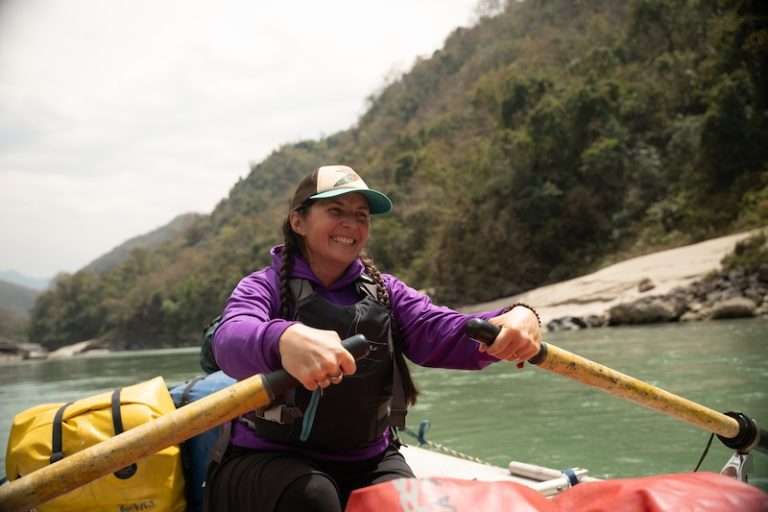
Anna: Kastorff is the co-founder of Endless River Adventures, the owner of Rio Quijos Lodge in Ecuador, and the founder and executive director of the nonprofit Need More Outdoors. She’s been part of the Western North Carolina paddling community since 1991. As with many small business owners, she has spent the last 34-plus years teaching kayaking during the day and doing the business side of things after hours.
This has also included the winter season, when most paddlers have some downtime, as it’s the season for guiding internationally. She started guiding first in Chile and Costa Rica, and in 1995 added Ecuador, which to this day is where she loves to guide the most. The Rio Quijos Ecolodge came to fruition alongside the Quijos River in Ecuador, and it stands as her commitment to helping a community create sustainable tourism.
Need More Outdoors was created in 2020 in recognition of the partnership between Maria Noakes and Juliet, getting kids playing outdoors. As a nonprofit, Need More Outdoors works with area businesses and organizations to encourage kids in the 828 area code to get outdoors.
Thanks for being here, Juliet. I’m excited for our conversation.
Juliet: Thanks so much for having me on. It’s really a pleasure.
Anna: Yeah, it’s always great to get to chat with you, which actually we don’t get to do very often. I do see you out on the river teaching when I’m teaching. And I’m excited to talk with you. You’re a pioneer in the whitewater world and in the instruction world. So I want to start with this: when I say discomfort zone, what comes up for you?
Juliet: I think, if I’m being honest, what comes up for me is really being front and center. When I was in college I was on the swim team, and my times in practice would be faster than my times in a meet. And when I decided to really challenge myself professionally in kayaking, I went and did slalom, and that was probably some of the most discomfort I’ve ever felt, not just because of the challenging part, but because of having all eyes on you.
Anna: I can really relate to that. From my years of freestyle competition, I was always one of the best female paddlers out there in training, and I loved training. Then when I got to competition, I would worry so much about what other people were thinking versus what I actually had to do. It was that all-eyes-on-me feeling as well.
Juliet: I think it’s also what helps us thrive as instructors, because your goal isn’t to be the best yourself, it’s to be the best instructor. You’re always looking at how to make the person you’re working with better. It flips the role. So I think it helps.
Anna: That’s so fascinating, I’ve never heard you say that before, the all-eyes-on-me thing. And I can relate, as I mentioned. Yet we’re both leaders in our communities and businesses. So there is an all-eyes-on-me component to leadership too, but it’s almost like leading from the back, maybe. As you mentioned, in teaching it’s about the student, one hundred percent student focused. From a leadership perspective, I wonder why all-eyes-on-me as a leader feels different from all-eyes-on-me in a competition. What do you think?
Juliet: I think maybe it’s because even as a leader and business owner, you’re looking to build up everybody else involved with your business. It can’t be egocentric. When Endless River first started, obviously Ken Kastorff’s name had so much value, but from the beginning we were really careful about not marketing on his name, and instead pushing Endless River Adventures, because one day he wouldn’t be a part of it. So I think as a leader, if you’re always looking at how to build the community around you so that you could be replaceable, if you pulled yourself out the whole thing wouldn’t collapse. A good leader knows how to build up their team, build their confidence, and let other people take credit for stuff, or help them earn the credit, so they feel part of it too.
Anna: For sure. With Endless River Adventures, you’re much bigger than my brand. My brand is built around me, and I’ve done that on purpose. Part of that is because it allows me to be fluid, I don’t have a business location, there are a lot of things I do differently. With your business model, having a bigger staff and a much bigger operation, and wanting to hand that over, I think that creating something that will outlast you is amazing. I’m actually not going for that in my business. People have told me I should, but for my life it’s just a different way to go about it. At the same time, I one hundred percent agree on empowering clients. I have a very small team I work with, and it’s about empowering them, and even working with outfitters in different countries when I run international trips, having that collaboration mindset. That actually took me a minute, because I felt pressure to do everything the right way, and I was a bit more of a micromanager. It was so freeing when I let other people do it, let other people lead, especially on international trips. They know the river. That was so freeing, and it was good to get out of my own way.
Juliet: It is, but it’s also scary, because you have to try and set them up for success and also be there when they make mistakes. It’s a balance. Where you might not have the brick and mortar, what you’ve created extends to all the partners you have, and how much they’ve come to respect what you do. I think it’s the same end goal in a lot of ways.
Anna: What you just said is so important: be there when they make mistakes. There’s the coaching aspect too, whether it’s for students or for staff. Giving feedback and having hard conversations can be really uncomfortable for me. How do you approach those conversations?
Juliet: As far as personal feedback goes, in some ways I’m a lot better at handling those conversations personally than I am as Endless River Adventures. I wear Endless River Adventures on my sleeve, my heart is just there so much. So I can take personal feedback, like staff coming to me and saying they want to talk about something. It took a long time. It’s very easy to get defensive and close down, but to be able to say “I hear you,” and more importantly, to be able to say “I made a mistake.” That was a lesson a manager in my very first job taught me when I had made a mistake. I was in the hotel industry, in a management training program run by Harvard business graduates. It was the first all-suite concept, and they recruited college graduates from mostly private schools into this training program, then put you in every part of the hotel business.
At the time I was at the front desk, and one day I checked in three people to dirty rooms, which is the worst thing you can do in the hotel industry. The manager of housekeeping was this woman, probably five feet tall, but when she got angry she was like ten feet tall. I could hear her coming across the lobby after my third check-in. She got in my face and said, “Little management trainee, I’m going to teach you your first management lesson.” I started to say something, and she said, “Stop. Do not make any excuses. I want you to look me in the eyes and say, I made a mistake and I’m not going to do it again.” I said, “Yes ma’am, I made a mistake, and I’m not going to do it again.”
That’s definitely one of the things I’ve taken and tried to impart to my staff, that it’s okay to say “I made a mistake.” Especially with kayaking, where people screw up all the time. As a coach and mentor, getting them to understand that it’s okay, that’s important. When you’re dealing with the strongest force of nature, in a sport that’s very mental, you’re going to make mistakes. The thing about kayaking is that it’s so ego-driven, because when we screw up we’re swimming next to our boat, you can’t fake it.
You said something earlier this year that I loved and have tried to incorporate. You gave Jill Wren credit for saying that if you mess up a rapid, or go for a swim, or don’t quite get your line, that’s not a bad day, that’s a bad moment. It doesn’t mean it should ruin your day. I took that and processed it, and I thought, that’s really good, I’m going to embrace that, and I’m going to remember you gave Jill credit, so I will too. I continually use that now when people say they had the worst day, and I ask why, and they say they missed their line at the falls. I ask how the rest of the day was, and they say it was really good. So that was a bad moment in time, not a bad day.
Anna: You’re welcome. Thanks, Jill, that’s good wisdom. Part of it is so much about reframing. Thanks for sharing that story about when you were young, that’s intense, and taking responsibility is so important.
It can be hard. I tend to be hard on myself, and it’s interesting because sometimes I need to take my own advice. I coach clients all the time on exactly what you just talked about, and I have to remind myself, in business and relationships, that it’s okay to mess up as long as you take responsibility. I call it cleaning it up. People respect that a lot more than trying to protect ego or make excuses, they can see through that. And the river, for sure, there’s no making excuses in the river. Which is what makes it so good for personal growth as well as kayaking skill, which I love.
Juliet: It’s so honest.
Anna: For sure. When did you start kayaking, back in the eighties? Did you experience any discomfort in terms of whether there were a lot of other female paddlers around you, or was it very male dominated?
Juliet: In the late eighties. When I came to the Nantahala Gorge in 1991, it was a really vibrant time with a lot of powerful women. I didn’t know most of them because I was kind of an outsider, I wasn’t a longtime kayaker, when I moved to the Gorge I was wobbling my way down the Nantahala. But they were out there guiding and teaching, and they set a really great example, at a time when there were also a lot of really strong, powerful men, the Ken Kastorffs and the Chris Speliuses and Eric Nieses of the world.
One of the things I was so fortunate for, to this day, is that it was a time where you just proved yourself. It wasn’t about wearing a badge for being male or female, because everybody was exploring and learning and figuring things out together, running new things. You had little tiny women who were guides on Section Four of the Chattooga, and the whole river makes you honest. They’d get in a raft with six men and say, “All forward,” and those guys would be thinking, we’re going on one of the hardest rivers in the world and we have this little girl guiding us. By the time it was done, they’d be like, “Yes ma’am, what do we do next?”
That definitely helped me when we started running trips, because in the early years it was pretty male-dominated as far as our guests went. It was also a different caliber of boater back then. The people who went on international trips tended to be really committed, dedicated class four-plus or class five boaters who all they did was kayak. Then there came a time, I remember we had a guy, Doug Geiger, who left and came back for one winter season. He was looking through the trips and said, “What’s a class three-four trip? There’s no such thing, you’re either class three or class four.” I said, “Maybe when we started, Doug, but it’s a new world.” The Agua is a class three-four river. Now people get into kayaking who also want a family, want a successful relationship, and don’t want to get a divorce because they’re kayaking all the time, and they want to mountain bike or climb too. Maybe they don’t paddle two hundred days a year, maybe they only paddle thirty to fifty days a year, but they love kayaking. Times have changed.
In those early years, I was put in the role of guide on hard rivers, and I’ll be honest, there were times we’d go scout a rapid and I’d be asked by my guests, “Well, are you going to run it?” I would take umbrage in that, and I’d march up and get in my boat and run it, because I’d think, yeah I am, and I’m a girl. Fortunately my fellow guides were so supportive, they’d say, “Juliet looked like she just danced that rapid, what happened to you surfing around in that hole?” It was nice that support was there, and there wasn’t as much labeling, you just had to prove yourself. That definitely influenced me early on.
Anna: I love that you mentioned the guys asking if you’re going to run it, because that still happens to me sometimes when I’m paddling with friends. I can tell when they’re on the fence, and they ask if it’s typically a class four, and I’ll say, yeah, I’m going to run it. Then it drives them to run it too, which is fine, that’s their deal. I don’t know exactly how I feel about it, but I’m making my own choice based on the river and my experience, so I always feel good about my choice.
I’ve also said on this podcast before that sometimes it’s nice to have the ego push me. I want to be someone who still paddles Cascades, for example, and it makes me nervous, and I don’t always have great lines. So it’s good, I have that ego push to do it. Sometimes I see folks running something and think, I don’t know why you’re so nervous, you have way more experience and skill than me. So that ego push can be a blessing or a curse, it’s important to be self-aware about what’s pushing you. But yeah, I still get that from some guys, “Are you going to run it?”
Juliet: It also brings great satisfaction when you get in your boat, run it, and run it really well. Afterward you’ve earned their respect, because they did kind of second-guess you, and then they say, “Wow, you had a really nice line,” and it’s like, thank you.
Anna: Totally, it’s very satisfying. Or when I’m doing an instructor course for a local camp with young eighteen, nineteen, twenty-year-old guys who are very good paddlers, typically Kiwi or UK paddlers who’ve already gone through their own instructor systems, which are very good. And they’re like, here’s this middle-aged woman, instructor trainer, ACA, whatever. I love it, because they’ll be working hard to get on a wave, and I’ll say, you’re working way too hard, why are you paddling so hard to get on that wave? They say, what? And I take one or two strokes and slide onto the wave, and I love seeing their faces, eyes big, like, she can paddle. It’s great.
Juliet: In some ways, our industry has more ageism than sexism. There’s an amazing guide named Laura Heflin, Dr. Laura, who would help us out on the Agua. One day some folks came back and said, “Wow, so our guide walked up to us,” and she was a little older, limping, stretching, said she had really bad hips, and they thought, my god, this is our guide on the Upper Agua? They got in the raft with her and she was hands down the best guide on the river that day. After a certain age you’ll get people asking, “Do you still run rivers like that?” and you think, why are you asking that? I think once a woman is out of her twenties, especially because there aren’t as many women over sixty who paddle that much, the way there are still a lot of men, women have to deal with that more.
Anna: I was on the Upper Gauley a couple of years ago with women in their late forties and early fifties, and I’m curious about that, how many women my age and older are still paddling class four. It’s a smaller number than men, traditionally it’s been more male dominated. And with women there are other factors, families, kids take time. I love working with women who’ve had kids and want to come back to kayaking, holding that space for them, encouraging them, helping them refind themselves.
It’s cool to be out there role modeling that we can still do this. And unfortunately I sometimes feel like I’m carrying all women on my back when I don’t have a good line, which is crazy. I remember paddling Section Four a few years ago, I totally missed my line at Sunken Dog and got worked, swam out of the hole. There were five guys, and they were very nice about it, but I thought, okay, I’ve got to walk back up and do that again, I’m not going to let that stand. So I went back up, ran it again, had a good line, and they cheered, and that felt really good. I did that at Oceana too, on my fiftieth birthday. I didn’t have a terrible line, I just didn’t have the line I wanted. Andrew helped me walk my boat back up, which is a beast of a hike, but I had a much better line the second time. It feels good to do that, but it also kind of sucks to feel that weight sometimes, which is self-imposed.
Juliet: That would be so scary.
Anna: It does feel that way sometimes.
Juliet: Oceana reminds me, it’s self-imposed, but it sets a lot of people up to look up to you. I was running the Tallulah one day with the gang, just the guys, and on the way over I said, Oceana’s kind of a messed-up rapid, it’s the easiest class four rapid where you can have serious consequences because you have no control. I thought, maybe today I’ll walk it. The whole way down the stairs I’m having this conversation in my head, like, I could walk this rapid, it’s not a big deal to walk a rapid, I really try to teach people that. All the way down the stairs, I get in my boat, go to Oceana, get out of my boat, and there’s a girl and her dad I had taught to paddle when she was ten years old. She said, “Miss Julia, I’m so excited you’re here, can I watch your line? This is my first time running Oceana.” I thought, oh my god, and I just turned around and started walking back to my boat. Craig and Steve and those guys asked where I was going, and I said, to run this rapid, don’t ask me any questions. So sometimes it’s neat that we’ve set up these generations of people who look to you and get inspiration from what you’re doing. That’s really cool.
Anna: I love that story so much. That’s the thing, we’ve set up accountability partners without even officially setting them up. My clients keep me accountable, because if I’m going to coach at a certain level, I need to be paddling at a certain level, I feel strongly about that, I need to role model it. When I decide it’s time to not coach at that level, that’s fine too. Thank you for sharing that. And I love how you said, “Don’t ask me any questions,” I’m like that too when I go back up to run something. Some people love the pump up, but I need to be centered, I need to just be talking to myself and focus on what I’m doing.
So, what have you learned about yourself? You’ve spent decades doing this. What have you learned through navigating your discomfort zone?
Juliet: I’ve learned that it’s really easy to stay in your comfort zone, and that’s not always good. That’s probably one of the things I struggle with the most, because as an instructor and guide, I’m really not supposed to make mistakes, I need to be taking care of everybody, especially guiding. I’ve spent a lot of my international time as the photo boater, especially in the last few years, as I’ve allowed some of my guides to take on that leadership role on the river. I’ll tootle down the river by myself in just about any rapid and set up to take pictures by choice. What that has meant over the years, in both roles, is that you don’t take the hero lines very often, because if you’re leading people down, or if you’re by yourself, you set yourself up not to. There are times I have to put my big girl pants on and take the hero line.
There’s a rapid in Ecuador, El Toro, in the middle canyon of the Quijos. It’s a big deal, comes out of nowhere. The canyon run is hard, but El Toro stands apart. Because I was often videoing or running down first, I had nailed a line that pretty much set me up not to make mistakes. Then one day a few years ago I thought, I need to get in my boat and run the line the guests are talking about, they might see me run it and I might mess up, because there’s a big hole at the bottom. And I did it.
But for all of us, it’s really easy to stay in your comfort zone, whether it’s the river you paddle or how you run a rapid. In the Southeast, look at Nantahala Falls, there are people who can run it without getting their hair wet, but if you ask them to run a different line, they say they’ve never run that line. You ask, how many times a year do you run Nantahala Falls, and they say twenty or thirty, and you’ve never run another line? No, because I’ve really got the one nailed. I’ve used myself as an example that you have to take yourself out of your comfort zone sometimes, you have to go into that hole and surf around, or run that rapid, because afterward it reaffirms that you’re actually a better boater than you thought, that you could push yourself and be challenged by it and be excited about it afterward. Like, whew, I surfed that hole and didn’t swim out, that was really awesome. I think that’s important, for me it’s important.
Anna: Like with your story about Oceana, having that accountability, coaching and leading, having clients who want to try harder lines too, keeps you on your game. I find a lot of satisfaction in that, and I’m very grateful for that push.
When you’re at the top of Oceana, or at the top of El Toro, what are your strategies for moving through fear, or centering yourself, or focusing?
Juliet: I definitely use music in my head. If I’m on a river and I need to settle down, where I start to feel that anxiety climbing, I’ll put on a song, not hard metal or loud banging, usually a calm song, and then just focus.
Juliet: I think that’s one of the things that’s so cool about kayaking. Sometimes you run a rapid and get to the bottom, and you can’t really rewind the film and say what was going on, because you get so focused on what you’re doing that you’re just in that moment. That’s definitely what I do. Years ago on the Middle Reventazon in Costa Rica, we had this cool Irish guy, and after we ran a rapid he said, “Did you see those two iguanas up on that rock?” I said, you looked around and saw iguanas on a rock? I was just so focused. I think that’s what helps me, getting into that uber-focused zone where it’s just me and the boat, that’s it. If a student asked me how to develop that, I wouldn’t have a good answer, everybody’s a little different in how they think when they’re pushing themselves.
Anna: Thanks for sharing. The other discomfort I’ve been grappling with this past year, in terms of longevity for kayaking, was a back injury I’ve recovered from, gratefully, with a lot of consistency and commitment. How does your body feel after paddling for four decades?
Juliet: One of the first weeks I was in the Nantahala Gorge, a guy came in with his arm in a sling, his name was Hugh. He said, “Ugh, I just dislocated my shoulder for the third time.” It freaked me out, because I was a pretty new boater and I thought, dislocated, now you don’t get to go kayaking? I asked him what he’d done each time in physical therapy afterward, and he walked me through it. I took that to heart. At the time rubber bands were really in, doing stretches with rubber bands, so I bought one and did it every day when I got to the river. Some people asked why I was doing it right then, and I said, because it’s in my gear bag, that way I won’t forget it. Now I have one of those, not a Bowflex, but similar, that I keep on my railing, and I have to walk by it on the way downstairs.
What Hugh taught me was that there are times a hurt back or shoulder happens, you can be the best boater in the world, be so careful, and accidents still happen. But you can also prevent a lot by taking care of yourself and making good decisions, and for me hands down it’s stretching. Every morning I stretch. I had a huge realization this year. I think from all these years sitting in a kayak with your legs splayed, my hip flexors got weak, and I work hard every morning to strengthen them. In Ecuador this year, something came across my feed about a mobility test, going from standing all the way down onto your back, sitting back up, crossing your legs, standing back up, showing how well you’re aging. I’d just finished stretching and thought, no big deal, I do yoga, I stretch every day, that’ll be a piece of cake. I got down, no hands, sat up, no hands, crossed my legs, and I couldn’t move. I was like, oh my gosh. I realized my hip flexors are really weak now. It was very enlightening, I never thought that was something you had to strengthen. Looking into it, people who sit a lot, and sit with their legs splayed, it’s really terrible on your hip flexors. So I’ve started incorporating strengthening work for them. I want to be able to get up, I don’t know if I’ll ever cross my legs and get up again, but I can roll to my knees and stand without using my hands, and that’s almost as good. That’s probably the recurring issue I’ve had as a kayaker, pain in my hip flexors, so being proactive about it is important, because it’s not fun to do something you love but hurt.
Anna: Glutes as well, for me, supporting the back is a lot about glutes and glute medius, which also goes to sleep when you’re sitting a lot. Thanks for sharing that, every morning for me too now. Stronger glutes are really important, because kayaking matters to me both professionally and for fun.
So, you’ve been in this industry a long time, this is more of a business question. I see folks come in really hot and fancy, and then I see them go away, because I think it takes a lot of consistency, and there’s discomfort, times when cash flow is low, or you don’t feel like doing it, but you get up and do it anyway. Have you seen patterns, from being in the industry so long, that make people successful, and patterns that make them unsuccessful, in business or instructing?
Juliet: In terms of instructing, people find out that taking your passion and making it your profession, you can lose your passion. I’ve watched people come in all fired up to be a professional paddler or guide, and then after a while, it’s raining, everything’s running, and they just don’t feel like going out. I’ve definitely seen people get a little jaded about kayaking or teaching over the years. I feel very fortunate that I haven’t, and I can’t one hundred percent say why, though the work has become all-encompassing.
As far as the business side, our industry is so challenging on so many levels. People can be absolutely passionate, think they have a great idea, want to start their own business, but there are so many hurdles, permits for rivers, insurance, the list is so long, it’s really hard to start a business. I used to talk to Debbie Singleton’s class, she’s Mark Singleton’s wife, she taught the Outdoor Program at Western for years, and she’d have me come talk to her students every year. One year she called and said, “Juliet, maybe we should use a different subject.” I said, do I depress people? She said, yeah, because they’re in the middle of their business plan and you throw all this at them, and suddenly they’re redoing it and realizing they can’t do it. It’s hard, it’s very hard. I also think our industry isn’t always as supportive, because everybody wants to do it themselves. You have people without permits, without a business, without insurance, but they’ve got an ACA certified card, so they think, I’m going to teach kayaking. Or someone wanting to run a retail shop, and that’s part of why kayak stores close down, everybody wants to come in and try the stuff, but kayakers take pride in not paying top dollar for things.
Honestly, sometimes the most frustrating part for me personally is not getting that support, people not recognizing how hard it is. We’re so happy every day, because we love our jobs, excited about who we’re working with and what we’ll help them learn. But in the back of your mind you’re also thinking about liability insurance being due.
Anna: It’s due, I’m literally renegotiating that right now.
Juliet: I just finished that, and it was just as depressing. Then you find out a group was on the river running a clinic, and maybe that’s why none of your instructors had work that weekend. Sometimes I wish people could recognize that we do love our jobs, it’s really fun, it’s a joy to teach kayaking and guide people down the river, but that we choose this as a lifestyle, and to give back. Because if we’re not out there keeping quality high and bringing new people in, our sport, our industry, would be hurt. So we give a lot, and sometimes that lack of recognition and appreciation for what’s going on in the background can be frustrating.
Anna: I hear you on that. The industry can’t survive if no one is paying retail for anything, if there’s no value placed on instruction and creating spaces where people thrive. Another pattern I see, I’m in business because so many women go through instruction and get certified and work with their club, that’s great, I love that. But there’s a difference in quality between folks teaching on weekends once in a while and folks teaching and coaching full time as professionals. I’m in business because of those classes though, where people say they were scared and just told to follow, or told they needed a certain thing.
One recent example was a newer boater who was convinced to buy a small half-slice when she really needed to be in a medium river runner. She was struggling, flipping so much there was no chance for her to build confidence, but the people paddling with her kept saying she needed the smaller boat, it’ll push her, it’ll challenge her. When I got her into a river runner her size, she took off, both her skill and her confidence. She went from not wanting to kayak anymore, because it wasn’t fun and she was scared and flipping all the time, to loving kayaking and being proud of her skill development.
Juliet: That’s a big difference. It’s funny that sometimes people use instruction to promote their ego, but you have to leave your ego behind. It’s okay to be generous with your time, donating a weekend to help someone, but also to say, if you want to continue this sport, you should get professional instruction, there’s really good professional instruction out there. There’s a whole group of us who’ve been willing to help keep instruction professional and growing and changing and getting better.
On the boat thing, as instructors we’ve seen how people have changed over the years. Now you get people who’d love to go kayaking every weekend but don’t have time, people are so overcommitted. So would it be great if they were in a half-slice? Sure, but if they only paddle two weekends a month max, why not get them in a more stable boat? They’re not going to turn into champion kayakers, but they’ll get to a point of confidence and enjoy the sport, instead of being on the verge of quitting because it wasn’t fun. You see more creek boats and river runners out there now. Should people eventually be in half-slices and learn to stern squirt? Yeah, because it gets you upside down, and for somebody whose skills progress but who’s got young kids and will be on the Tuck Gorge for the next five years, get them a half-slice and keep having fun. But is it okay for someone who won’t be paddling much to not be in the latest, hottest boat? Yeah, get them in something that builds their confidence and makes them feel good about going out.
Anna: For sure, agree. I feel like we could have this conversation a lot longer, and we have in the past. Do you have a question for me, Juliet?
Juliet: I think a question would be, if you could share one thing with your colleagues, instructors, to help them be better, I’d love to hear it. I feel like I’m always learning, and I love finding out something new or a different perspective. Is there something you’ve recently figured out in instructing that I could take away and share with my instructors?
Anna: Great question. I don’t know if I have anything new for you, you’ve been at it a really long time, but I do agree, I love to learn, I always learn from other instructors. The number one thing, and it’s pretty simple, is be student centered. Talk to your student, what are their goals, what do they want to accomplish. You’ve got to have your plan, but be willing to let it all go if it’s not suiting or supporting the student. For example, if someone gets really nervous and it takes a lot longer to do wet exits to gain confidence there, you just spend the time there. In whitewater kayaking it’s easy to think, let’s get to the good stuff, let’s get to the rapids. Some folks need longer, some need shorter. Let them dictate that, not your plan or what you think they should be doing. That’s my rule of thumb.
Juliet: That’s great advice, and a really good takeaway, not having a preset agenda, finding out what people need. With some people it is shorter. I really try to share with my instructors that you want to be very aware of how people learn, because if somebody isn’t an auditory learner, you can talk all day and it goes right over their head. I’ve had people who literally weren’t hearing anything I said, and at a certain point you have to say, okay, put the paddle in your hand and go paddle around, then come back. That’s what separates instructors, being able to differentiate between clients and tweak your presentation.
Anna: Totally. I said it’s pretty simple, but actually I take that back, it’s not simple, it takes a lot of experience. I listen and look for things beyond what people are saying, I’m looking at body language, and I can tell a lot from that, which comes from a lot of experience being with a lot of different folks on the water. The concept is simple, actually doing it is less simple. When I’m teaching instructor courses, that’s one of the hardest things for folks, a lot of other things go out the window, like group management, because they’re so focused on delivering that they don’t have unconscious competence yet, being able to just be there, without the plan, and see what unfolds. Being present.
Okay, are you ready for rapid fire?
Juliet: Okay, ready.
Anna: What’s your favorite river metaphor?
Juliet: I have two. “You have more time than you think” is one of my most important ones. And “go with the flow,” which really is true, sometimes you just have to go with the flow and be okay with it.
Anna: What’s a morning ritual that sets you up for success?
Juliet: Stretching. If I don’t do it in the morning it almost never happens. That hour in the morning is the closest thing to selfish me-time I have, and it’s really important.
Anna: What’s a non-negotiable self-care practice?
Juliet: Sleep. I love sleeping.
Anna: I’m with you there, me too. What motivates you these days?
Juliet: What motivates me is watching people find joy from being outside. I worry about electronics, about social media and how people are defining themselves by it. It’s that joy someone has at the end of a day of accomplishment, getting them out of their comfort zone, away from what they’re used to doing, and doing something new that’s really gratifying for them, that’s really powerful.
Anna: I love that. Agree. What do people get wrong about you?
Juliet: That I’m an extrovert. It’s amazing in this industry how many people are in an extrovert job but are introverts. I learned that about six years ago, the first time I traveled by myself, to Ireland. It was a big deal, I was nervous, and I thought, I’ve been leading trips internationally for years, but this was going by myself, and I loved it. What I found was that I could be really fine not talking to anybody. I went to a pub in Dublin, the oldest pub there, went to the bar because that’s what you do when you’re by yourself, had a shepherd’s pie and a Guinness. There were a couple of folks a few chairs down, and it didn’t even dawn on me to talk to them. A young lady showed up and sat between us, and within ten minutes she was chatting away with these guys. I was just drinking my Guinness, eating my shepherd’s pie, thinking, wow, that is just so not me. So I think that would be a big thing.
Anna: I can relate to that too, one hundred percent. Throughout your life, have you felt like the underdog or the favorite to win?
Juliet: Underdog.
Anna: Hard moves and easy water, or flooding?
Juliet: That’s easy. Hard moves and easy water.
Anna: What’s one word that describes your comfort zone?
Juliet: You might have me stumped on that one. Confidence.
Anna: Freedom through discipline, or I do what I want?
Juliet: That’s a self-awareness thing. I think it’s freedom through discipline more than doing what I want.
Anna: In one word, what do you hope your legacy will be?
Juliet: If it’s one word, my legacy would be that we all create the foundation for our industry continuing, that we, as a group, as a community, being outside is so important. It’s never been more important, and will never be less important. Giving people the resources and the confidence, and seeing that continue through time, other people acknowledging it and picking up the torch and following behind us.
Anna: I have a follow-up question. Why should people get into whitewater kayaking? Because it’s uncomfortable, it can be challenging, which is why I like it, but why should people get into it, Juliet?
Juliet: I think we have to start with what you said, it is uncomfortable. You’re wet, you can be cold. If you’re a type-A personality it’s hard, although being type A is actually really good for it. It’s okay for people to try kayaking and have it not be for them, that’s one of the reasons I love the spud and the tater. But why should they get out? Not just for personal enjoyment, but because this planet we live on is endangered, our rivers, our water quality. Years ago I found a t-shirt in Costa Rica with what I think is a Native American saying: once all the trees have been cut, and the fish have been eaten, and the rivers have been destroyed, will we only then realize that you can’t eat money. Everything is so dictated by that now.
Why should people get into kayaking? Because it builds community. It’s a very equalizing sport, you can be Joe Jock, an eight-year-old, a seventy-five-year-old, or a tiny woman, and when everybody puts on their paddling gear, they’re all just kayakers. That’s one of the coolest things about kayaking. You develop a community, you learn to back each other up, you learn to not compete against each other, but to be on the river supporting people when they do something really good. You learn to walk a rapid but be happy for your friends who run it, and there’s just not enough of that in the world. So whether it’s a kayak, a spud, a tater, a shredder, or a raft, I think it’s really important that we remember that connection with nature, and not lose it.
Anna: Well said, thank you. Is there anything else you want to say to our listeners before we wrap up?
Juliet: I’d just say, delight and find joy in every day you’re out on the river, find support in your community, learn, find a community that supports you, and have fun. That’s what our sport is about, having fun.
Anna: Awesome. Thanks so much, Juliet, I really appreciate you being here. That was a fun conversation.
Juliet: Well, Anna, thanks for all the time you put into doing these podcasts, it’s been a long-term commitment and you’ve really developed great conversations with so many interesting people. Thanks for what you do for our industry.
Anna: Well, thank you. And thank you for everything you’ve done, coming before me, pioneer woman. I couldn’t do what I’m doing without folks like you who did it before me. So really appreciate you, Juliet, thank you.
Juliet: Absolutely, the same. Thanks so much.