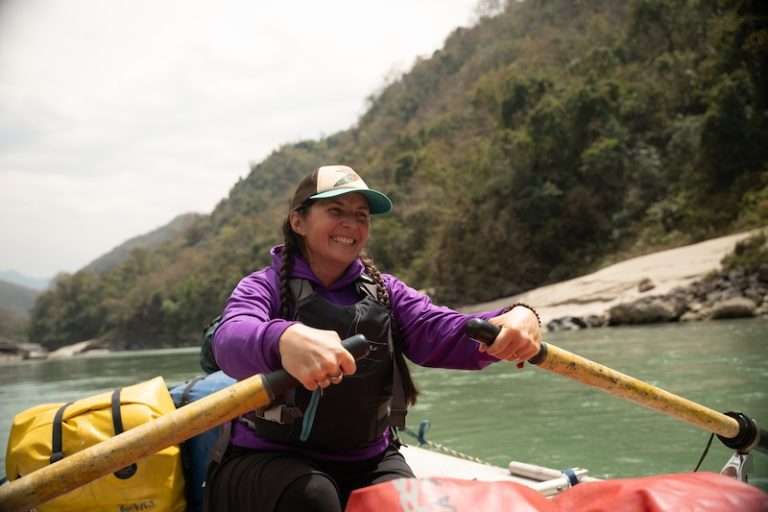
Anna: My guest today, River Mutton, is an extreme whitewater world champion kayaker from New Zealand who mostly enjoys being in the air in her kayak, boofing waterfalls, or trying to do flips. She’s also a paddling instructor and Waka team rider. Thanks for being here, River. I’m excited to chat with you.
River: Yeah, thanks for having me.
Anna: Yeah. So when I say discomfort zone, what comes up for you? Like, what does that mean to you?
River: I think discomfort zone for me is anytime I’m feeling a little bit scared, which in my kayak usually happens when I’m running something hard or trying something new that maybe is a bit consequential if I don’t perform well.
Anna: Yeah. What’s your strategy? To be clear, everyone listening can go to her Instagram. She’s such an impressive kayaker. River has run so many amazing waterfalls and rapids. She does tricks over waterfalls. You’re just such an impressive boater and an exciting paddler to watch. What’s your strategy for when you’re scared about to run something that could be consequential? Do you have a strategy that you use?
River: Thank you. I’m going to be honest, I actually hate being scared and I’ll do anything I can to avoid that feeling. I think when I’m running something that maybe might put me out of my discomfort zone, I try to only run things I feel like are very well within my skill level, which maybe means my progression is a little bit slower. I don’t want to run things until I feel as safe as I possibly can doing them. So when I’m doing something, I want it to be way below my skill level, not just within my skill level, but below it. So I know that it’s going to go the way that I want, and I’m as certain as I possibly can be about that. And I think I’d rather have a steady, safe progression than to be constantly pushing myself.
Sometimes I do find myself a little frustrated for that, but I think I also just hate being scared and I don’t want to put myself in places where I feel scared. I just want to have fun when I’m kayaking. And I think I can still do those things when they’re below my skill level and feel stoked about them because it’s something I wanted to do. And it gives me that adrenaline rush because you’re always going to get an adrenaline rush no matter how comfortable you feel with something when it’s big or consequential.
Anna: Yeah, that’s interesting. You like to build up and when you want to run something really big, you want to wait till it’s well below your skill level. To me that blows my mind, because I watch the stuff you’re running and I’m like, wow, what would she be running as a buffer? And you say you get frustrated with yourself sometimes because of your slow progression. Why do you get frustrated with yourself? Is it because you see other people doing things and you’re like, I could do that?
River: Yeah, kind of. I’m very ambitious with my kayaking and I want to be the best I can be. And I think I find it a little frustrating when I see people doing things and I’m like, I could do that, I know that I could do that, but it feels too scary for me right now and I want to wait until I have more skills. So that fear kind of goes away because I can then look at it and be like, well, of course I’m going to make that line, rather than, I can make that line but I’m scared. I want to feel as comfortable as I can doing something. And I think sometimes I feel frustrated because I want to be really good at this and I want to do these things as fast as possible, but I also want to feel comfortable and have fun in what I’m doing.
Anna: Yeah. Well, that takes a lot of self-determination to follow your own progression and not get swept into what everyone else is doing. I think that actually takes a lot of courage to be like, no, this is my process. This is how I want to feel. This is how I’m going to do it. It’s very cool.
River: I think I’ve just found what works for me in doing things that scare me and that’s what I’m going to stick to.
I try to just switch off, look past the feeling of the jitteriness in your stomach. What I like to think about as a good way of explaining it is, one of my friends once told me about a podcast she listened to that was talking about fear as being your body being the most focused that it will ever be. Like being super hyper aware and locked in on the moment. And I think that’s a really cool thing to think about — using that as a tool to perform my best. Being able to switch from that feeling of, I’m so scared of this, to, okay, I’m locked in and I’m focused. Not ignore the feelings, but feel more focused on what I’m doing than those uncomfortable feelings in my stomach. Sometimes that’s a switch I can turn on in my brain and sometimes it’s not.
Anna: What’s the difference between being able to turn it off or not?
River: Sometimes I feel like I can look at something that I might feel scared of and be like, okay, I’m doing this, and I’m hyper focused, and I don’t really feel anything else other than being completely aware of what I’m doing. And sometimes those feelings of thinking about everything that might go wrong kind of creep in. And to be honest, it’s probably when I’m not going to run something.
Anna: Yeah. Have you ever looked at something a long time before? What’s your process if you’re running a big drop? Do you look at it a certain amount of times, or build up to it?
River: Usually I have things in my head that I know I want to run — you’re seeing videos of them — and then sometimes you see it in person and you’re like, okay, sweet, I want to do this. You look at the line and you either see it or you don’t, and sometimes it’s a really straightforward process. And sometimes you rock up and you’re like, wow, this is way scarier in person. I don’t know if I want to do this. And you look at it a bit longer and maybe start to break it down and it starts to seem less scary. Or sometimes it’s just not the day for it.
Anna: Yeah. I was interviewing Mariam Saylor for the podcast and we are of the same generation, and we were saying how we tended to be really hard on ourselves. And I wanted to ask you as a young paddler — we were saying how that seemed to be something that women did more than men, being hard on ourselves if we messed up. Do you feel that way about yourself? Are other women you’re paddling with of your generation hard on themselves, or has that shifted?
River: I definitely hold myself to a very high standard. When I’m doing something, I want to do it well. I don’t want to just survive it. So if I do something that I feel like I could have or should have run better, that I know I have the skills for, and I don’t, that can definitely be something you’re a bit hard on yourself for. But I think that’s what makes people better kayakers.
Anna: Like if you walk something, are you hard on yourself, or are you able to just be like, I’m walking it today, I just don’t see the line? Does it light a fire under you or do you go into negative self-talk?
River: I usually feel pretty comfortable in my decisions whether I’m running something or not. And if I decide I’m not running something, if I do feel a little bit of disappointment about that, it’s something I would consider coming back to and running when I feel more ready. But I wouldn’t say I feel super negative about it.
Anna: Yeah. That’s great. When I was paddling harder stuff, it took me a long time to let go of caring what people think. That was really hard for me. I came up in the nineties and it was a lot judgier within the whitewater world. Do you feel super supported in what you’re running and pushing yourself?
River: Yeah, I definitely have a lot of people who are very supportive and hype me up. It’s nice to feel supported and have people in your corner.
Anna: Yeah, absolutely. I think it makes a huge difference. And you grew up in a paddling family, on an awesome river, the Kaituna, right?
River: Mm-hmm. Yeah. It’s a cool place. I love it here.
Anna: It’s a super cool place. One of the coolest paddling runs I did was the Kaituna on a midnight run with the glow worms. I will never forget that. I think paddling in the dark actually made me a better boater because maybe I couldn’t overthink it. We just ran it. I had like the best line off the falls during the whole trip. You go into this canyon with these glow worms and it’s magical. Do you do that a lot? Midnight runs?
River: Definitely a fair amount during the summer when it’s warm. It can be a bit hectic sometimes but it’s pretty fun.
Anna: I imagine you’re probably running it a lot higher than I would. So you’re a paddling instructor as well?
River: Sometimes, yeah, it’s a little side job, a little bit of extra money when my friends give me some work every now and then.
Anna: Nice. So when you’re coaching people and they’re fearful, what do you say to them? How do you hype them up?
River: I like to hype people up when I know that something is very within their capabilities. I never like to tell someone that they should or shouldn’t do something. I think it’s cool to encourage people to take little steps to build up their confidence. And sometimes when they’re thinking about something, you can see they’re on the edge, and you give them a few words of encouragement and remind them of what they’re capable of, and hopefully that encourages them to step into their discomfort zone a little bit more. Which when they do, is really cool to watch.
Anna: Yeah, it’s super cool and fun to see folks succeed at that. What have you learned about yourself through traveling the world, running these big drops, pushing yourself through your discomfort zone?
River: I’ve definitely learned that I don’t perform well when I’m scared, so I try to avoid that feeling. If I can’t flick that switch from being scared to being focused, then I just don’t perform. And so I think that’s helped me find my limit of what I should and shouldn’t be running.
Anna: Can you give us an example of a time when you were scared versus a time where you felt really locked in?
River: I think for me, when I’m doing things that I feel are very within my comfort zone but I’m kind of pushing myself within that comfort zone, that’s when I find I can feel those feelings of, okay, I’m locked in, I can’t mess this up, it might be a little consequential if I mess this up. Often when I’m doing things that I’m super comfortable on, like Huka Falls, which is close to my home, and just trying new tricks off that — I can feel that little bit of adrenaline of being focused and having fun and not feeling really scared. And then there’s doing things where I feel just straight up scared and not really able to find that space where I’m focused and locked in. I honestly don’t really have any examples of that because I just avoid those moments. If I’m feeling like that, I just don’t paddle things.
Anna: You just walk. Yeah. Do you do any external off-water stuff like breathing or meditation, or is there something else that helps you lock in?
River: For me, it’s definitely a process of telling myself what I’m capable of and only running things that I feel super confident about. There’s always going to be that element of something could always go wrong, but I like to run things I feel are very below my skill level so I can be as sure about what I’m doing as possible. And if I’m feeling scared and I want to do something and I know I can do it, I just come back to reminding myself, what is the actual consequence of this? If I’m in the eddy and I’ve decided to do something, I’ve already gone through the whole process of what I should and shouldn’t be doing and why I want to be doing something. So I feel quite confident, and any leftover jitters and nervousness, I can be like, okay, I don’t need to think about that. I’ve already gone through the thought process. I can put those feelings to the side and use the hyper focus that gives me and be like, okay, I’m going for it.
Anna: So are you talking to yourself ahead of time? Do you sit down and visualize? When you talk about a thought process, is it more like, okay, these are the consequences, this is what I know I can do, I’ve got this?
River: It’s both for sure. It’s like going through a logical process of running something with consequence or possible consequence. And then when I’m there and I’ve decided to do it and I’ve been through that decision making process, visualizing the line and the movements and just being very present in what I’m doing.
Anna: What is your first memory of stepping into your discomfort zone? Getting nervous doing something scary?
River: I think my very first memory of being scared in my kayak was the first time I ran this little Grade 2 rapid just below my house. I was really young. I don’t remember heaps of details, but I do remember deciding to run this and following my dad down and just being so scared. But then doing it and it wasn’t that bad.
Anna: And when you were like, that’s not that bad — was that a feeling you held onto going forward? Like, I’m scared, but I remember this, it’s not that bad?
River: I think there’s a cool feeling of — I mean, everyone loves a little adrenaline kick after you do something that you’re scared of. There’s definitely an element of fun in being scared. It’s not always fun, but it can be if you have it within reason.
Anna: It’s like type two fun, right? Fun at the end. What’s your draw to keep running the big stuff and challenging yourself? What motivates you?
River: I had, for the first time in my entire life kayaking, my first ever bad swim this year. And after that experience, I suddenly had all these doubts because it happened when I was way within my comfort zone. I was a bit complacent, but it was just a bit of an eye-opening experience to realize that scary things can happen even when I feel like nothing scary should happen. And I think that was a bit of a process. After that experience, I took a step back and was like, wow, do I really want to do scary things in my kayak? I love kayaking and stopping kayaking was never really a question in my head, but I was definitely like, wow, why am I chasing such scary things in this sport? And I actually took pretty much a whole month of just not really kayaking too much.
And then I went to Chile. I’ve always wanted to go to Chile as a kid. There are so many things I wanted to run there. And I think it was a process of realizing I wanted to do things for fun. I think it was a huge process to face those feelings of discomfort again, doing something consequential, and being able to work through that and do the things that I wanted to do. I actually injured myself pretty much in the first week so I didn’t get to do many of those things, but there was definitely a moment on a random stretch of whitewater where I was like, this is the first time I’ve been scared since I had that swim. And that was an interesting experience to walk through in my mind.
Anna: Yeah, thanks for sharing that. It sounds like you learned a lot in that month off, contemplating and coming back to the why of why you love to paddle. And scary things can happen for sure. I hear that you like to be in control, so that being out of control and having that bad swim, I think that hit differently.
River: Yeah, it hit me a lot. The thing that really messed with my mind was less the swim itself, because I think everyone who’s kayaking a lot kind of knows it can be a consequential sport. But I’ve always had that thought of, well, I can do things where I’m never going to put myself in dangerous situations. I can be doing maybe dangerous things in the safest way possible. Obviously things can always go wrong, but it was that thought of, wow, things can go really wrong even when I’m way below my skill level on something I think is safe. That was a scary realization. And so I think it was a bit of a process to work back to doing things I actually find scary and being like, okay, how do I deal with these feelings and why am I doing this?
Anna: Yeah. And it sounds like rediscovering your fun was part of that process.
River: Yes, for sure. But I think it also is quite a — I mean, terrible experience, but a good experience to have in some ways.
Anna: Yeah, for sure. I can think to my back injury. I was like, there’s no way I herniated a disc, I do all the right things. And then it was a herniated disc and I had to stop kayaking for six months. And I’m stronger now, I am back kayaking, and it taught me a lot. So in a way I’m kind of grateful for the experience, even though it really sucked. I was in excruciating pain and couldn’t sit for two months. But after all of it, it taught me something about myself, about getting stronger, about rediscovering my love. You really miss it when you can’t do it.
River: Yeah, definitely. You learn things and you grow and you get better and you change things.
Anna: Yeah. And also, don’t be so cocky. Just because you think you’re doing all the right things, shit happens.
River: Yeah, that was a big one for me, honestly. Never get complacent. Don’t get too cocky.
Anna: Yeah. It’s a big one. It’s a good one. What is your draw to keep running the big stuff and challenging yourself? What motivates you?
River: I think the more you run and the better you get at kayaking, you’re kind of always chasing that little bit of adrenaline. And the better you get, the bigger you need to go to get that same level of feeling like you’ve achieved something. So I think it’s just like an endless chase of that feeling, maybe.
Anna: Yeah. How old are you right now?
River: I just turned 24.
Anna: So you’re in it — prime, chasing. Not that people my age don’t chase it, but the body gets there and you just start maybe pulling back a little bit. And you’re in the prime. Do you feel like you’ve got a lot more to go and push yourself?
It’s a really exciting time. I remember being there. It’s super fun, regardless of whether you’re the best. And I shouldn’t say age because for folks listening, you can push yourself wherever you’re at, whatever age you’re at. I just know because I was paddling when I was 19 and through my 20s and that was definitely when I pushed myself the most.
River: Yeah, I definitely feel like I’ve got a lot of things I want to do. And I don’t really feel like I’ve quite started everything yet. I’m definitely fired up on getting as good as I can and doing everything that I want to do.
Anna: That’s awesome. What drives you to keep getting better?
River: Honestly, I just find it really fun. I just really, really like kayaking. It’s just always been part of my life and I really enjoy it. And it’s cool to have goals in life and feel like you’re chasing something. And kayaking for me is definitely the thing I want to chase and I feel very passionate about.
Anna: Do you like the competition side as well, like racing?
River: I love competing. I like feeling like there are people who are also really good and they can push you along and it helps you get better. And it’s just fun to try and do your best — usually for me it’s racing and trying to put down something in the moment that you know you can do.
Anna: Do you train with your competitors? Are you pushing each other?
River: A lot of people I’m racing with are my friends, but a lot of them live on the other side of the world. So I don’t get to paddle with them crazy often. But definitely some of my friends at home, we paddle together and we push each other along. It’s fun. It’s good times.
Anna: What do you think is the biggest misconception people have about extreme sports like whitewater kayaking?
River: Honestly, I don’t even know what misconceptions people would have. I think a lot of people think it’s crazy. Sometimes they look at things and they’re just like, why? But I think it’s hard to understand something unless you’re a part of it. I think it’s like that with every sport or anything really.
Anna: And your answer is because it’s fun. Yeah. Has the kayaking scene grown in New Zealand? As an instructor trainer with the American Canoe Association, I’ve had some Kiwi instructors in my courses and they were always the best. Kiwi paddlers and instructors are just awesome. They always paddle well, they’re great instructors. Has the paddling scene grown?
River: Yeah, we definitely have a very strong community of kayakers here. I think we’re really lucky in that we’ve got a really good location to be able to kayak all the time, something that’s really easy to build your skills on. We’ve kind of got everything you could want, honestly. And there are a lot of really cool pathways that get people into the sport. A lot of people get into kayaking through high school and then polytech and they just kind of stick around. It’s cool.
Anna: That’s awesome. Did you grow up mostly paddling with your family or did you always have friends as a teenager who paddled as well?
River: When I was a kid, it was mostly my dad and my brother. And then there’s a good crew of friends, similar age, that we all grew up together, paddling together and playing games on the water and doing new things together. That was really cool to grow up with.
Anna: Yeah, right on. It keeps the fun in it for sure. Oh, do you have a question for me, River?
River: Actually, yeah. From what I understand, you’ve done a lot of interviews with people talking about discomfort zones. What would you say is the most interesting thing that stuck with you that someone’s said to you on the subject?
Anna: That is a good question. There’s so much that has resonated and everyone is so different. I’ve done over a hundred episodes now, so it’s hard to pinpoint one thing. But a theme that keeps coming up over and over, that is really basic but so powerful, is preparation — kind of like hard moves in easy water. Building it up, whether it’s an off-water practice to get you pumped up or just consistency over time. Putting the time in and not giving up. Don’t give up just because it gets hard. Because it’s fun, right? We all do it because it’s fun, but we’ve all had difficult experiences on the water. And if something keeps drawing you back, that’s a theme too. There’s something about the discomfort zone that helps us grow. So not giving up is a big theme.
River: I think that’s what it comes down to really, isn’t it? The reason you push yourself through these discomfort zones is because you have an underlying drive.
Anna: That’s right. And it is a drive to get better, to see what you can do. Can I do this? Is it going to work out? And that’s the other thing — the discomfort zone is when you don’t know if it’s going to work out, and you go for it anyway. I love to kayak for the metaphors. I actually love to kayak because it keeps me from getting dull, from getting resigned. It just keeps me growing and challenging myself, even on rivers that I know.
Is there anything that you feel like kayaking has really taught you that’s helped you in life? Whether it’s decision making or focus?
River: I think it’s maybe helped me to look at things logically. If I’m uncomfortable with something, to look at the facts of it and what’s applicable to me, and then be able to make decisions based on that rather than just the feeling of, I don’t like this.
Anna: Yeah. There are the facts, and then there’s the story we tell ourselves about the facts. And typically our suffering is in the stories we tell ourselves about what’s going on. And like you’re saying, it’s not even true most of the time. It’s just our mind making things up, based on old experiences. Our brains are designed to protect us so it makes sense we have those doubts, but that doesn’t mean we have to believe them. I love hearing your mindset. It’s very inspiring to me because it took me a long time to get to what you just said. It’s so cool that you know this at 24, because it took me until my forties to really understand the fact versus story thing. It is so powerful.
All right. I’ve got some rapid fire questions. These are designed to just be answered or not.
River: Alright, shoot. I’m terrible at rapid fire, but shoot away.
Anna: Okay. What is your favorite river metaphor?
River: I might need an example.
Anna: Like, okay, there are some really cheesy ones like go with the flow. I really like the riverbanks. When I think of setting boundaries, I think of riverbanks because without the riverbanks, there would be nothing directing the flow downstream. So when I set boundaries in my own life, it directs the flow of my attention and energy towards where I want it to go. That’s very deep, but you get the idea.
River: I think the only one coming to mind is kind of nice — the idea of a river being kind of a journey, and you’re encountering these obstacles and going through them one way or the other. And you can either do that with a bit of style, or you can just survive.
Anna: That is a great one. Okay. What’s a morning ritual that sets you up for success?
River: If we’re talking success in kayaking and performing well, I think it’s just waking up and putting myself into a relaxed headspace and feeling like I’m having fun. Maybe listening to some music, jamming out, just having a normal day and then getting on the river.
Anna: Right on. Okay. What’s a non-negotiable self-care practice?
River: Kayaking. 100%.
Anna: Yeah, right on. Okay. What do people get wrong about you?
River: I don’t know.
Anna: Great. That can be the answer. Okay. Do you feel like you’re considered the underdog or the favored to win?
River: I would love to say the underdog because everyone loves an underdog, but I definitely feel like with my family, there’s a bit of pressure and expectation that comes with that.
Anna: Yeah, high performing family for sure. Okay. Hard moves in easy water or flooding?
River: Also a hard one. Can I say both? I mean, I love doing things that are super chill and making them fun and doing cool moves, but it’s also cool to do all the sled runs and run the big stuff.
Anna: Yeah. That reminds me, I was watching one of your highlight reels and I love that you have in there — you’re running all these big drops and then you have shots of yourself backferrying. And I was like, that’s really cool. She’s awesome at backferrying. As an instructor, I was like, sweet. Okay. What’s one word that describes your comfort zone?
River: Where I feel confident.
Anna: Okay. Freedom through discipline or I do what I want?
River: I do what I want.
Anna: Okay. In one word, what do you hope your legacy will be? This seems heavy to ask someone in their 20s, but.
River: I mean, I think I’m just out here trying to have a good time and chase my own goals. And I think it’d be cool for people to look at that and want to have the same experience.
Anna: Yeah, right on. Okay. Is there anything else you want to say to our listeners?
River: Not really, I don’t know.
Anna: Well, I really appreciate you making time to be here, River. It’s great to chat with you and I’m really inspired by what you’re doing and having fun out there. So thanks for following your passions.
River: Thanks for having me.
Anna: Thank you. All right.