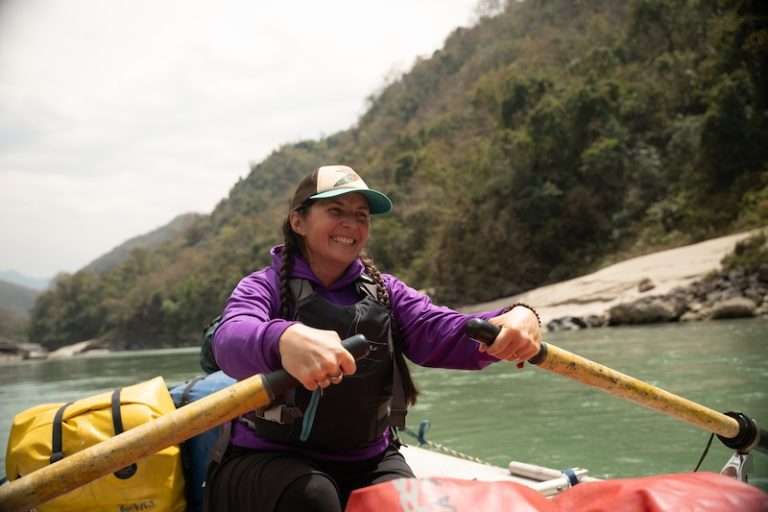
Anna Levesque
Hello, welcome back to the show. Today, I’m exploring how most people focus on the wrong things, superficial things, symptoms when it comes to building skill and building a confident mindset, which means that they’re actually trying to build something strong on top of a weak
foundation on top of a weak structure, a weak core, right? And that can only last so long until it falls apart, right? It’s so important to go to and uncover the root causes of the skills deficiency or of the belief system that is having you feel
letting fear overwhelm you, for example. And when you get to the root cause and you actually address that, then, and you build up, you know, a strong, strong core, then you can move forward with building strong skills and a strong mindset. And to illustrate this, I wanna start with the kayak roll.
Right? Most of you, a lot of you are whitewater kayakers and whitewater kayaking is my area of expertise. And so I’m going to start there. No, however, that if you are not a whitewater kayaker, what I’m about to go into can and does apply to other activities, right? Other sports. So in whitewater kayaking, it’s not a matter of if you’re going to flip over, it’s a matter of when. And
learning the skill of how to roll yourself back up is super important for the fun of it, for safety, for maneuvering, just for doing the sport. And so it’s one of the, you know, it’s a core foundational skill. And when folks are learning, one of the most ineffectual, ineffective,
think ineffective cues on the roll is stop lifting your head or don’t lift your head or keep your head down. And the reason that is, is because it’s very obvious when people lift their head first. And if you lift your head first, it’s instinct because most people want to get a breath of air. However, it is counterintuitive because if you do that, you don’t, it’s almost impossible to then roll your hips under you.
Right? The body mechanics just don’t work. You have to roll your hips under you first. I’m, by the way, this is super basic. Okay. So there are different ways to roll and all this. I’m doing basics to get the point across here. So you need to roll your hips under you and then your head should come out last to allow your boat to right. And then you come up and it doesn’t, I’ve videoed many, many rolls. takes four seconds on average.
for someone to roll. The reason it’s not an effective cue to tell people to stop lifting their head is because the head is not the problem. We need to get to the root, right? So you dig a little deeper and when you start understanding body mechanics, you understand that the root cause physically of the head coming up
is holding too much tension in one of the hips. So let’s say someone’s rolling on the right side, and their head is coming up, it means they’re holding too much tension in their left hip. The tension in the left hip is what has the head stay up. Okay? If they can, so a much more effective cue is relax your left hip, engage the right to roll yourself up.
Okay. Or when performing the role, there’s of course the sweep, all of y’all who are whitewater kayakers again, I’m focusing on the basics here, like just to get the point across. So when, and then, so if they can relax their left hip, engage the right, the head tends to stay down. Why is that so challenging for folks? Well, then you have to go deeper to the core root cause.
of holding too much tension in your left hip. And that core root cause is fear, discomfort of being underwater, right? And if you can address the fear, bring it to the surface, bring it to the light, have folks get comfortable underwater, which does mean, okay, let’s take a break from practicing the roll and hip snaps. Let’s
have fun and play around underwater with like what some activities that we can do together underwater to get you more comfortable. And there are many like holding your breath, timing it, all kinds of things that we can do with folks to help with water comfort, right? And yes, when you explore that root cause,
Yes, then you go even further back into root causes of maybe why there’s a fear. A past experience as a kid in water that was really scary that your brain is just seared into your brain, right? And reacts, and by the way, from my understanding of science right now is that our bodies actually have their own reaction system.
So sometimes our bodies react even before we realize what’s going on in our brains.
Getting to the root means digging deeper and it means discomfort zone, right? And in a sport like whitewater kayaking, is, I will say, overall has been a sport where showing fear has not been accepted, right?
Now things are changing for sure, but it can be a challenge or even in our culture to like, because the role is foundational, we practice it in flat water. It can be easy for someone to think or be hard on themselves because they don’t feel comfortable underwater. Or I have people all the time will be like, I’m a swimmer. This isn’t going to be a problem for me. Well, your legs are not in a plastic.
boat with a spray skirt on top of it when you’re swimming, right? And you’re not just hanging out upside down with your feet, you know, in this boat when you’re swimming. It’s a whole different ball game. And, and so people will be shocked and maybe internalize something about like their inability to feel calm underwater.
Right? So it can be like an identity crisis. And so it takes some time to work through that. It takes vulnerability and courage to really take a look at that root cause. And that’s why folks don’t want to do it. And I’ve had clients who, I had one client who I was coaching their role and they had been paddling for years, like 15 years and, or maybe even 20. And they’re,
role had worked and they were really just stomped about why it wasn’t working anymore. And when we dug into the roots, we started talking about how the role was and how they approached the role and what their belief system about the role, what they say to themselves when they roll. It turns out that they were always fearful of the water. Like they always had an urgency to roll and they were always muscling up their role.
when they were younger, that strategy worked. As they were getting older and were experiencing less flexibility, maybe a little bit less time on the water, less strength, that strategy was no longer working. So then what was right up in front of them, again, the fear and having to work through that fear to then build back.
the confidence and the skills for the role. And it works. It really works. It takes patience. It takes commitment. And I’ve seen it over and over again. And that’s true for other skills as well. I’ve mentioned before, to me, too many people focus on when peeling out of an Eddie, I’m getting pretty Whitewater specific here, but when peeling out of an Eddie,
People will focus so much on speed, speed, speed, speed. Wrong thing to focus on, right? Especially in the beginning. You don’t need a ton of speed. You just need to be paddling as fast or faster than the current. What’s the root cause of feeling like you need to paddle so fast? Fear, right? Like, if I don’t go now, it’s not gonna work or, you know, the current might get me. Boat angle is by far more important when peeling out of an eddy than
than speed. Okay. So this goes to like coming back to the root cause and it typically always comes back to navigating fear. Also true for my healing journey, I’m on month six of no kayaking, which is okay. I’m really looking forward to getting into a boat.
I’m so stoked that I can sit on the floor with my legs extended and externally rotated. So I’m almost there and I’m looking forward to it. this disc herniation also has had me in a vulnerable place of coming to terms with the fact that I wasn’t engaging my core effectively for 50 years of my life. And now I’ve had to
completely stop kayaking, and focus on moving differently through the world, focusing on building my core, not by doing big movements, because I’ve been rehabbing, and now really focusing on building that core. My core feels much stronger. I feel more effective.
I have a stronger foundation. So when I get back in my boat, I’m confident that I’m gonna be, my skills will actually be better. And I bet my confidence will too, because after a while, at first it’ll probably be, I’m gonna have to retrain my brain to be okay with being in a kayak in the sense of like, I’m not gonna hurt myself. But I think that this strong core foundation is key.
And it’s uncomfortable and it’s a bummer, right? It can be a bummer when we think that we’ve got something and really then we uncover that we have a lot more work to do or that we have to unlearn habits in order to learn more effective habits, replace them with more effective habits. And so it’s true of physically and it’s
for the mindset piece and is true for the paddling skills piece. So how do you focus on the right thing, getting to the root cause? One of my biggest teachers in this has been the practice of Ayurveda, which is the sister science to yoga, which many of you know I’m a certified Ayurvedic health coach as part of my private coaching with paddlers and
Ayurveda really believes in what’s built around getting to the root cause, addressing the root cause of health issues. And typically those are based in diet and lifestyle habits. And so it’s the same thing in terms of health habits. What is your morning routine look like? What is your nourishment look like? What does your diet look like? Are you eating foods that
nourish your constitution? Are you eating according to the seasons? What is your daily routine? And so Ayurveda has been a big teacher for me and apply, I love applying that lens onto the mindset piece and the paddling piece. Right? It’s taught me a lot. And so some things you can do to uncover
what the root cause might be. One is building self-awareness. So paying attention, getting curious, like what is actually happening? If you have an emotional reaction, right? Being able to pause and create space between yourself and that reaction and get curious, why am I reacting this way? Right? What is going on? What’s the real…
reason for my reaction? Is it really that person or are they mirroring something or is it a belief system? There are many ways, many different questions you could ask, but even just in the beginning, pausing, catching yourself and having presence to get curious. That’s a big one. And that’s the same in paddling and paddling skill. What is
And a great thing for paddling school, of course, is video review. When you’re looking at activities, get yourself on video. You know, I just did a webinar this past week on the role and two members of the MindBody Paddle community generously sent me clips to review in real time in front of like hundred people. And you learn so much because the video doesn’t lie and you can get curious, okay, what’s happening?
what’s happening in my body, what’s happening with my paddle, what’s happening with my boat. So video review, again, it’s the ability to, it can be tough to pause in the moment on the river and get curious about what’s happening, right? Cause there could be a lot going on. So that video review is nice because it creates space between yourself and the experience and you can watch it over and over again. Right? And I think that,
questioning like, where are you moving from? Both physically in the body, also in the mind. What gets you agitated? Or what are, am I moving from my core? Am I feeling strong? Or am I compensating with smaller muscles because my big muscles aren’t really doing their job? And I think, so getting curious.
I also think, you know, having someone, coach, an instructor be able to coach you through this, because again, they’re removed, they’re observing, they can help you get present, they can help you ask the questions you might be missing, right? And uncover something that’s a blind spot for you, right? And when I say you, I say me, right? All of us, we all have blind spots. So getting curious,
having presence, creating space between you and the experience to be able to get curious, know, relying on a coach, an instructor, a mentor, someone that can really help you work through it and get to the root. And again, this takes courage. It takes courage. And I acknowledge you for listening. If you’ve listened to this whole episode so far,
I acknowledge your courage and I encourage you to go out there and try this. And don’t just take whatever’s happening at surface value, dig deeper in mind, body, and paddling. And if you want a structure, if you’re curious about a structure, keep in mind that I run a course, an online live course called Mental Agility Mastery.
And it starts in January, the end of January. And it’s a cohort together for eight weeks. work from what I call my mental agility wheel. So we focus on different aspects of our mindset, self-awareness, right? Movement from the core, paddling skill, boundaries.
We do focus on nourishment and food. I bring some Ayurveda into it, morning routines, daily routines, sleep. Really because that is my approach to, I believe that if we compartmentalize everything in our lives, we don’t get the full picture, right? We perform better when many aspects of our lives are working for us, right? And so we do that.
As a cohort, we meet once a week on Zoom. We have a WhatsApp group where we share. It’s a really great program. It’s actually one of my favorites. so keep that in mind. And because you listen to the podcast, you get a 20 % discount. So you can go to mindbodypaddle.com forward slash mental dash agility dash mastery.
and use the code pod20 at checkout. That’s mindbodypaddle.com forward slash mental dash agility dash mastery and use code pod20 at checkout. And if you have questions, just reach out. You can email me at Anna at mindbodypaddle.com.
Thanks for listening and appreciate you and we’ll see you next week.