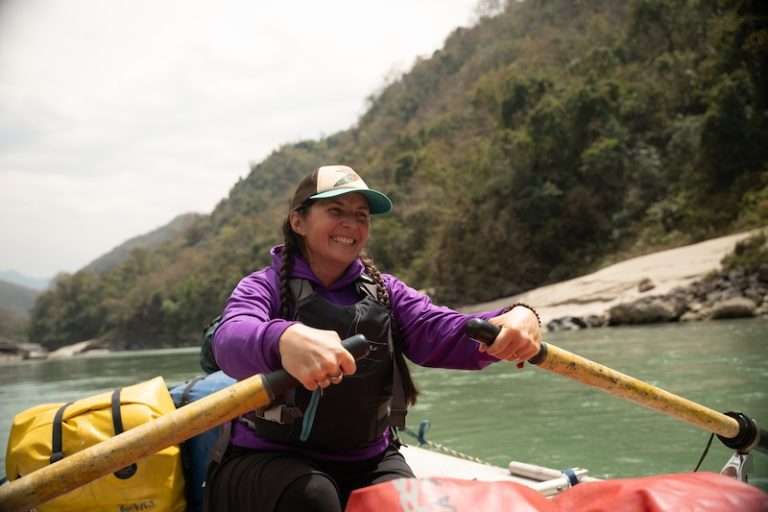
Anna: My guest today is the organizer of one of the premier whitewater kayak extreme races in the world, the North Fork Championship. He is probably the most high-energy, stoked person that I know. His name is James Byrd, and he’s also a registered nurse. He ran the North Fork Championship for nine years before taking a break, and he and his wife Regan are bringing it back in a different format this year, coming up on June 9th.
I’ve known James for many years, and not only is he high energy, he loves sharing. Today we talk about his discomfort zone when it comes to paddling hard whitewater, his visualization technique, the discomfort zones of organizing a huge event, why he’s passionate about promoting the amazing whitewater athletes who will be competing, and why this is a passion project for him and his wife. We also talk about the challenges of making events and businesses in the paddle sport industry sustainable, how to deal with haters, and more. It’s a great conversation and I’m stoked for you to hear it. Let’s get to it.
—
PART ONE: THE DISCOMFORT ZONE ON THE WATER
Anna: Hey James, welcome to the podcast.
James: Yeah, thanks for having me.
Anna: I’m excited to chat with you about the discomfort zone.
James: Me too. It’s been a long time since we hung out, so stoked.
Anna: Super stoked. Okay, so when I say discomfort zone, what does that mean to you?
James: That’s actually a good question. I feel like kayakers, especially when you’re young and pushing it, the discomfort zone is pretty common. It’s a good thing and a scary thing, but also so fun. I like going there, but I like going there if I’ve practiced for it. I don’t like being there if I haven’t. In any situation, I enjoy it if I’ve practiced, but if I haven’t, it’s not as fun.
Anna: Can you give an example of something where you’ve been in your discomfort zone and you’ve practiced for it, and something where you haven’t?
James: Hiking is an easy one. Some of the bigger things I’ve done — you train for it, you move somewhere to paddle, like Boise or here, and the water’s high and you’re like, I’ve been training, I’ve practiced this, I’ve scouted it, I feel good about it. But now — am I going to step up or not? I was laughing with Ben Fraker about that. You feel dialed, and then you have that moment when you put your skirt on and you’re like, okay, now’s the time. Can I do what I just scouted?
Jake’s at nine grand was one of those moments. I got up early that morning, scouted it, and when I was there I felt ready. Stepped up, which was awesome.
But here in White Salmon, it’s like — you and your friends froth for the highest water you can get. You’ve run the river as high as you’ve ever run it, and then the next morning you wake up and it rained all night. You’ve already committed and didn’t even sleep. So you’re like, okay, that was sick, but scary.
Anna: What’s your strategy for moving through that? Preparation, scouting — what are you doing in that moment at the put-in?
James: Breath is huge. Really focusing on your breath calms the nerves. And visualization helps me a lot. Some people get off on flying into something and figuring it out. That’s just not how I’m wired. I like to see it, know it, visualize it, and then step up to that challenge. So when I put my skirt on, I take a breath, visualize it again, and go.
Anna: When you’re visualizing, how long does that go on? Days? Weeks?
James: The days and weeks part is the preparation. And when I’m scouting and visualizing on the day, I try to be kind and gentle to myself. How are you feeling? Why do you want to do this? And I really listen to that. If I feel ready, yes. If I don’t, then don’t. When I was younger I’d send it sometimes to feel good about it. Now I really listen and ask, do you feel ready? And when you do, step up.
Anna: Are you sitting somewhere to visualize, or is it in the car, at the lip?
James: I just love to think a lot. If it’s something scary, I’ll think about it until I feel good about it. It could be in the car or at the lip of the waterfall. It’s not usually sitting for me. Me and my wife joke about it — in wrestling there’s a “triple threat” stance where you’re on your toes and ready. That’s kind of how I feel before a big rapid. It’s not sitting down. It’s like an attack mode. Yeah.
—
PART TWO: ORGANIZING THE NORTH FORK CHAMPIONSHIP
Anna: You ran one of the premier whitewater extreme races in the world for a while, then stepped away, and now you’re bringing it back. What’s your discomfort zone with organizing and planning something like that?
James: It was definitely a dream I had. A lot of paddlers moved to Boise and saw the North Fork as a stepping stone. I did the more conventional route — walked onto the football team in college — but by the end I was like, I’m ready to go kayak. My major was nursing, so I moved to Boise, didn’t care what job I got, and just paddled the North Fork of the Payette constantly.
My brother told me about this kid in McCall, Jesse Murphy, who was incredibly good. I found him, we paddled constantly, and I was fortunate to get on the North Fork at a 150-year flood, along with a bunch of big rivers in Idaho that same week. Working week on week off in nursing, I had the time.
The stadium was right next to the road, and I started mixing my college football experience with kayaking — thinking, kayaking hasn’t had this. I had a shoulder injury and was sidelined, so I was like, let’s see if I can rally the best guys in the world to come to Jake’s. I got a little hate for that at first — kind of a stupid hare-brained idea — but it worked. People came. And careful what you wish for when you have a creative idea in kayaking, because there’s not a lot of money. It’s a passion project. But it totally worked.
I literally just met my wife Regan at that time too. I had this idea for a kayak race and little did she know — by January that year she asked, “Do you want some help?” And I was like, oh my God, please. For the last decade-plus it’s just been our life. It made us both go part-time in our nursing jobs. It was a mountain of work.
We did it for eight years and then said, we kind of want our lives back. So we took some time off. And now a new crew brought it back — Cody Laro came to us and said we need to bring this back, and through his persistence and Aaron Prusanne and this team, it’s coming back. Two and a half weeks from now. Ton of work, but I’m stoked. So many good paddlers are coming.
Anna: How do you deal with haters? You mentioned some early pushback.
James: Yeah, it was hard. Boise has so many underground, really sick kayakers who aren’t doing it for the fame or the camera. I wanted to bring the best kayakers in the world here, because this is the stadium for the sport. There were a couple of people who pushed back — like, we don’t need that, these pros better come in here and be nice.
That was the last thing I wanted. I wanted to blow everyone up and show how good the underground people were. It was honestly insanely hard. But I feel like you can meet these people, let them see your intentions, and bring them to the event. And everyone who came — it was so beautiful to see. The best-known athletes came, and the local athletes were there too. Ryan Casey won — he’s on Team Beer, they call it, humble guys who do the gnarliest things and you just hear about it later around a campfire. When he won, it fully switched. After that, everyone was just so cool with everyone. It never happened again.
Anna: I think that’s your ability to be genuinely stoked for everyone. People probably feel that.
James: Yeah, thank you. It was really fun to be that liaison. Once it happened, it was so special and the energy has never looked back. And now immediately with it coming back, the energy is insane. I’m so stoked to get everyone together, meet the new young guns, and paddle with them. That’s what makes it all worth it — the people.
Anna: You’re balancing nursing work with organizing a passion project. What keeps you going?
James: Nine years of our lives are in it, honestly ten. I do believe in what it’s actually doing for kayakers — blowing them up and putting them in a stadium setting. A lot of my college football buddies would come and be like, “This is Jacob’s Ladder?” and just be blown away. My nursing friends too. That’s the underlying thing: kayaking deserves this.
And now my new goal is to showcase these athletes, these characters who live out of their cars not because they’re broke but because they’re so passionate. I want to build a platform and bring that college atmosphere, fun stadium vibe, and energy to it.
We all needed a break. My team and family — we worked them to the bone. It’s a passion project and you can’t pay people what they’re worth. You can only do that for so long.
Now with it coming back as a nonprofit — Carly and Aaron helped hugely with that, along with Idaho Rivers United — we can get the support we need. That goes into people holding signs on the highway, friends who film at the highest level getting their day rate, maybe even renting their camera. Ways to make it more sustainable. I’m really motivated this year to make it bring in more money, and that goes right back into the event to make it last.
Anna: I love that you’re really highlighting the racers this year on social media — the personalities, who they are.
James: Yes. My nursing friends watch the most ridiculous reality TV, and I’m like, these athletes — people need to know about them. They’re so passionate. We’ve had known Olympians and silver medalists come, and these people traveling in their cars are beating them. What cool characters. I cannot wait to just focus on telling their stories. I’ll come into the break room and my friends are reading through the athlete bios. Hell yeah.
Anna: Telling stories in kayaking — I think sometimes the story is just “check out this cool waterfall.” And that’s cool. But the story behind it is what really draws people in.
James: Exactly. And I want to incorporate that more — every one of these athletes at this level is sitting on the most incredible footage from rivers all over the world. Someday when we bring back a live feed with a real budget, I want to showcase that too. But within our budget this year, it’s really about introducing and meeting these athletes. That’s been a big, fun focus.
—
PART THREE: MONEY, SUSTAINABILITY, AND WHAT IT COSTS TO GO ALL IN
Anna: This is something I’m passionate about too. Yes, kayakers love kayaking and would probably paddle no matter what. But I’m going to venture to say most paddlers who are really passionate would also be stoked to get paid well for it. It’s something I’ve challenged myself on for years — charging my value. I do get some hate for it. We have to put value on our skills, whether it’s on the instruction and coaching side or on the athlete side.
James: Totally, and you’re right. Back to the winnings — that was a big part of it from the beginning. I want these athletes to make money. I want it to be a legit amount. It’s still only $5,000, but every winner has taken it and gone kayaking. Exactly what we wanted.
With the nonprofit board now, me and Regan don’t make all the decisions, which is honestly a blessing. We’ve raised the race entry fee to $200 this year. Everyone on our team said no way, dirtbags don’t spend money like that. But I said, let’s make it worth their entry fee — a great festival area, good raffle, shuttle systems, feed them at certain times. And there was little pushback on the $200, because I think they understood it goes to keeping it going.
Same with camping — we’re charging per person per day for the all-access pass, but you get real value from it. There’s not a lot of places to charge for this event, so we’ve had to get creative. But the rubber’s about to meet the road and I’m stoked to show people it’s worth it.
Anna: For these amazing events to keep happening, there has to be sustainability. Same with being a coach into my fifties — it has to work as a win-win for everyone.
James: Definitely. Me and Regan did the math on our nursing wages versus the hours we put into North Fork. If we’d worked that much in nursing, we would have been millionaires. It was crazy to see. But it was fun to look at — and now you can advocate for yourself, the athletes, the volunteers, everyone.
Anna: I also want to ask about dealing with opinions from people who aren’t organizing. People always have thoughts, but they’re not the ones doing it.
James: Yeah, we’ve had a myriad of those. But there hasn’t been a lot of hate, honestly. What I tried to do from the beginning was think through as much as I could so I had answers when those conversations came up. You inevitably get people who try to poke holes — people thought it was dangerous, people thought women shouldn’t race Jake’s. What? Everything has gone so well and women are so badass and crushing so hard. I’ve literally said to people, you put on an event and I will come and not say a thing.
We do get some criticism for the qualifier format — if you place top 10 in the men and top three in the women, you get invited back. I’m from a wrestling background, so I’m meritocracy-based. You earn your way through. This year we’re actually adjusting and expanding the women’s field because so many women are paddling at such a high level.
Anna: You know what else whitewater needs? Equity. I can’t believe people were saying women shouldn’t race Jake’s.
James: Those were very short conversations. People like to talk crap, especially if they’re not in it. But the women crushed it at Jake’s at 3,000 CFS — so stout — and it was just proof that everyone at the highest level is that good.
—
PART FOUR: RAPID FIRE
Anna: Okay, rapid fire. What’s your favorite river metaphor?
James: God, I don’t have one off the top of my head. Let me come back to that one.
Anna: What’s a morning ritual that sets you up for success?
James: Yin yoga. My dad’s high school friend got into yoga and my dad has done it for 30 years, and he’s 65 or 66 and he looks 20 years younger than his contemporaries. I love it too. Yin yoga — sitting in a position for a couple of minutes and feeling your connective tissue release. If I do it consistently, I feel younger and more snappy. I’ll say it to all my shred friends: just do it. It takes time but it’s not hard and it pays dividends.
Anna: I love it. When I was putting out DVDs with yoga content back in the early 2000s, people were so judgy. Now almost every top paddler I interview talks about breathwork and yoga.
James: Just do it, guys and girls. My dad is living proof.
Anna: What’s a non-negotiable self-care practice?
James: Exercise. And exercise in the fun shred sense. When North Fork was at its most intense, that’s what got compromised — windshield time on the computer, email, permits, fundraising. I would sacrifice a workout because time would bleed into everything else. Moving forward, never again. Exercise, and then use it for the fun stuff.
Anna: I agree completely. I spent a good decade focused heavily on my business and not paddling as much for myself. Now in my fifties I’m more dedicated than ever to paddling for me. Shredding class four, and it’s really good.
James: Same joy, honestly. I dislocated my shoulder and had a full-thickness tear of a tendon in college playing football and just toughed it out. Total regret, especially for kayaking — it’s so hard on that joint. I don’t froth for the high water the way I used to. But I just want to paddle with my friends, and the joy of that is so special. I’ve started slowly paddling again. My shoulder’s not where it was, it’s painful, but it’s so fun.
Being around the energy here of people still pushing at the highest level is incredible, but I don’t need to be there anymore. I’m stoked for them. Owen and Isaac just ran the Little White at six feet, like seven in the morning catching it on the rise, this historic run. For me it was just, I’m stoked for them. I don’t need that. I feel like I pushed myself in my prime through the scary times and faced those fears enough that I’m comfortable and happy for them. Keep it fun. You don’t need to be pushing it hard to really enjoy it.
Anna: Hard moves in easy water or flooding?
James: The flooding. Watching a river be way more badass and more powerful than humans — I really enjoy being around that. When I was younger and frothed for it, it was sick to be a part of it. The added layer of attention, looking for logs, the bridge floating by. Just so badass.
Anna: What word describes your comfort zone?
James: Stoke. If I’m in my comfort zone, I’m stoked.
Anna: Freedom through discipline, or I do what I want?
James: Definitely discipline. The things I’ve done for a long time — mountain biking, dirt biking, kayaking, now getting into flying and speed flying and snowmobiling — I enjoy getting as good as I can at them to do more of it and learn new things. I enjoy the repetition of learning, like manualing a mountain bike versus wheelying it. It’s so hard, takes so long, but when you get it, that’s so fun. I like having that structure and putting in the time.
Anna: In one word, what do you hope your legacy will be?
James: Passion. Whether that’s in kayaking, nursing, or life. Passion.
Anna: Right on. Well, thanks James. Is there anything else you want to say to folks listening?
James: Thanks for listening, and thank you for putting the energy into these podcasts. People love them. And lastly — come to the North Fork Championship. Everyone come. It’s midweek and I’m sorry for that, but we had to do it because of the highway. Come. I’d love to be around you. Kayakers are just so fun, rad, and positive, and if you’re not a kayaker, come be around this crowd. They are an exceptional group of people and I guarantee you’ll have a good time. Come to North Fork, too.
Anna: What’s the website for info?
James: northforkchampionship.com, or North Fork Championship on our socials. June 9th through the 11th in Smiths Ferry, Idaho. Come. It’ll be fun.
Anna: I’ll pass the message along. Andrew’s up for just about anything, so that’s great.
James: Tell him I won’t put him to work this year. I’d have him help set the course, paddle it, and give feedback — but I don’t need to be putting him to work. Yeah.
Anna: I’ll let him know. I do want to say, I’ve always felt like you have a real ability to be genuinely interested in people and form relationships. And I bet that’s a big part of what makes the event what it is — people feel like you’re stoked for everyone.
James: Thank you. I’ll never forget — the first gates I made were cut from this core plastic, like plastic cardboard, made into three sides. My goal was to use spray foam to put it in there and let it set up. We were up at the race, I’d put it in there, and Andrew and Holt were holding it. It was a ridiculous, stupid idea for a gate. And then the tip broke off one of them at the very end and I had to stab it with something — also a dumb idea — to get the last little bit in to make it hold. And it exploded all over Andrew and all over my friends. Oh my God. Thanks for bearing with me. But it was hilarious. A very fond memory of having Andrew out there.
Anna: Right on. Andrew’s up for just about anything. Okay.
Anna: Right on. Well, thanks James. I hope the event goes amazingly. I’m so stoked to see the media and hear all about it. One day we’ll all get out there.
James: Yes, we’ll make that happen. We’re going to try to keep it going as long as we can. Come when you can — no pressure, but you definitely need to come. You’d bring a lot. And bring Andrew, give him a hug for me.
Anna: Of course. I will for sure.