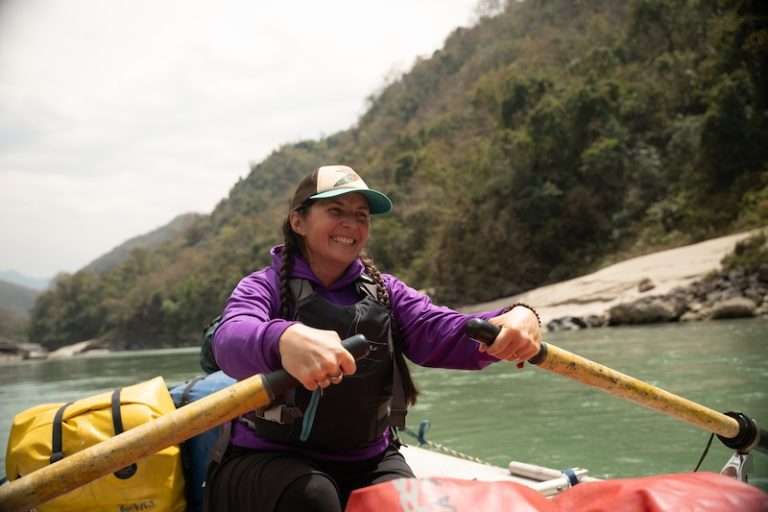
**Anna Levesque:** My guest today, Marianne Sauter, began kayaking in 1995 and has spent nearly three decades traveling the world in search of whitewater. She retired from competition in 2024 as a two-time world champion in extreme kayaking with standout performances on both steep creeks and big waves. Over the years, she’s left her mark at events like the Whitewater Grand Prix in Canada and has received multiple honours, including Female Kayaker of the Year, best line and drop. In 2022, she became the second woman in the world to run the 23 meter, okay, Alder Yar Foss, close, okay, in Iceland as a mother of two. Marianne owns property on the Fudalufu River in Chile, where she offers guiding, camping and instruction. Together with her partner, Ron Fisher, she also runs River North, a rafting company in Northern Norway.
**Mariann Sæther:** Close.
**Anna Levesque:** With a nine-year university education alongside her athletic career, Marianne brings depth and perspective to her work and is available for motivational talks on courage, resilience, performance, and balancing ambition with family life. Welcome, Marianne. Perfect, we wanna talk about resilience, performance, courage, all of those things today. So I’m excited to have you, thank you.
**Mariann Sæther:** Thank you, Anna.
**Mariann Sæther:** Very nice to be here Anna, nice to see you again. It’s been a few years.
**Anna Levesque:** I know it has, it really has. So when I say discomfort zone, what does that mean to you or what comes up for you?
**Mariann Sæther:** For me, think this comfort zone is really a space or a room to improve myself. To get to know myself a bit better. Why am I feeling discomfort? Why am I feeling uncomfortable? And then understanding the mechanisms within myself, but also around myself, like in the scene I’m in or in the society I am.
**Anna Levesque:** And what can you share with us what you’ve come up with in those explorations of what you’ve learned about yourself through examining the discomfort zone?
**Mariann Sæther:** Are you sure you only have one hour, Hama? Yeah, no, I mean, it’s an ongoing journey, right? And it has changed for me over the years. I mean, from when I first started kayaking, which is now so many, so many years ago, you can relate to that. I do, I remember like I was being in this discomfort zone quite a lot with feeling out of control.
**Anna Levesque:** Yeah, I hear you.
**Mariann Sæther:** Like just simply sitting in my kayak and not being able to control where I was going in the water. That was for me quite scary and I still remember this feeling. And at the same time, it was quite thrilling. It added this layer of like action, you know, that I didn’t have elsewhere in life at that point. I was like a very normal teenager. was skiing, snowboarding, swimming, like all the normal stuff, dancing, baton twirling. So not just normal stuff. But yeah, so when I got in the kayak,
**Anna Levesque:** Hmm. I was going to say Norwegian normal stuff. Yeah.
**Mariann Sæther:** Yeah. So when I got into kayaking, like there’s like to feel a little bit out of control was like for me discomforting. And I realized very quickly that I had to work to get out of that, to put down the work. And I realized there were no shortcuts. The only thing for me like was I had to repeat and repeat and repeat. And I…
**Mariann Sæther:** Something I thought quite a lot about over the years is like often you hear people say, she’s so talented or he’s so talented. No wonder she won the world or he won the championship or, or Dane can run these insane waterfalls. He’s so talented. And I, in a way, yes, I do understand that some people are maybe more inclined towards a certain sports or whatever in life than others, but I actually really believe that what
**Mariann Sæther:** it takes a lot is just grit and hard work, resilience. So like when you, for instance, like, I mean, I felt out of control. I wasn’t swimming that much as a beginner. Like I was pretty stubborn when I was trying to roll. I usually made it up right again, like not very prettily, but I made it up. But I would be, I tried to be at least after a little while, a little bit honest with myself saying like, well,
**Anna Levesque:** Hmm. Hmm.
**Mariann Sæther:** it like this talent because if I, if, if I leaned into this talent idea, I was clearly not having any talent in kayaking because I wasn’t like slaying it from the first strokes out of the Eddie. was like fully struggling, even though I didn’t swim so much. I was out of control. I couldn’t drive my kayak. Edging was, as we all know, quite challenging. And, and if I was thinking to myself, well, I’m not talented in this, like I would kind of like put myself down.
**Anna Levesque:** Mm. Mm-hmm.
**Mariann Sæther:** you know, saying that I was lacking something that would make me accelerate and I didn’t like that. So instead I said, well, I just need to practice more. That is for me, like some of these things are more challenging than for many other people, but I just need to practice. And I felt like that was quite helpful. In all fairness, it took me a while to get there. Because to begin with, it was very uncomfortable to not be as good as the boys, know, like wanting to follow, wanting to be allowed to go on the same rivers or run the same lines even. then being told that, no, you’re not good enough. You can’t do that. That was like, it didn’t feel so great. But then, and I was definitely like mad at myself a few times, you know, like when you’re failing lines or competitions and
**Mariann Sæther:** And it did take me some years to arrive to the mindset of like actually what it takes is like you would just have to get back on the horse or get back in the kayak and keep going. And eventually things will get easier because that’s also kayaking. It’s not an easy sport I find, especially for beginners and intermediates. yeah, so yeah, that was me rambling a bit.
**Anna Levesque:** Yeah, no, that was amazing. Thank you so much for sharing. And I’m so happy that you shared your perspective because you’re so accomplished and you still run really challenging Whitewater. And, you know, like you said, it can be easy for someone to say, like you said, they have talent or that’s just who she is. She’s just good, miraculously good. And it is really relatable when really accomplished paddlers talk about maybe how they struggled as a beginner. Not that you have to have, like some, yeah, some maybe didn’t struggle. I can totally relate. I remember trying 11 rolls one time and I finally rolled up on the 11th roll as I was about to go down into a rapid. This is on the New River Gorge. And, you know, so that tenacity. So I really appreciate you sharing.
**Anna Levesque:** sharing how it was for you and that it took time and time in the boat and that it wasn’t all unicorns and rainbows.
**Mariann Sæther:** Hmm No, I, there’s something I’ve seen a lot, know, like is, especially women, I find we’re very harsh on ourselves. Like we, it’s not just about failing a lie, a line. It’s, it feels like you’re failing life. Like you, you, tend to take maybe the setbacks in kayaking and be like, I’m so bad at this. And then we carry that into our normal life. And we have that.
**Mariann Sæther:** negativity with us and I don’t know why that is if we tend to set higher standards for ourselves or what it is but at least for me it was I remember like it was quite a relief when I could separate myself from the kayaking. I could be well I’m not so good at late booths and I’m not very I don’t like sticky holes so much and that’s okay that doesn’t mean I can’t cook dinner or I can’t you know
**Anna Levesque:** Yeah. Yeah. Yeah.
**Mariann Sæther:** have a great speed to write a proposal. it’s, and I think it’s also about honesty. Like to be honest to yourself and be aware that you can, you could admit like, I’m not so good at this part in kayaking. What do I do about that? Well, maybe I should, I should train that particular weakness and try and get better. So I was, I was quite…
**Anna Levesque:** Mm-hmm. Yeah. Mm-hmm. You
**Mariann Sæther:** I remember like I really didn’t like late booths. I wasn’t good at them. I always missed. tried to booth too early very often and ended up like surfing the crap out of some of these holes. then eventually I do remember like, something happened when I started doing Slalom. That was like for me, like a big step when they came to the late booths and because I got more aware of my back edges.
**Anna Levesque:** Hmm. Hmm.
**Mariann Sæther:** So like, for instance, when I won sick line in 2015, was, I came out of a season of doing slalom first, my first season of trying to do slalom. And I was fit of course, but I also realized like, cause I struggled a lot on champions killer to get the booth right. And I was getting frustrated. And then I remember I was watching, I don’t remember who he was, maybe he was some of the Germans and they really loaded their back edge and that helped lifting the nose and
**Anna Levesque:** Right. Right.
**Mariann Sæther:** And just do it. And then it clicked in like, yeah, of course it’s what I do in slalom with my slalom belt. And when I started doing that, and this was literally just like two runs before the competition, then it all came to me. I was like, okay, good. No, I’m good. But it also took, you know, I didn’t give up. Like I was training and I was practicing and I was being frustrated and I was a little bit uncomfortable or like in discomfort. because I was paddling well the rest, I just didn’t get Champions Killer right. And then when that clicked in, then I was happy that I kept struggling and kept trying, but I didn’t, I really tried to not talk myself down in the process. I was trying to figure out what am I doing wrong? Like what is it? And I think that approach, like…
**Anna Levesque:** Hmm. Hmm. Mm-hmm.
**Mariann Sæther:** It’s a lot healthier. Not saying that it’s easy to get to that, but like if we can be honest with ourselves and just be like, well, I’m not so good at this particular thing and that’s okay. But if I want to be better and comfortable, I need to work on that. And that’s like, and it doesn’t, even if I’m bad at this one thing, doesn’t mean that I’m in general a bad kayaker. Yeah.
**Anna Levesque:** Yeah. Yeah. Yeah. Yeah, I don’t know why it is that, and I work with a lot of women in instruction and it’s, yeah, and myself as well, I can really relate to that being really hard on myself. And I remember in freestyle competition, if I wasn’t on the, like at my peak, like when I was, you know, one of the best competing, if I wasn’t on the podium, I would like cry. I was like, and we’re talking like I would be fifth. You know what I mean? It’s like, yeah, do you?
**Mariann Sæther:** And I remember this Anna, I remember it, that you were upset quite a lot when you weren’t performing. And I was too, and many of us were. And I guess not just the women, but it is a thing. We are very good at putting ourselves down, like the whole package, even though we’re only maybe struggling with one part, right? Like it’s…
**Anna Levesque:** Yeah, no, for sure. Because there would be so many stories in my head about, I’m a shitty kayaker. Why do I even do this? And I look back, and it could be generational too, because we’re of similar generation. don’t know if, you know, I’ll have to ask. I think River Mutton is coming on soon. I’ll ask her this question actually is great. But I think that
**Anna Levesque:** Yeah, it was so much energy towards like just stories that aren’t even true about our us. And so, you know, in my coaching, I work a lot with my clients have got to separate fact versus story. Like there’s what happens and there’s the story you’re telling yourself about what happened. And the suffering is in the story. And it sounds like what you’re saying is that you are good, you know, you started doing that for yourself. Like, yeah, I’m not good at this, but it doesn’t mean you know, I should quit kayaking. I’m going to keep working. You see opportunity. And yeah, we’re always in conversation in our lives, whether that’s with ourselves or someone else. And the quality of those conversations creates our life. So it is a good thing to pay attention to.
**Mariann Sæther:** Yeah. And I really, I think that it’s okay to just having to work on some things, just having to admit that at this part I’m not so good and then I just have to deal with that and be honest to myself. this, also saw, I really believe in like hard work and how that, like, I’m not so sure I believe in talent always, you know, but I believe in the grit and resilience and I can, maybe one of my, well, I have.
**Mariann Sæther:** Another example, you know, is the North Fork, the NFC, when I won in 2019. For me, like that was like I arrived at the North Fork and I’d never been there before. And it was really nice. Like I reconnected with some really old friends of mine there. And some of the people that I’ve been paddling with in the later years were also there. So I had good people to hang out with and paddle with, but Not a lot of people were palling on Jakes because he was pretty high. It was more than 3000 CFS. But I didn’t know any better. But I looked at the rapid and I was like, well, if my main goal here is to get to finals, I can’t wait till Friday to get into this rapid. So I did one warm up run. I don’t remember on which which of the sections. And then I started putting myself into Jakes.
**Mariann Sæther:** And there weren’t many guys out there either. There was Jane. remember Dane was there and Benny Mar was there and they were eating shit, those two a lot. then Michele Ramazza that I was paddling with quite a bit and David Sodomka. So, but there was no safety or anything. like, and honestly, like it was pretty scary at times, you know, like it was, it was definitely.
**Anna Levesque:** Ha ha.
**Mariann Sæther:** You know, at that level you’re on your own if something happens and everyone was trying to train. So you were not, no one was like looking out for me. And then that was really, that was really like a talk to myself. Like, well, if I want to be in finals on Saturday, I need to be able to pal this rapid on Tuesday on my own confidently. And this I had in the back of my head and that was.
**Mariann Sæther:** And I put down the work for it, you know, like, I rolled and I flushed and I flipped and God knows, like I went upside down, down that rapid so many times. But eventually when I did make it to the finals, like I knew that I would be fine. I knew that like most likely I wouldn’t have two clean runs because that was pretty hard for me to do at that point with the gate. At least I was confident that I had put down the work. I put in the work. I was resilient. And yes, it was scary sometimes or like at least challenging. But I also remember like feeling afterwards, even though I didn’t have the greatest runs in finals, like I was pretty happy with the effort I put in. And that felt honest, that I kind of felt that I deserved to be there because I put in the work.
**Anna Levesque:** Hmm. Hmm.
**Mariann Sæther:** And that was quite nice. I think, again, it’s like just to be a little bit honest with yourself, right? Like, yes, it is a little bit uncomfortable. But if you want to get better, you want to arrive somewhere, I really believe in hard work. You just have to put in the hours and the effort.
**Anna Levesque:** Yeah. Even when it’s not working, even when you’re flipping and it’s scary. Like that’s the thing. can’t, it’s not just when everything’s going well and you feel great. It’s, and I think that’s the, so two questions for you. One would be in the face of risk because you know, Jake’s really hard rapid.
**Anna Levesque:** you there’s been deaths on that section and you’re running it high. And like you said, you’re watching like the best paddlers, like including yourself in the world getting, you know, getting a little, yeah, pummeled. So, and then you’re saying, but if you knew that if you wanted to be in finals, that you needed to do it. So what is, how do you weigh risk for yourself? Like what is your, if you have a process of
**Mariann Sæther:** Yeah, we were trashed.
**Anna Levesque:** What has you like decide? Like this is worth it. Like literally something, you know, I could really hurt myself doing this. And I think not only on Jake’s, but you know, I’ve always been curious about that because you’ve run like huge, huge stuff. So I’d love to hear your process if you have one.
**Mariann Sæther:** Yeah. Well, I do have, there’s a few different elements to this, but like one thing is like, I say I’m scared, but what I mean is more I’m nervous. If I’m scared, I don’t run stuff. That is a big difference for me. So this is my, this is maybe my English, not being my first language, but like to be scared is different than to be nervous. That’s one thing. And then the other thing is like, I don’t, in general,
**Mariann Sæther:** I don’t know if I’ve been lucky or if I’ve been, maybe it’s from my background of doing very different sports. So I’ve been always quite strong and flexible. Like I haven’t injured myself much in kayaking. I’ve been pretty lucky in that way. My worst injury came from biking actually, like trying to compete when I shouldn’t have competed. So when I stand like for instance,
**Anna Levesque:** Great. Right.
**Mariann Sæther:** on top of jakes or it’s, stand there and I realize, and I’m honest with myself like this might be uncomfortable, but it’s not that I’m thinking, my chance of swimming here is like 50 % or something. Like I, I, I trust myself. I run stuff when I trust myself that I can get myself out of things like on, and on jakes in practice, that is something you need to be very honest about because there is no safety there. And it changes a bit when you’re running.
**Anna Levesque:** Hmm. you
**Mariann Sæther:** some bigger rapids or some bigger lines and you have a team, right? Then you can rely a little bit on, oh, if I mess up this one, here’s my plan B, here’s my plan C. And then I do have someone with a bag there or someone that could help me. But like, for instance, on Jakes, was for me, it was a very honest thought process that if I was going to enter the rapid, like I was not going to swim. And I,
**Anna Levesque:** Mm-hmm. Mm-hmm.
**Mariann Sæther:** I know it sounds a bit silly because who can guarantee that you’re not swimming and who can guarantee that you’re not getting injured, right? But I have a history of, I know myself that I’m quite resilient and I’m quite stubborn and I’m quite strong and I know what I can do and not do. I mean, what made Jake’s heart was not the rapid, it was the gates. Right? So we were trying to catch the gates and they were…
**Mariann Sæther:** they were quite offset and they actually changed the gates before the finals. They changed it the night before. So I knew that at any point I could just straighten up and go straight down the rapid and that wouldn’t be a problem. But yeah, but yeah, I do find like it is, even though I can’t guarantee it, like I, at least after the first few years of kayaking and being lucky sometimes and learning myself.
**Anna Levesque:** Right. you
**Mariann Sæther:** a lot about myself, I do think I have a pretty good idea of what I can run and what I can’t run. And that leads me to right away, for instance, to when I ran Aldearfoss in Iceland, which is a 23 meter waterfall. Because I stood on the lip of that waterfall, I think first time in 2001 or something with like Brad Ladden and we’re filming for Valhalla probably.
**Mariann Sæther:** I think it was TGR. And I didn’t really see, well, I saw the line, but I didn’t see myself running it cleanly. So I walked away and I did that on another trip as well with Shannon Carroll and Katrina Van Wyk and Martina Wegman. We were over there filming for Nuit de l’Aglisse, this French company. And we walked away and I was, one thing was like we…
**Mariann Sæther:** The safety situation wasn’t the best for us, felt at the time. But again, for myself, I couldn’t really see myself running the line cleanly. And then I walked away, even though I so wanted to run it. It’s one of the most beautiful places in the world. It’s magic, that waterfall. If you ever go to Iceland, just have to go there and look at it. Running it or not running it, it’s magic. And then I went back over there with a film crew.
**Mariann Sæther:** Because a friend of mine, Barbara Holland, she’s a director and she was asking me many years ago if I would like do some film stuff with her and I said yes and then it got bigger and bigger this film project so we filmed for seven or eight years actually and then this was kind of like the grand finale like Iceland’s great for filming you know it’s spectacular and there was a story there with this waterfall.
**Mariann Sæther:** And I arrived, and know, it’s not so many years ago and I have almost three decades behind me and I was still standing on that lap. And I was like, well, these people have run it. Like there’s been some serious injuries happening here. So I can, I know that it’s, it’s a scary waterfall. I can see it’s scary. It’s so beautiful. I really want to run it, but I still couldn’t see the line. Like that I would run it cleanly. I could see that I would get down it like.
**Anna Levesque:** Hmm. you
**Mariann Sæther:** many others with various success. And it took me, I think we went back one, three or four times to that waterfall on that trip in like six days. And I shouldn’t really like, well, I mean, it doesn’t matter. Like people can watch the documentary. It’s out in a couple of weeks. Yeah.
**Mariann Sæther:** But it was a huge psychological process for me to step into the line and trying to figure out, I run this? And I was feeling so shit, you know, because I’ve been looking at this waterfall for almost three decades and I still couldn’t see the line that I could run the way I wanted to run it. Until finally I was like, and I can’t believe it took me so long, but finally I was like, one last chance.
**Anna Levesque:** Hmm. you
**Mariann Sæther:** And I’m going to get in my gear and I’m ferrying across the river. And I’m going to look at it from the other side, because you always look at it from river left. That’s where the parking lot is. And literally I ferried over, jumped out, walked down the bank and I’m like, yes, yes, yes, yes. I got to the edge. Yes. Then I looked back upstream, up through the rap and I’m like, yes.
**Anna Levesque:** That’s awesome. Right, right.
**Mariann Sæther:** There it is. And I just gave the okay signal. The safety guy, Julian, really good friend of mine, barely had time to get in his kayak to do safety. Barbara was like giving the drone to some Austrian tourists. Because I was like, I’m going and I’m not stopping. I don’t care if cameras are ready. This is my time to run this rapid. Finally, this waterfall. And it was so beautiful. I got in the kayak. I had a great line, exactly the line I’ve dreamt of. And my spray skirt popped at the bottom. But honestly, I didn’t even feel bummed about it because it doesn’t matter. It doesn’t matter because like it came off as I was resurfacing and I had such a great line. It wasn’t a big hit or anything like it. So in the end, I was like, you know what? That’s exactly the line I’ve been waiting for all these years. And that’s what I mean. Like I don’t run stuff if I don’t feel that I can do it.
**Anna Levesque:** Yeah, whatever.
**Anna Levesque:** Sure. That’s awesome. What is the name of the documentary? I Follow Rivers. Okay, great.
**Mariann Sæther:** way I want to do and of course I’ve failed on that sometimes you know like it’s a long journey but that felt really nice I’m gonna live on that line till the next time
**Mariann Sæther:** I follow rivers. Mm-hmm.
**Anna Levesque:** I love the passion that you just told that whole story with. it’s one thing that I love is one, I think, you know, for listeners who maybe will never run that big of a waterfall or even half that big, just wanting to, you know, paddle class three, four, not just, but wanting to paddle class three, four, that
**Anna Levesque:** couple of things of that it takes time, you were patient and you were very confident in your decision, both when you didn’t see the line and then when you did see the line, you were like, no, and then yes. And so it like, as you’ve said, throughout this conversation, it takes time. And the other thing I love is that you ferried across. I mean, that’s such a good metaphor for life as well. You’ve got sometimes you’ve got to look at things from different angles.
**Anna Levesque:** because you just don’t see it from the one angle or from your specific lens or tunnel vision that you have right now. But if you change things up, ferry across the river, look at it from the other side, then you’ll see it. I mean, that’s so true for so many rapids, actually, so many rivers.
**Mariann Sæther:** Change of perspective, yeah. And trusting yourself that, and I have another one that was, and this is just a, this was not a class, well actually it was a class five rapid, but doesn’t matter. It wasn’t that hard. But this was with, on the song Dals Elva in Norway, which is a, it’s quite famous for a triple drop. It’s beautiful, the river on the West coast. And I was there with Matze Brustmann. Good old Matze is such an amazing kayaker and person.
**Mariann Sæther:** And we were just looking at this one rapid and I just remember like, he was like, yeah, Marianne, then you just charge through this hole and straight down here and then you just boof the bottom hole. And I just looked at him. Are you crazy? I can’t run that line. I don’t make it through those holes, but I’m going to go left and then go down there and then back to the middle. And he just looked at me. Wow. I can’t run that line. I’m too heavy for it. And I’m like, yeah. So we both have.
**Mariann Sæther:** like a good line, they’re different lines because we’re basing our lines on our ability. it wasn’t like mine was not a sneak line. And his was also not a sneak line. They were just equal. And that is to be able to recognize what works for you and be confident enough to follow up on that. I think that’s that’s a big step in kayaking. that’s, you know, it’s very transferable to life in general.
**Anna Levesque:** Right. Mm-hmm. Mm.
**Anna Levesque:** Yeah. It’s also huge, I think, for women. Not that I don’t want to generalize. I did that a lot throughout my career. There’s men, people, gender fluid, women. Everyone experiences life differently and has… And I do think that there… Because anecdotally, having worked with hundreds and hundreds and hundreds of women in my career,
**Anna Levesque:** It’s, yeah, the courage and confidence and boldness to do your thing, you know, what you see and to trust yourself is, I don’t know, it doesn’t, it can, I find it’s a challenge, it’s a journey for, and for myself included, you know, and I think.
**Mariann Sæther:** Mm-hmm. Yeah. I also, I, like over the years, I’ve seen a couple of things like, I mean, it is really nice when your boyfriend or the men tell you to, just follow me. You’ll be fine. But I do think women, we tend to follow a little bit too easily. So that one I remember, and I have to say this is the late Benji, Benjamin Yacht. He died 10 years ago. He was my best friend, but I still remember
**Mariann Sæther:** As I was approaching, more going from the class four towards the class five, we were on the Shirley River in Norway, which is also quite a famous Norwegian river. It’s very continuous and quite dangerous actually. And there was a section there. And I remember at one point he just pulled into the eddy and I pulled in behind him and he just lifted me. He’s like, Marianne, I am not moving out of this eddy unless you’re ahead of me.
**Mariann Sæther:** I was like, what? I need to follow. And he’s like, you don’t need to follow. You need to read that water yourself. And I was like, And then it was such a, that was such a moment for me because I realized, yes, I can’t just keep following. And then I started more and more just like getting up ahead or finding my lines or even waiting a little bit so I would not have someone right in front of me.
**Anna Levesque:** Yeah. Yeah.
**Mariann Sæther:** And not on the class fives. mean, I talk even about the class three or at least when, if it’s unknown a little bit, I started to be the one that preferred to go ahead. And it’s actually now it’s, it’s hilarious. Cause I, up here in the North, I have a couple of friends I’ve had quite a lot. One of them is Rowan. He’s from England, great kayaker. we, there’s been, I don’t know, we probably have hundreds of descents together, just me and him on the local rivers. And he still does the same. Like he, we’ll get in. He’ll hang in the Yeti till I leave the Yeti. And then he goes behind me because he knows that I prefer to be in the front. And I find that it’s amazing. And I, I commented to him like a few times about that. And he’s like, yeah, I just noticed that you’re happier in the front. And I’m like, yes, cause it’s actually, I just feel now I feel like there’s no disturbance. Right. I don’t. And I notice if I end up behind people and it’s the same also from the Futa, like I pal a lot on the Futa alone or.
**Anna Levesque:** Mm. Mm-hmm. Yep.
**Mariann Sæther:** I’ve been leading groups a lot on the Fura. I can read the white water better when there isn’t someone in front of me. And so for women, I think that is a big thing. just to start class two, three, be ahead, be upfront. Not ahead maybe because you want to stay together with others, but at least be upfront and start practicing that little bit of independence.
**Mariann Sæther:** having to make your own choice, even if it’s very subconsciously and not very difficult. I do think that helps us a lot to improve quicker. And I totally forgot what my other point was.
**Anna Levesque:** I don’t know, but that was a great point you made. I just want to encourage all the women who are listening. I do the same thing in my Creek Week or in my classes. Like that’s part of the thing is to get women out in front, like go in front. I’ll be behind you. So I’ll see everything. And if you get into trouble, I’ll be there, which rarely happens because they of course then realize that they have better skills than they thought they did. And they can read the water.
**Mariann Sæther:** Hmm. you
**Anna Levesque:** And so what you get stuck on a rock once in a while, then you learn how to get off. You get stuck in a little hole, you learn how to get out or, you know, these are, like you said, hard moves in easy water, but yes, leading down the rapids is so, so, confidence building. That’s what I tell people. If you want more confidence on whitewater, start leading for sure.
**Mariann Sæther:** Yeah, that is, it’s a huge thing. I, excuse me. Yeah, the Fudelafjord has taught me a lot, I have to say in this regard, because I was quite young. I went there first time in 99. I had just turned, I was 18 or 19 years old, I think. And this was before, you know, there’s nothing there. It’s just a river. And I was paddling often.
**Mariann Sæther:** Throughout the next few years, they’re often a bit alone as well. And even if it was on bridge to bridge, and I shouldn’t say only bridge to bridge, because bridge to bridge is a serious section. But I was on my own because there weren’t kayakers around, you know, at the end of the season. There were none. this is, I mean, this was in 2001, 2002. There were no phones. People didn’t have phones. You didn’t connect. So either you were staying together in Caradolindio.
**Mariann Sæther:** or not and then if there weren’t people then you paddle alone. So I learned a lot to stretch my neck and to read the white water because I had to. And I was sneaking without shame. But I had to. And the other thing, now that I can talk, know, I actually have maybe more to say than I thought I would have on the show, which is great.
**Anna Levesque:** Yeah. Yeah, totally. Yeah.
**Anna Levesque:** That’s great.
**Mariann Sæther:** But I also notice a lot like when you’re a group of people and you have some women that are, it could also be men. I mean, it doesn’t need to be just women, but people that are maybe not so skilled as the rest of the group. So you get to a rapid and you’re like him and hawing, should I run it or should I not run it? And then some people are very hard on themselves and you can tell they get upset. And I used to do this too. And you pick up your kayak and you walk past it and you grump, but you get in the eddy, right? And then you keep going. So when I learned that I should make myself useful, when I can’t run the rapid, when I learned that I should get down to the bottom quickly and set safety and think about where should I set safety, where can I be useful? Or should I be the one to distribute the signal up and down the riverbank? As soon as I made myself useful, I didn’t feel like a failure. I didn’t feel so bad about not running. And then I rather tried to
**Mariann Sæther:** turn it into like a learning experience. That was very helpful for me. So I really, it doesn’t matter in the end, whether you’re running the line or not, the, like the best ones, but if you can still contribute to the group, then that’s, I mean, that’s, it makes you learn, makes you feel better about yourself and you’re helping the group dynamics. And then, you know, here comes next time around and then the group will do the same for you. And then that’s a beautiful progress.
**Anna Levesque:** Yeah. Yeah, and it’s also about in that way you stay engaged. You stay engaged in the community of the group. Yeah. Do you, I know earlier in our conversation you said you don’t know, you mentioned you don’t know how you got this way, but I’m gonna ask. the question anyway, because I’m really curious. You have so much confidence and an ability to separate that fact versus story, to view things as a learning experience, that grit, that resilience, tenacity. Is that something that you learned? Did you have any role models in your life who were like that?
**Mariann Sæther:** Oh, now I have to think. like, I mean, when I grew up pretty normal in a pretty standard society, my brother was, I mean, he was into snowboarding and he was a bit of a role model to me. But I really, kind of feel like I don’t know, maybe I wasn’t born with the trait, but. It was a way for me very quickly to realize that if I can separate myself from my errors and like what’s causing the errors, like not loaded onto myself, that’s, it makes me feel better. But I don’t really have a good answer for you, Anna. I, I, I’m not entirely sure. I don’t know. Except that I’ve, yeah, I’ve been always quite driven. I’ve always wanted to be good.
**Anna Levesque:** Yeah, that’s okay. Hmm.
**Mariann Sæther:** I think I was never really good at being intermediate, which sounds really bad because I’ve been intermediate a lot in my life. But I think maybe that’s the thing. I also, I got my second horse when I was 10. So I was horseback riding since I was four, but I got my second horse when I was 10. He was only two and a half years old when I got him. So I had to break him in myself.
**Anna Levesque:** Hmm. Hmm.
**Mariann Sæther:** as an 11 year old and I spent a lot of time with that animal and it taught me a lot about you know like both great success communicating with an animal but like it also it made it very clear to me like you got to be independent like you got to trust yourself and what you’re doing and especially when you’re like training horses and you’re with animals that’s
**Anna Levesque:** Hmm. You
**Mariann Sæther:** that is, if that horse, for instance, understands that he is 500 or even more, like a thousand kilos more heavy than you, you are screwed. So you got to like, you have to break it down. And like, how can I train this horse in this way? What can I do? And you break down all the, you want to get to the goal, but you have to break it down in little pieces to get there. So I thought a little bit about that. Like I, I’ve definitely grown up with like,
**Anna Levesque:** Yeah. Hmm.
**Mariann Sæther:** breaking down my bigger goals into smaller pieces a lot and putting it together. And I do have to say, I really think for me, like I was not, I was never particularly talented at anything, I would say. I always had to put work in. And that sounds like I’m like talking myself down, but I’m not. I just think that is really a truth.
**Anna Levesque:** Well, it’s a testament to hard work then and staying with it. Definitely if people look at you from the outside, you’re extremely talented at kayaking and other things. Okay, go ahead.
**Mariann Sæther:** think maybe the other thing which is a little bit of my personality is that I get bored very easily. So when I started kayaking, I didn’t just get into running the river or freestyle. I always liked to mix it up from the very beginning. And that meant that I was worse at all disciplines for longer. But eventually I got to the point where I was actually, I can now say that I was good at creaking.
**Anna Levesque:** haha
**Anna Levesque:** Sure. Mm. Mm-hmm.
**Mariann Sæther:** good at big volume. was good at freestyle in smaller features. really loved and I was getting good at freestyle on bigger features. I guess I just got, I started with slalom maybe too old in life and I a little bit of the drive for that. But like I wish I’d done slalom earlier. That would have helped. But it was also big reason why I picked up slalom in the end late in my kayaking career.
**Mariann Sæther:** It was so much fun to be bad, to not be good at it, and just to go back like, wow, look at this freaking class three rapid and I can’t get from here to there without touching that gate. Like what’s going on? And that that feeling of being really bad at it. was great because then you see your improvement very quickly.
**Anna Levesque:** Yeah, it sounds like you love learning. You love the challenge of learning and getting better. Yeah. Mm-hmm.
**Mariann Sæther:** Y- That is very true, Anna. I’m not very good at being stagnant, think. I like development.
**Anna Levesque:** Yeah, cool. Marianne, do you have a question for me?
**Mariann Sæther:** wow, should I have prepared myself? Yes Anna, when are you coming to Norway? When are you coming over here?
**Anna Levesque:** No, I mean. I would love to, I know I’ve never come to Norway. I would love to come to Norway. know Andrew would love to come to Norway as well. I know there’s so much there, beautiful. I don’t know, but I will let you know.
**Mariann Sæther:** There’s a lot of, yes, there’s a lot of, it’s a lot to experience outside of the rivers as well.
**Anna Levesque:** yeah, I’m sure. And I love winter too, so, you know, I love all the skiing and all that good stuff, so.
**Mariann Sæther:** Yeah, no, skiing is good. I do prefer summer.
**Anna Levesque:** We’ll to make it happen. Do you? Yeah.
**Mariann Sæther:** Yeah, no, I don’t have… I don’t know Anna, like, I mean, you’ve been… How many years have you kayaked Anna?
**Anna Levesque:** I think 30, 31, 32, 32 years. I started in 94, I think. So.
**Mariann Sæther:** What is your… Do you… Because I’m always curious about this talent thing. Are you… Do you believe in talent? What do you take from it?
**Anna Levesque:** I, I, no, I worked, I worked really hard. You know, I, and in the very beginning, I begged people to teach me how to kayak, because I worked at a rafting company on the Rouge River in Quebec. Yeah, it’s such a great river and, you know, and then there’s the waterfalls that are super fun. It’s just, yeah. And yeah, I swam, I actually swam.
**Mariann Sæther:** I love the rouge.
**Anna Levesque:** I remember I swam three times in a row, like on one corner of the river at the bottom, like above washing machine. Didn’t bother. was just like, okay, well, I’m going to get back in. All right, tomorrow, here we go. So similar to you, think. I mean, I definitely think that I had, you know, I grew up doing sports like alpine skiing and basketball and cycling. And so I felt like I had… athletic ability to be able to do it. I never questioned like, what could I do this? That was never a thought. It was like, okay, I want to get, I want to get good at this. And so then I would just put myself in situations like starting to rough guide and it all, you know, went from there. But yeah, I mean, I think honestly for me, or in my opinion, it’s how…
**Anna Levesque:** Like when you look at the really, really, some are a lot of the really exceptional folks, not everyone, but some of them, I do see a trend of family, like you were in it. Like I even look at Andrew, my husband. mean, he grew up at the Nanna Hale Outdoor Center. He was in a raft at six months. I’m not saying everyone, cause there’s like you and there’s other folks who didn’t grow up in a family that was kayaking. But when you look at,
**Mariann Sæther:** Hmm, yeah.
**Anna Levesque:** Some of the folks who are really good right now, they had, and they do have a lot of family support. Their families are into it, they were into it, they had opportunities very early, and they don’t have to, yeah, they have a whole system, a whole family system around them. And I do think that that makes a difference more than talent.
**Anna Levesque:** and maybe even more than hard work. think hard work combined with that is like the golden ticket, so to speak. Because I know that if I had grown up in it and I had started earlier and had a different mind, like I came from a very risk averse family. Like it’s amazing that I even got to paddle class five at the level that I did. I look at that, I’m like, wow, crazy.
**Mariann Sæther:** Yeah, me too.
**Mariann Sæther:** think we’re very similar, Anna, because it’s the same with me. My parents are farmers. They still have not seen me compete once. Because they’re too scared. But I do think this talent thing, I thought a lot about it because I’ve heard a lot. Now we’re probably in overtime, I’m sorry. I also got hit quite a lot with like, but of course you’re getting sponsors, you’re a girl.
**Anna Levesque:** Wow. Yeah. Yeah.
**Anna Levesque:** It’s okay.
**Anna Levesque:** Mm. That’s so weird.
**Mariann Sæther:** I go, off. And this was maybe more to begin with, you know, to like, of course you’re getting all this, all these, this was, you know, early 2000, all these articles printed and stuff. You’re a girl and you’re blonde. And I kind of felt like discredited quite a bit. And then the other one that I would hear is like, well, you’re talented, you know, like you’re just talented. And the third one, you’re lucky. You’re really lucky that you got to live like this. And I’m like,
**Mariann Sæther:** First of all, I’m not lucky. I chose it. Second of all, I worked really hard. It’s not like it’s not talent in that way, you know, like and a girl. Well, I’m running the same as the guys. So how can that be like it’s not because I’m a girl, it’s because I’m actually like doing well. But that was I remember like early 2000s. I’m not like there was some hard stuff for us women out there. Like we were it wasn’t easy. I
**Anna Levesque:** Yeah, yeah.
**Anna Levesque:** yeah, they’re no. And I will say from my perspective, so I will say like there are women like I feel you are very beautiful and that is amazing. Yeah. And I look different than like beauty standards. And I would say that it was harder. It’s the same in surfing to get attention.
**Mariann Sæther:** Thank you.
**Anna Levesque:** especially from like, at the time, what was so difficult was that if you knew people who were videographers, like if you had boyfriend or you were just friends with them, or if they thought that you would fit in, then you were included more and I didn’t, and I could have been projecting. to be clear, I’m not like blaming and I’m not like, the…
**Mariann Sæther:** Yeah, yeah.
**Anna Levesque:** I am very happy with my career and how it went. And part of that is because I decided like, this is actually what I like. I like teaching. And now like to your point of like liking to learn, it’s like, I think I’ll start a podcast. You know, like I’m always looking for like, what’s a cool project to do. So I don’t feel, you know, super bitter. There may be a little bit bitterness, but more in the sense of though, there were,
**Anna Levesque:** Like, do you, I mean, you remember that wave sports spread with their female athletes at the bar, like they were not even in kayaking clothes. I mean, that was, yes. And it was all, and it’s not there. I mean, again, I don’t want to put blame, but it’s, was the industry and the marketing, but they had a whole spread of like female kayakers who were excellent kayakers, but they had them at the bar in like club clothes. It was just,
**Mariann Sæther:** Was that Erica Mitchell time? Yes.
**Anna Levesque:** weird and or I don’t know and then there was so the whole deal of like yeah if you’re sexy you’ll get more sponsors or more attention that was definitely a thing you put on a certain image yeah.
**Mariann Sæther:** or if you put on a certain image. It was more, I would say, than what I’m seeing these days. I do think it’s great to see the male part of the community. It seems less sexualized than maybe it was for a while. And more that you’re being…
**Mariann Sæther:** being really thought so much about as a woman anymore, like you’re a kayaker, you’re a fellow, you’re a friend, right? And I do think like I was maybe a bit lucky in that way, because like the people I paddled with, they were mainly men, right? But I didn’t have, they were really friends. Like it wasn’t, how can I say? Like I didn’t feel…
**Anna Levesque:** Mm-hmm. Yeah.
**Mariann Sæther:** Well, I mean, they were taking care of me, but I don’t think they were taking care of me because I was a girl. I was just struggling with certain things like late booths. So they were like, okay, here goes Marianne, like another, we need another bag at the bottom here. Yeah. Yeah.
**Anna Levesque:** Yeah. That’s funny. Yeah, no, same. I paddled with great people. I feel like it was… But there was also a time, I remember Running Spirit and my paddle got ripped out from out of my hands and I hand rolled. And I was like, did you guys see that? That was awesome. They were like, yeah, it’s too bad you lost your paddle. There was no celebration. There were a few times when I was paddling because I was traveling with the team.
**Anna Levesque:** you know, and so you didn’t always get to choose who you’re paddling with and sometimes they were great. And then other times they just said, like, I don’t know, it’s almost like they were wanted to beat you down because
**Mariann Sæther:** Yeah, it’s been a journey, Anna. We’ve known each other for three decades. We’ve seen some things. I mean, have you had Nikki Kelly on the show yet?
**Anna Levesque:** No, but I would like to. need to have you talked to her recently. Yeah, she’s absolutely. Yep.
**Mariann Sæther:** She’s… No, but she was my big idol. And it was so cool when I grew up, I have to… Well, grew up, I mean, like in kayaking. mean, I was 18, 19, 20. But it was really cool to have… There was Deb Pinninger. He was like a freest… Amazing. And I traveled a little bit with her and she’s such a good person. It was amazing. And then there was Shannon Carroll.
**Anna Levesque:** Yes, so fun. Mm-hmm. It’s fine. Mm-hmm. Mm-hmm.
**Mariann Sæther:** that the men love to hate because she fucking had, sorry, shouldn’t curse, but she has the biggest balls and she did, you know, like, and she was such an inspiration on like, like the grit and like, wow, she swam and then she went back up and ran it again, you know, like her attitude, like for me, that was so inspiring. And there was Nikki Kelly that didn’t run the big drops, but like her style and her technique. So like these three women. Debs, Nick and Shanna, they inspire me in such different ways. And they were all, you know, when I started kayaking, they were all above me, ahead of me. And that I do think all three of them together without them ever knowing it shaped me and my path in the kayaking. And that’s great. It’s beautiful. There’s been some amazing women out there. Yeah. It’s very cool.
**Anna Levesque:** Mm-hmm. Yeah. Absolutely. And for some reason I feel like, and maybe this is just projection as well, but I feel like… the younger generations maybe don’t know enough about the pioneering women. Like I don’t know that there’s still like, I don’t know. I feel like there’s more pioneering dudes that are celebrated versus pioneering women, but that could just be a projection.
**Mariann Sæther:** Maybe. I’m not sure either because I do hear… I have a suspicion, Anna, that it might just be us getting older because Ron’s complaining about the same ones in a while. I mean, I for instance, like, but like, for like Ron first designed the Rom du Gorge on the Indus and they didn’t walk much. Who knows that? Not so many.
**Anna Levesque:** Hahaha, yeah. We’re getting grumpy. Old.
**Anna Levesque:** Mm. Right. Mm-hmm.
**Mariann Sæther:** So I do think it’s this is maybe also, but yeah, of course, like there fewer women of us and maybe even though we left the mark, you know, like it’s easier to kind of like drown in the crowd as time passes by. But I mean, I also have to say like when I was getting into it, Buffy Bailey was really, that was a name, but she kind of, I think she stopped a bit like when I was.
**Anna Levesque:** Hmm. Sure.
**Mariann Sæther:** 2003 or 2004 maybe. So I didn’t hear so much about it and I know that she ran some really big stuff and I think today probably no one has heard of Buffy Daily. And that was her.
**Anna Levesque:** Yeah. Well, yeah, well, she was my role model. Like, that’s who I definitely looked up to. She’s been on, I’ve had her on the show and, because she lives here too, and I get to paddle with her. And she’s still like so, such a good boater. Of course, still, we all are.
**Mariann Sæther:** Nice, yeah.
**Mariann Sæther:** Yeah, great.
**Anna Levesque:** I mean, we’re grape voters, so yeah. And I think that’s cool too. There’s more and more women in their 50s, 40s, 50s paddling hard stuff still. And I’ll put like class four even in that, you know, because, and that’s great and awesome. And you like as a mom, paddling hard stuff. It’s great.
**Mariann Sæther:** Yeah. Mm-hmm.
**Mariann Sæther:** I could talk another hour about that. Being a mom and still paddling. The one does not exclude the other. By far.
**Anna Levesque:** I know. Yeah. Right. Yeah. Well, we’ll just have to have, I’ll have to have you on again and we can do part two later.
**Mariann Sæther:** We should talk about motherhood and family and kayaking because I do have some thoughts about that and some because I get asked a lot and I get asked a lot from athletes in other sports, which is interesting. All right, Anna.
**Anna Levesque:** Yeah. Yeah.
**Anna Levesque:** Yeah, I bet. Yeah. Yeah, we’ll do it. Well, let me, okay, this is rapid fire. So just meant to be answered in like short, short answers. So, well, okay. What’s your favorite river metaphor?
**Mariann Sæther:** God, I’m so bad at this stuff.
**Mariann Sæther:** to be stuck in the Yeti.
**Anna Levesque:** Hahaha Okay, but you, it sounds like you like to learn. So you’d like to figure out how to get out of the eddy. Right.
**Mariann Sæther:** I would get out of the edit very quickly. If I get stuck, that’s not a good thing. If I’m swirling too much around, same place, not good.
**Anna Levesque:** Yeah, not good. Okay, what’s a morning ritual that sets you up for success?
**Mariann Sæther:** Coffee. I have to have coffee.
**Anna Levesque:** Coffee. Okay. What’s a non-negotiable self-care practice?
**Mariann Sæther:** to read a when I want to. As a mother of two and lots of work and you know, just to take that moment and be like, no, this half hour is mine, I’m gonna read my book. I love books. That’s one.
**Anna Levesque:** Mm, awesome.
**Anna Levesque:** That’s great. What are you reading right now?
**Mariann Sæther:** god, right now I’m into like, I’m going through this fantasy period. So there’s nothing academic or cool, but yeah, so nothing. fantasy at the moment.
**Anna Levesque:** Okay. That’s awesome. It’s great. Okay, what motivates you these days?
**Mariann Sæther:** Wow, a lot of things. Right now, I would say, so I’ve been paragliding for some years. But since I haven’t paddled so much the last year, but I’ve done quite a lot of paragliding. And it’s maybe like this whole thing again, like I’m learning and it’s great. So like it motivates me when I see that there’s conditions to go and fly. And can I say something? I flew last summer.
**Anna Levesque:** Right?
**Anna Levesque:** Yeah. Yeah. Wow.
**Mariann Sæther:** 50 kilometers, I spent more than three hours in the air. And it was like running my first Class 5 rapid. It was such a great experience. Yeah. So that motivates me.
**Anna Levesque:** That’s awesome. That’s awesome. Okay, what do people get wrong about you?
**Mariann Sæther:** that I’m talented.
**Anna Levesque:** Okay. Throughout the course of your life, have you felt like the underdog or the favored to win?
**Mariann Sæther:** I felt it’s split. begin with, first 10 years I felt like the underdog and then there’s certainly been some times in life, in later life that I felt like I’ve been expected to win.
**Anna Levesque:** Okay. Hard moves in easy water or flooding?
**Mariann Sæther:** flooding.
**Anna Levesque:** Okay. What’s a word that describes your comfort zone?
**Mariann Sæther:** Balance. and a bit of peace, a bit of peace of mind that I’m gonna be okay running this.
**Anna Levesque:** Hmm. Hmm. Okay. Freedom through discipline or I do what I want.
**Mariann Sæther:** I do what I want.
**Anna Levesque:** Okay, in one word, what do you hope your legacy will be?
**Mariann Sæther:** Legacy!
**Mariann Sæther:** Resilience.
**Anna Levesque:** Okay, awesome. Do you have anything else you want to say to listeners, Marianne?
**Mariann Sæther:** I believe that we will all be on the river. It doesn’t matter if you’re leaving the river for a time in your life, the river will always be there and if you want to ever find back to it, it’s there and I think most of us will. We’re river people. If you’re once a river person, you’re always a river person.
**Anna Levesque:** Mm. Love it. Well, thank you so much. This has been great and I really appreciate you coming on. It’s great to reconnect and yeah, we’ll have to do part two sometime.
**Mariann Sæther:** Thank you Anna, I very appreciated it.