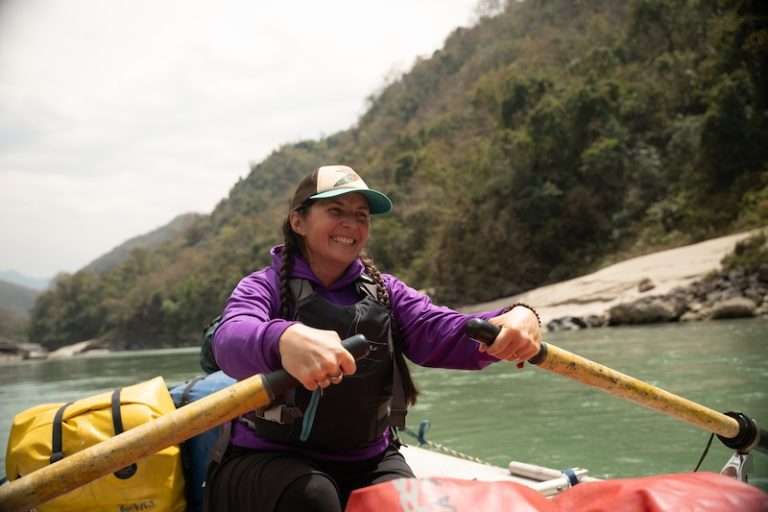
Anna Levesque:
For my guest, Matt Hamilton, an Ottawa Valley local, the line between professional duty and personal passion is drawn in high-pressure environments. As a paramedic and member of the Sierra team, he’s spent his career operating where the margin of error is razor thin — a reality that carries over into the winter months as a ski patroller. These roles have taught him that true composure isn’t the absence of stress, but the ability to remain effective within it.
That psychological grit has been the cornerstone of his journey as a longtime paddler and freestyle competitor. On the water, he finds flow in the most technical corners of the sport. He’s competed at multiple ICF Canoe Freestyle World Championships and thrives on the mental recalibration that whitewater demands.
Whether he’s chasing mystery moves as a squirt boater or navigating a complex emergency scene, Matt views every rapid as an opportunity to explore what I like to call the discomfort zone — proving that whether you’re saving a life or sticking a ride, the secret lies in staying grounded when the world starts to move fast.
Welcome, Matt. I love that bio, by the way. That was fun. You’ve done a lot. I think we’ve been in the whitewater world around the same timeline — 30-plus years.
Matt Hamilton:
A little bit longer for me. Late ’80s — I think 1988 was the first time I ran the Ottawa River. So yeah, quite a while.
Anna:
I love it. I’m excited to have you here. My first question: when I say “discomfort zone,” what does that mean for you?
Matt:
Mostly problems I can’t solve. A line I can’t figure out. A call at work where I get stumped.
Anna:
That’s a cool answer — I haven’t heard it put that way before. So when you get stumped, what’s your strategy?
Matt:
I take a deep breath. Step back. Look left, look right. Try to see the whole picture. Then refocus on the task at hand.
Anna:
Do you break it into small tasks, or stay focused on the big picture?
Matt:
It depends. Arriving at the top of a rapid — or arriving on scene professionally — you look at the big picture first. Then you narrow in on the individual tasks that get you through it.
Anna:
You have such a high-pressure profession, and you choose to paddle whitewater and do mystery moves — which are also high-pressure. Some people might think you’d want something more relaxing off the clock. Why do you keep putting yourself in the discomfort zone?
Matt:
I was diagnosed with ADD pretty young. My brain doesn’t shut off easily unless I exhaust it. High-activity, high-focus sports quiet my mind. Reading whitewater, reading a scene at work — things are changing quickly. When I’m fully engaged, my brain finally quiets down.
Anna:
What does that feel like?
Matt:
Calming. I can focus. I can have one conversation instead of four in my head.
Anna:
Does that happen in the middle of a big rapid?
Matt:
Absolutely. Being in the middle of a big rapid is one of the only times I feel truly quiet and focused.
Anna:
What about mystery moves?
Matt:
You can’t focus on anything else. A mystery move is going underwater in a squirt boat — a very low-volume kayak designed to sink. You corkscrew between currents and work with the water. The goal is usually to stay under as long as possible.
Doing a breath hold is difficult. Doing a breath hold while physically and mentally performing is incredibly difficult. You have to be fully present.
Anna:
Do you train breathwork for that?
Matt:
Yes. I’ve used breathwork apps. I’ve practiced Wim Hof breathing and cold exposure. Living in Canada, I’ve found open water in winter and gone in. You learn how resilient your body is. I’m not sure how much it helped kayaking specifically, but it helped build resilience.
Anna:
What has the discomfort zone taught you about yourself — both professionally and on the water?
Matt:
You can solve almost any problem if you keep moving forward. Take a step back when needed — but keep trying. That’s the only way through.
Anna:
So you don’t let being stumped stop you?
Matt:
No. It’s daily for me. It can be stressful, but it’s rewarding. You learn to thrive in it.
Anna:
Where did that confidence come from?
Matt:
Probably built over time. My grandfather put me in situations that were over my head — wilderness trips, snowmobiles, hunting, fishing. You had to solve problems. Then paramedic school — repetition. Skills practiced over and over until they move from conscious effort to automatic response.
Anna:
You’ve been in the sport for over 30 years and still seem stoked. What’s kept you in it?
Matt:
The community. The people. I competed in my first Worlds in 1999 or 2000. Some of those people I still only see at events around the world. The friendships, the travel — and the sport itself. It’s dynamic. Getting to the bottom of a rapid and looking back at what you accomplished never gets old.
Anna:
Has doing different disciplines helped you stay in the sport long-term?
Matt:
Absolutely. I started in slalom. Still try to run gates once or twice a year. If you want to sharpen your paddling, run gates. Then freestyle, squirt boating, long boats, rivers — the variety keeps it interesting.
Anna:
Which discipline brings you the most joy right now?
Matt:
Freestyle. Even as a slalom racer, I’d stop mid-course to surf a wave. It’s dynamic and creative. There’s a lot going on.
Anna:
How has aging influenced how you approach freestyle?
Matt:
I don’t chase every new trick anymore. I focus more on maintaining what I can do. As we age, our bodies don’t absorb impact the same way. But you still try new things. Sometimes you land on your face. Then you get back up and try again.
Anna:
We talked about being a “pro kayaker.” What does that mean today?
Matt:
To me, it means making a living in the sport. Years ago, sponsors paid athletes more directly — cash, vehicles, media incentives. There were more events, more magazines paying for photos and articles.
Now it’s different. Social media changed the ecosystem. It’s easier to show who you are, but harder to monetize. You have to produce more content, and it has to be high quality.
Anna:
I do appreciate that social media democratized exposure — fewer gatekeepers. But yes, monetization is different.
Matt:
Exactly. It’s easier to put yourself out there. But turning that into a living requires a lot more effort.
Anna:
Final question — what keeps you leaning into the discomfort zone after all these years?
Matt:
It’s rewarding. Solving problems. Staying engaged. And the community. When you’re in the middle of something challenging — whether it’s a rapid or a call — and you move through it effectively, there’s nothing quite like that feeling.
It doesn’t have to be the biggest rapid or the newest trick. It’s just that process of figuring it out. That’s what keeps me coming back.
Anna:
Yeah. I love that — it doesn’t have to be the biggest thing. It’s the process of figuring it out.
I think that’s such a powerful takeaway. Whether you’re on the river, at work, or in life — when you feel stumped, when you don’t know the answer, when the line isn’t obvious — take a breath. Zoom out. And then just take the next step forward.
Matt, thank you so much for being here. I really appreciate your perspective and your steadiness and just your long love for the sport. It’s really inspiring.
Matt:
Thanks for having me. It was great to chat.