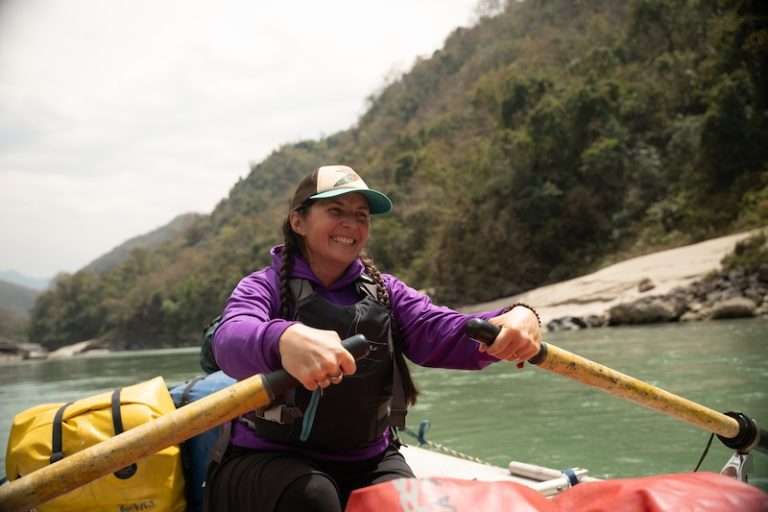
Anna: My guest today, Bryan Kirk, has been a whitewater lover for the vast majority of his life. From his first class two rapids in an aluminum Grumman on the Delaware River at seven, to surfing most days on the Potomac at age forty seven.
Bryan got into competitive freestyle kayaking while attending Virginia Tech back in 1996, and went on to make the US Freestyle Kayak Team and compete internationally at seven Freestyle World Championships between 2001 and 2015. He joined Team Wave Sport in 2004, then accepted the role of Team Wave Sport Manager from 2008 to 2015, including working closely with R&D to test and shape prototype kayaks.
He’s traveled the globe to coach kayaking and teach high school math and physics, and to explore some of the coolest rivers on the planet. He’s been working a desk job since 2016, just a few miles from the Potomac River, where he lives in McLean, Virginia, with his wife Courtney.
I will say that Bryan recently has been posting videos of himself paddling and doing all of these old school freestyle moves in all kinds of boats from all eras, and it’s actually kind of taken the internet by storm. I will also say that Bryan has been a longtime friend of mine. We’ve paddled a lot together and traveled over the years, over the decades. And I’m really excited that he’s here. So thank you, Bryan, for being here.
Bryan: Well, thanks so much for having me. I’m stoked to be here.
Anna: I’m excited to talk to you about the discomfort zone, and a little later, how the discomfort of being in some of those OG boats. But we’ll get to that in a little bit. Okay, when I say discomfort zone, what comes up for you?
Bryan: That’s a great question. The first thing that comes to my mind is generally any situation that causes me to have self doubts. Whether that’s getting up and doing a quick announcement on the stage at Gauley Fest, announcing the winner of a Wave Sport raffle back in the day, to coming out and competing in front of a couple hundred people in a stacked stadium. Basically any situation where I feel like there’s a lot of attention on me, a lot of eyes on me, and there’s a lot of different types of judgment. I would say that kind of defines my discomfort zone.
Anna: I can relate to that a lot. And as you were talking, it dawned on me that you and I have similarities. We’ve talked about it in the past, where competing was always challenging for me because of what you just talked about, a lot of judgment, all eyes on me. And I do remember you saying that, and remember you being, and still are, one of the best freestyle boaters. And when it came to competition, it was more of a struggle with your mindset. Is that true? Is that resonating?
Bryan: Absolutely. I’ve chatted with a bunch of friends over the years, just about whether it’s competing or doing well down a big class five rapid. Once you have a certain skill set, it then becomes ninety five percent keeping your mind under control. Almost like a mental test. And if you can take control over your mental state and calm things down, then success is practically guaranteed. And it becomes a lot more fun as well.
Anna: So what are some strategies you used to calm everything down?
Bryan: I’ve got a couple of different strategies I’ve used over the years. In advance of really whatever it is, I’ll practice visualization. So whether it’s a competition ride, I’ll visualize my routine that I know I’ve practiced tons of times, and I know how to do all these tricks. And that really builds up my self confidence. It reminds me that I can do it. I’m picturing myself succeeding in my mind, and then it’s a lot easier to go out and make that happen in the physical world after I’ve pre acted it out in my mind.
And I would say that definitely slowing things down through taking deep breaths. A lot of times I’ll get anxious about something, and I’ll be taking shorter breaths before something that is scary. I think a big thing is self realization that that’s happening, being aware. That enables you to do something about it and slow down your breathing. Just take longer breaths, hold your breath for a few seconds, let it out. That’s done wonders for me over the years in terms of calming down my mental state. And it’s a lot easier to perform well after you slow things down in the mind.
Another thing is reminding myself that I’ve done a bunch of scary things over the years, whether it’s getting up in front of a bunch of people or competing. I’ve had different failures and different successes, and just reminding myself that things tend to work themselves out. Everything’s going to be okay in the long run.
Anna: I love that. A couple of things. When you mentioned being aware is the first step, how did you build that awareness? Was that a practice? Because building awareness is a skill, and it changes over time. I love practicing self awareness. Sometimes it’s simply sitting in meditation or doing yoga. That’s one of the benefits of yoga, it’s a practice in becoming aware of your body. How does it feel when you stretch or strengthen, or you’re in this position? Is your breathing easy or hard in this position? So how have you built that self awareness?
Bryan: I think I had a really good mentor. My mother has long been into Tai Chi, and then she got really big into yoga and became a yoga instructor. As I was still at Virginia Tech, I was training a bunch to try to make the US Freestyle Kayak Team in 2000, to go to the ’01 Worlds in Spain.
Anna: Where we were both third. Team bronze.
Bryan: Team bronze, yeah. So she came upon this book, Thinking Body, Dancing Mind. It sounds like you’re familiar with that one.
Anna: You suggested that book to me. I always remember, whenever someone brings that book up, I always think of you, because you were the one who introduced me to it.
Bryan: I actually read that book a couple of times, because I spent a bunch of time down at Rock Island before the events, during that long cold winter. I was camping out of the back of my pickup truck in the state park there, with Ranger Joe and a bunch of old legendary freestylers like Eric Southwick, Sam Drevo, Billy Craig, Jimmy Blakeney, all those guys. There was a ton of downtime. You can only spend so much time actually doing physical training. So a thing you can do off the water is mental training, if you will. And that book really opened up my eyes to some pretty cool techniques of being aware of your mental state. It got me into different visualization techniques before going out and doing something. It’s been really helpful, and it’s resonated and stuck with me over the years through different challenges.
Anna: One thing that I’ve added on to visualization recently, and that I do with my clients, is focusing on the feelings that come up. Focusing on how you want to feel, let’s say after a solid performance, after your best performance. What will that feel like? Pairing that with the visualization. Have you ever tried that?
Bryan: I have not specifically tried that, but that sounds like a super cool idea.
Anna: It’s very cool, because it gets the body involved as well. I’ve been playing around with it and it’s been very helpful, and it’s been helpful for my clients.
Bryan: I’ll definitely try that.
Anna: It feels a little more woo woo, because you’re focusing on the feelings. When I first say that to people, they’re like, what? Sometimes we’ll be by the river right before we put on, and I’m like, okay, no one cares what we look like. They’re doing their own thing. Just close your eyes for a minute and picture yourself at the end of your day. You’ve accomplished everything you want to accomplish. How does it feel? And you’ll have images pop into your head related to the feelings. At the end of the day, it seems to be very helpful. It’s anecdotal, but yeah.
Bryan: It makes total sense. The mind and body are just absolutely so connected that it makes sense that you’re visualizing a future overall body state, of after the activity, and how that’s going to be. It’s just got to be a super positive experience, I would think.
Anna: The other thing you mentioned was off the water. You’re saying you’re doing on water training and then off water training. I always find it interesting that so many people talk about hard moves in easy water for skills building. Everyone’s so focused on skills building. What you’re talking about with visualization, that’s hard moves in easy water for the mind. Taking the time to visualize, building awareness. And what you said in the beginning was that once you reach a certain skill level, and I love this, you said it’s ninety five percent mindset. So why haven’t we been talking more about hard moves in easy water for mindset training? It should be given almost equal time, maybe not total equal time, but as much as the physical skills training or practice. What do you think about that?
Bryan: Yeah, absolutely. I completely agree. That makes total sense, because if you’re getting into something where you’re in your discomfort zone and you haven’t done that pre mental conditioning and visualization training, then it’s going to be really hard. I feel like that would be entering something like a competition, or getting in front of a big crowd of people, and just winging it. For me personally that would greatly increase my overall nervousness and tension. So I realize in advance that something is making me nervous and I’m going to enter a place where comfort is diminished. I pretty much always try to mentally prepare myself, and it’s just a huge benefit overall.
Anna: Another book you might like that I’ve recently discovered is called The Confident Mind by Dr. Nate Zinsser. One thing that has stuck with me from that book is that nerves are your body and mind prepping themselves to do something that’s important to you. And that we don’t have to put a negative spin on it, which has been really helpful. Instead of being like, I’m nervous, is it going to go well, just be like, okay, I’m nervous, great. That means my body’s revving up to do something that’s important to me. It’s a reframe. But that book, The Confident Mind, is also really good. You might enjoy it if you haven’t read it yet.
Bryan: That’s a good one. I’ll definitely check that one out. And I like what you took from the book. That it’s a sign that you’re getting into something that really matters to you, and that you can funnel that into positivity. You’re doing something super cool, and it’s going to be awesome once you do succeed at it.
Anna: I’m going to shift gears just a little bit. Well, actually before I do that, I do want to ask, using the strategies you’ve used, did it always work, or did your nerves just get the best of you sometimes? And what was that like?
Bryan: It hasn’t always worked. I have had a couple of competitions where I put too much pressure on myself, to where it overwhelmed my preparation. Just this extreme pressure on myself. An example of that would be the 2013 World Championships on the Nantahala. It was pretty much a local world championships, which doesn’t really happen that frequently. A lot of the time you have to travel to Europe or somewhere really far away to compete in a Worlds. So because of this, a bunch of my family drove down there, spent a bunch of money, rented houses. They spent a bunch of time and effort and money to be there.
Another thing was that all of the chief executives from Confluence Watersports were there, including the CEO and the chief marketing officer and the whole executive team. And I spent some time schmoozing with them right before my competition rides. That totally, they’re all great people, extremely friendly, but that kind of jarred me out of my preferred mental state right before competing. So I didn’t stick with my plan. I got distracted.
It was tricky, because you have pressures to different social things that you feel obliged to, hanging out with different social groups leading up to an event. And I really cared about doing well in front of my family as well, because they were all there in person. So that actually was a time where all of that overwhelmed me. I got kicked out of my mental state, and I didn’t make the finals on that run. I think I ended up like eighteenth or something like that.
I was just so frustrated afterwards, because I actually realized beforehand, before competing, that I was not on my ideal track, my ideal timeline coming into being about to compete. So it happens.
Anna: That was rough for Andrew as well, because it was actually where he grew up. He was sixth, I think, or something like that.
Bryan: I remember that. I felt so terrible for Andrew, being on his home river.
Anna: It’s the same thing, putting pressure. So how did you deal with that? That sounds like a lot of pressure. And I can so feel it, because I didn’t experience that exactly, but I’ve experienced what you’re saying. Not sticking to the plan, not setting myself up for success, whether it was with sleep or where we were staying, leaving that to someone else. There’s all kinds of stuff. So how did you deal with the frustration afterwards? How did you work through that?
Bryan: Afterwards, in my mind that was a failure. I did not accomplish the goal of getting on the podium. That was my main goal, because I didn’t know if it was going to be my very last world championships. It turns out it wasn’t, I did the next Worlds up on the Ottawa River in 2015.
But I realized after that failure, that was basically my worst case scenario happening. And yet I had this self realization that things were just fine, even though I didn’t accomplish my goal. Once I had that realization, it was just a huge weight off my chest. In the grand scheme of things, I realized that I maybe had taken things a little too seriously and put too much pressure on myself, and that made it a little less fun for me. Because I was tense during competing, and I could feel it during my ride. If you’re tense and rushing your tricks, you’re going to be a little more sloppy, and you’re probably not going to get scored if you do a sloppy phonics monkey. If your end is not vertical enough, those judges are strict, especially at the Worlds, and they’re not going to give it to you.
But just having that realization afterwards, that even in a worst case scenario, everything was still okay in my life, and life goes on. I took that lesson with me afterwards and applied it to future challenges. I just put less pressure on myself. I was reminding myself beforehand, before every time hopping into my discomfort zone, that everything was going to be A okay. And it has been ever since.
Anna: That’s really profound, what you just shared. Such a profound realization that you’re okay, that life goes on. That your kayaking performance is not your self worth. Your kayaking performance does not equal your self worth, and how much you’re loved, or who you are as a person.
Bryan: Absolutely. And your relationships with all your friends and family, those are not going to change at all. If anything, it can make you even closer to people, because you can have chats with them about what happened and they can connect with you through that. So it can turn into a cool thing. Almost like turning lemons into lemonade.
Anna: And when you’re talking about being tense, so you rush your tricks. For anyone listening who maybe you’re not into freestyle, but you love kayaking and you’re working on your roll, it’s the same thing that Bryan’s talking about. You put pressure on yourself and then you rush the roll. You try and pull your paddle blade down. And that relaxation is so key. And even thinking that flipping over is fun, which is a tough one, but it can help.
Bryan: That’s a cool thing about playboating. You really do flip over for fun a bunch. Any time you go for a kick flip, you’re getting upside down for fun. In any given playboating session, just at your local play wave or hole, you’re going to be doing cartwheels and falling on your head, and it turns into a really fun thing. A side effect of that is it doesn’t matter if you flip over anymore. You’re just like, well, I have done this tens of thousands of times at my local play spot. And rolling, you don’t even have to think about rolling after a while. It just happens. It becomes instinctive.
Anna: We’ve been talking about putting pressure on yourself, and the discomfort zone, and all eyes on you, and preparing for that, and strategies, and that profound realization. And now, what I find so awesome is that you still love paddling. You’re paddling almost every day, it seems like.
Bryan: Still quite a bit, for sure. It helps to have the Potomac right in the backyard. It’s just such a gem.
Anna: You’re out there doing all these tricks in your playboat, cartwheels and blunts. And not just in your playboat, but in old school boats, a wide range of them. And people love it. When I watch you, and Andrew says the same, you’re so good. And so you are obviously very relaxed when you’re doing that. People have just been loving seeing all the different boats. So how is that? It seems like you’ve been having fun with that.
Bryan: I’ve been having a blast with it. I started kayaking back in the early to mid nineties, and I first got into cartwheeling back when my playboat, I thought it was crazy short for the time. My first short playboat was an RPM when it first came out in 1996.
Anna: Which, for folks listening, most people know the RPM, but it’s like a really long, big boat now.
Bryan: Totally. And that’s the boat I learned to cartwheel in. I first met Luke Hopkins out on the Potomac before I learned how to cartwheel. He was out there linking six and eight ends in a Savage Scorpion, which is eight feet long, out on the Potomac in Center Chute. I remember seeing this guy just shred, and I was like, I want to do that. So we became best buddies over the years, and I became really into cartwheeling.
These days, now that I’m not kayaking professionally anymore and I’m doing it just for fun, it’s like a new personal challenge to me. It’s also kind of a retro feel. It brings me back to my origin, the old school days when people were hucking big linked ends in big old boats. So a boat will pop up locally for sale, and I’m like, I remember that thing throwing down back in the day, seeing video of Mark Lyle or Scott Shipley link a ten pointer in that boat. So I’m going to pick that up, because it’s a hundred and fifty dollars and it’s just a few miles from me. I just picked up a Scorpion. And the Potomac is a high volume river. It’s got these big, deep, powerful play spots that are perfect for these old school boats.
It’s cool. I feel like it also motivates people to get out there and try cartwheels, to keep cartwheels alive, these big linked ends.
Anna: Keep cartwheels alive.
Bryan: And it lets people know, if you’ve got an old boat, the thing still shreds. Just get it out there and plug it into your local play spot and get that thing vertical. I’m hoping my videos just inspire people and show people how fun kayaking is. It’s another niche of kayaking, seeing what you can do in an old school boat. Just visually, and the feel of getting a long boat vertical. I love it.
Anna: I can tell you love it. Your videos are fun. They’re joyful and inspiring. And also, as someone who has had a back injury now, when I watch you I’m like, wow, your back must, you are in such good shape. And also amazing that you can still do that at forty seven. I’m not saying that once you get a certain age you should stop doing stuff. That’s not what I’m saying. But there is wear and tear on the body over the years, repetitive motions. That’s kind of what led to my injury. And now I can’t even imagine cartwheeling. I would be too scared to cartwheel. But I was scared to stern squirt, and I’m stern squirting again. And I was scared to front surf, this was after my injury, and I’m front surfing again. So maybe I’ll get more confident. But you are amazing to be doing that. How is your body feeling?
Bryan: Over the last ten years or so, once I got close to forty, I feel like I’m taking things really cautiously. If I’ve taken some time off of kayaking or playboating, I’ll slowly ramp back into doing more and more physically demanding things. For example, I lived out in California and just mountain biked for about a year and a half, so I took a long break from paddling. And when we moved back to the Potomac, I didn’t immediately hop in a ten foot long boat and go hop into S Turn and see if I could do a big split wheel right off the bat.
So I have really listened to my body, because I’ve had a bunch of little injuries over the years and they really frustrate me. So I’ve tried to learn. If I feel the slightest tweak in my oblique muscle from trying to initiate a cartwheel or a blunt too hard, I really back things off. I let it heal back to perfect again. And then I slowly will ramp back into giving more and more effort into whatever it is I’m doing. More and more snappiness on a blunt, for example. Just listening to my body and really letting things heal has been key into my older years.
Anna: Thanks for sharing. Does that mean you take some time off of kayaking, or do you just go paddle around flat water, or just do spins? What does that look like when you say you back off?
Bryan: It really depends. If I’ve just been paddling a bunch of days in a row during epic levels, if the Potomac is three point seven, and O-Deck surf wave, S Turn hole, and then surfing downstream with my wife Courtney at Maryland Chute. If I do that four days in a row of hard playboating, you start getting jello arms and I’m like, all right. It takes me two or three days off to get fully back to a hundred percent again. Whereas back in my twenties, I could just take one day off and be feeling perfect after that.
And then if I do tweak myself, I’ll definitely take some more time off than if I’ve just worn myself out from paddling. If I feel the slightest tweak in my lower back, I’ll switch things up and hop on the mountain bike, go on some hikes. Switch things up, basically. And that’s actually helped me, having a little bit of variety and not being a one trick pony, just only kayaking, like I was all throughout my twenties and thirties.
I think that getting more and more into really strengthening my entire body through mountain biking, trail running, disc golf. I do speed disc golf, so it’s not just walking around with a backpack. I’ll throw the disc and run after it, just to make it more fun. And I think you get more out of it physically. But just being more holistic, paying attention to overall strength, the overall body, has allowed me to kayak safely as I’m approaching fifty in a couple of years.
Anna: And it sounds like you’re very comfortable. You’re not putting pressure on yourself to paddle all the time. And I think for some folks, I had to take six months off of kayaking to heal my back, and I’m back paddling and it’s great. The six months off, honestly I don’t really feel it. Maybe in playboating, because I’ve gone to the local wave a few times. But I’m trying to save my body for the Ottawa, which we’re going to in a couple of weeks. So I don’t feel it. I think sometimes we can get it in our heads that if we take time off, we’re not going to be able to come back, which is just not true. And what you’re saying, healing. You said the words healing completely. That’s so important.
Bryan: Totally. And I’ve found when I have taken longer stints away from paddling, I’m so much more passionate and excited about it once I do get back into it, that it’s even more joyful than ever. And that is a really cool feeling. It refreshes paddling for me. So taking some time off can be an incredibly beneficial thing, just mentally and physically.
Anna: What keeps bringing you back to the water? And what’s at the root of your joy of playboating?
Bryan: I would say that it really just gets me in a state of nothing else in the world matters or exists. You are just absolutely in the moment. Whether you’re on your local favorite surf wave, or if you’re running a creek, like I lived in Fayetteville for a bunch of years, bombing down Manns Creek. You are just so absolutely focused and in your own groove, and working with the team of buddies that you’re with, that there is not another care in the world outside of that moment and that location and that time. Nothing in your past, nothing in the future matters. It’s just a great feeling. And it’s where I’ve attained my greatest happiness.
Anna: Thanks for sharing. I want to share one of my times that I was super in my discomfort zone, and it was totally all in the mind. Do you remember the time we ran the Upper Gauley at like eighteen thousand CFS? Was that right?
Bryan: Yeah, it was up there. Some huge release out of the Summersville Dam, and then the Meadow is pumping in an additional four or six thousand. So just a huge day on the water.
Anna: It was huge. And we ran Pillow. And I got into this eddy in this random place. There was like, on the left, now I know which rocks it was. And you and Andrew were waiting for me, and I just freaked out in my mind. And you had to come into the eddy to talk me down and get me to paddle out. And when I paddled out, it was literally class two. That was a crazy experience. I always remember that when I think about how the mind can go so crazy. That was an experience for me.
Bryan: Absolutely. Because Pillow Rapid itself was so violent. It gets so beastly and powerful at those flows that it can kind of slap you in your face and you’re like, whoa. Because any time personally that I’ve felt like I’m reaching that limit of slightly out of control on the water, that is a big discomfort zone for me, and probably for most paddlers. And that can totally happen in big water like that, where you just feel that power and you’re like, okay, I’m not fully in control in this.
But you were in that eddy, and really the only way out of it was paddling out of it, because it was those big vertical rocks. You couldn’t really climb out very well.
Anna: At the bottom, I had already run the rapid.
Bryan: But that was one of those things where you totally had the skill set to get yourself out of there. It was just overcoming it, taking the reins of the mental state and being like, all right, I got this.
Anna: And I couldn’t do it by myself. So I was very happy. Andrew was further down, I could see him down there. But then you actually paddled into the eddy with me. So I’ll always be grateful. Talking about working with the team, that’s what it takes. You’re showing up for other people, for yourself. I was always grateful that you came into that eddy. And then after that, I remember it being a great run. Just fun. Scary, but fun. We cruised down. At least that’s my memory.
Bryan: High water Upper Gauley, a gem. It’s one of the best ones in the world, in my opinion. If you’re out there in the main flow. With that being said, there are a few little gnarly spots.
Anna: Now I would not put on at that level. There are eras in my kayaking. And it was also, I think, thirty two degrees, which I would also not put on now. Especially not that combo, eighteen thousand CFS and thirty two degrees on the Gauley.
Bryan: That way ups the ante. Any time you get ice water, the consequences just go way up. I’m the same way these days. Great Falls is right down the road, and I’m basically only going out there if it’s really nice conditions and I’ve got a group of good buddies, support team, and it’s decent weather. Out there, if something goes wrong and it’s thirty two degree water, things can rapidly escalate and get really serious really quickly.
Anna: And I think that’s the other thing, what you’re saying, you find joy in the playboating. I was just saying there are eras in my kayaking, and that’s the beauty of it. It can be very sustainable if you’re willing to shift. If you’re willing to, like you’re saying, pay attention to your body, what brings you joy, what’s available to you. And not get stuck on, it has to be class five, or it has to be playboating in new playboats, or at this certain spot, or at this level. Finding the joy in what’s available. And that goes to, we can’t look to outside circumstances to make us happy. You have to continue to choose that happiness. What are you choosing in this moment, in this era? And there’s, I think, always something that you can find that’s joyful.
Bryan: Absolutely. And that’s really the beauty of kayaking. It’s such an amazing sport to be a lifelong activity. Andrew’s father is approaching eighty and still getting out on the Upper Gauley. And he had the first descent of it back in seventy six or something like that. Kayaking just has so many aspects, and each one of those aspects is so fun in and of itself. Whether it’s attaining, or surfing your local wave, just finding that mental state, getting in the flow. That’s what it’s all about.
Anna: Getting in the flow. Okay, Bryan, do you have a question for me?
Bryan: What’s the best advice you’ve learned in your collective interviews over the years, with all of these amazing paddlers and adventurers, in terms of dealing with stressful situations?
Anna: Almost everyone says the breath. Which I actually was surprised by, to be honest. Breath work, focusing on your breath, taking a deep breath. And honestly, in this interview, what you said about everything’s okay, life goes on, I think that is such a profound realization.
I can remember being in college, and I think I was stressed out about money or something. I was sitting on my bed and I was like, okay, well, I’m stressed, my bank account is low, but I’m still here. And I can still do something. I can still do things. I still have friends and I can make choices. I can pick up extra shifts, I was working at the graduate library. And that realization, I can still remember it so clearly, which is so interesting. Of like, I still have agency.
Now, I will say that I did not take that into my competitive career, and I spent a lot of time suffering, because I was collapsing my kayaking performance, my competitive performance, with my self worth. So I’m not saying it always translates. That’s the thing about the human brain. Sometimes we forget. Our brains will just go back to the same coping mechanisms. But I think that realization that you just expressed is huge.
And I talk about it with my clients too. Let’s stop, and I say this to myself, stop focusing so much energy on making myself wrong, or beating myself up about a performance, or about a missed line, or a roll or a swim or whatever. And put the effort into, what am I learning, and then what am I going to do next? I just think that’s really profound.
Bryan: It’s kind of just a realization that life is always going to present you with challenges, and it could go right or wrong, but one step at a time. And there’s nothing you can’t handle.
Anna: Exactly. Okay, are you ready for rapid fire?
Bryan: I am. Let’s go.
Anna: First, I added one because of your joy in playboating OG boats. So what right now is your favorite OG boat?
Bryan: At the moment, it’s the Perception Amp. It’s the one that fits my current paddling style and my current weight, being like a hundred and sixty five pounds. It used to be the Triple X. I’m thirty pounds heavier than what I used to shred and compete in the Triple X back in 2001. And the Amp is like an evolved version of the Triple X for someone my size, and it just performs so well. It takes me back to competing in the 2001 Worlds, which I was in the Shock, just the slightly smaller version of the Amp. So I’m in love with that boat. I think it’s underrated, and people are just starting to now figure out that the Amp is a gem.
Anna: When you said the Shock, I just remembered, I think there was a year where you all had your last names on your boats. Do you remember that?
Bryan: Yeah, they made custom stickers for Team P.
Anna: Team Perception. And I remember seeing Andrew’s last name, Holcombe, on his blue boat. And that’s when I started to think he was really cool. I was like, his last name is Holcombe. So funny. Okay, anyway. What’s your favorite river metaphor?
Bryan: Ooh, favorite river metaphor. You caught me off guard with this one. I would say it’s basically analogous to life. It’s just one challenge after another, and one small step at a time, and just go with the flow.
Anna: Or navigate the flow. Set your angle. Okay, what’s a morning ritual that sets you up for success?
Bryan: All my buddies and family laugh at my morning ritual, but I like to take things very slowly. I like to give my mind and body adequate time to ramp up. First thing I do is just a big glass of water. It invigorates me, gets things going naturally, and cleanses me out a little bit. Just attaining as relaxed a state as possible, as soon as possible, and taking things slowly.
Anna: Nice. What’s a non negotiable self care practice?
Bryan: Going kayaking. It’s where I find health both mentally and physically. And these days it’s really my number one thing.
Anna: What motivates you these days?
Bryan: What motivates me is fun, maximizing my fun, whether it’s on or off the river. And when it comes to the river, I take into account my risk to reward level. As I’ve aged, the risk that I’m willing to accept has definitely gone down. So I find myself on O-Deck Wave below Great Falls, where there is practically no risk whatsoever compared to Great Falls right above it. And it’s just absolute pure joy with not much to worry about.
Anna: Thanks for sharing. What do people get wrong about you?
Bryan: I’ve had a lot of people label me as a playboater over the years, which I can understand. That’s what I’m most well known for, because that’s what I’ve focused more on competition with, from the freestyle perspective. But I’ve always considered myself a kayaker. When I lived in Fayetteville for fifteen years, I wasn’t necessarily going playboating. I was waking up, checking the levels, and doing whatever was the best level for that day, whether it be Mill Creek being at the prime level, or the Dries.
I’ve had pretty good success in class five races over the years. I’ve gotten first place in the Great Falls slalom race, and second at the gnarly steep, manky Home State Creek Race, and the only person that beat me was Olympian Mike Dawson. So I think a lot of people don’t realize that.
I’ve been out on Great Falls just recently, and I’ve had a couple of the younger guys be like, dude, I’m surprised to see you out here. That’s awesome to see you out here. And I’m like, man, I’ve been running these drops since before you even existed, since the mid nineties. These are kids that were born in like 2007, 2009, who are out there, and they’re like, but you’re a playboater. And I’m like, dude, I’m a kayaker. Let’s go paddling.
Anna: That’s so awesome. I’m totally laughing with you, because that is just what happens when you get old. The young folks just don’t know.
Bryan: Totally. And that’s another motivation for me, posting these old school boats doing old school stuff. A lot of this younger generation, I think, have not been exposed to a ten foot long kayak doing a linked ten vertical ends. A lot of people just haven’t seen that. So I’m trying to keep that alive, or just let people know what we used to do.
Anna: For sure. Maybe three years ago, I was on the Ottawa with the Nova, and I was on Garb, and Keeners was there too. They do this rodeo, I think it was Fridays. They video each other and then they judge. And I was in there because they were videoing everyone, and they were like, I can’t believe she can do a blunt in that long boat. They were totally blown away that it was such a long boat. And Clay was like, yeah, they were just blown away, they didn’t think it was possible. And I’m like, that is hilarious. But it also made me feel good, because I was like, sweet.
Bryan: Those kids were like, she is a badass. They’ve never seen a blunt that tall and big before. That’s totally awesome. You open their eyes to what’s possible, and what we used to do.
Anna: Yeah, totally. That’s how I learned. I learned in boats like that, longer than that. I’m hoping, going back, I’m a little nervous about my back, but I really hope it feels good enough to surf Garb, because it’s my favorite. So we’ll see.
Bryan: Garb is incredible.
Anna: Okay. Throughout the course of your life, have you felt like the underdog, or the favored to win?
Bryan: I’ve often thought about this to myself, and I’ve always considered myself the underdog. Which I actually prefer, because it has taken away so much pressure on me. At the 2001 Worlds, I felt like nobody had even heard of me before. There were some Americans that had heard of me, just because I had made the recent US team trials. But overall, my name wasn’t on the map yet. And I didn’t put any pressure on myself. I was just like, I’m just going to have fun here and just paddle for fun and see what happens. And it turned out really well. That was my first big success, ended up with the bronze medal. Right along with you and Tom McKee. And Luke got bronze in the C1. Pretty awesome.
Anna: Team bronze. Okay. Hard moves in easy water, or flooding?
Bryan: These days, definitely hard moves in easy water. And that’s the advice I’ve often given to people who are working on their skills, intermediate boaters. I’m like, that’s where it’s at. That’s where you’re going to get best the fastest. And that’s where, if it does go wrong, you’re not going to get your butt kicked.
A lot of the times if people get too worked, that’s a massive hit to their self esteem, and they’ll come back a little bit in a state of fear and tension. And then they have to dig themselves out of a hole almost, mentally. It just makes things a little harder than if they had just dialed in those skills out on the Potomac, or on the ledges on the French Broad. Just catch that little micro eddy that is really hard to make. That’s where it’s at.
Anna: Right on. Okay, what’s one word that describes your comfort zone?
Bryan: Confidence. Having realized, before entering that discomfort zone, that I’ve got this. And even if it does go wrong, it’s still going to be all right. So really, just confidence.
Anna: Okay. Freedom through discipline, or I do what I want?
Bryan: I do what I want. That’s just always felt like so much more freedom, rather than if I’ve locked myself into being too strict and too hard on myself.
Anna: In one word, what do you hope your legacy will be?
Bryan: Satisfaction.
Anna: That’s a good one. I don’t think anyone’s said that.
Bryan: What that means to me is having done something that is potentially in my discomfort zone, and emerged from that having learned, having taken away different lessons from it, and had a realization that things are all right. In the grand scheme of things, that was just one little event. And everything is going to be all right.
Anna: Right on. Thanks, Bryan, for being here. Thanks for taking the time to have this convo.
Bryan: Thanks, Anna. It’s been awesome.
Anna: I’m stoked to hopefully get on the Gauley with you this Gauley season.
Bryan: We’re definitely going to make that happen.
Anna: Thanks, Bryan. Appreciate you. And everyone, if you haven’t seen Bryan’s Instagram, go see all his fun videos, or Facebook. I put those in the show notes on my website, so you can find the link there. Thanks again, Bryan.
Bryan: Thank you. See you on the river.