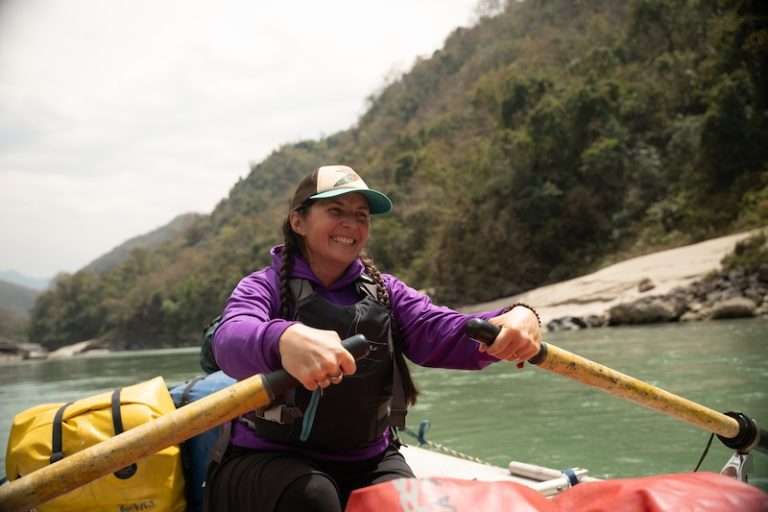
Anna Levesque
Okay, great. Awesome. Perfect. All right, here we go. My guest today, Laura Zelliger, is an ACA certified L5 advanced open water coastal kayak instructor, an L4 instructor trainer, and L4 whitewater kayaking instructor with over 15 years of coaching experience. She brings a multidisciplinary approach spanning sea kayaking, whitewater, canoeing, and surf.
to help paddlers gain the skills and confidence to treat California’s dynamic coastline as a playground. Laura also serves as saltwater program director for California Water Sports Collective and is proud to represent PNH kayaks and coquettat as a global ambassador. Welcome Laura, thanks for being here.
Laura Zulliger
Hey, thank you, Anna. It’s so great to be here.
Anna Levesque
Yeah, so I always start with the same question. When I say discomfort zone, what comes up for you? What does that mean to you?
Laura Zulliger
man, well at first I think it’s like a, you know, a torture reference. Like, I’m gonna take you to the just comfort zone. then, you know, then you think about the broader picture and then just like, yeah, that’s like, that’s where the learning happens. It reminds me of like your growth edge, you know.
Anna Levesque
Hahaha
Anna Levesque
Right.
Anna Levesque
Hmm
Laura Zulliger
embracing that, finding it, seeking it, retreating from it, developing a relationship with it, all of those things.
Anna Levesque
Right. Yeah, your growth edge. I love that. you do, so what are your strategies? Because it’s really interesting. You just talked about retreating from it, cultivating a relationship with the discomfort zone. Can you give me some examples from your own life and experience of how, like, how you do that?
Laura Zulliger
Yeah, definitely. think I’ve noticed a pattern, like in reflecting about this question. Here’s my pattern. Typically, I commit to something because I get really excited about it and I love to push myself.
And then I have doubts and I’m just like, gosh, what have I done? Can I actually do this? Similar to like, okay, you’ve committed to this new run that’s gonna push your skills in a whitewater context, or you committed to go surfing on a day where it’s a pretty consequential break or size, or even you’ve committed to speak at this engagement and you’re just like.
Anna Levesque
Right.
Laura Zulliger
So first of all, there’s the commitment, the seeking, then there’s the phase of regret and imposter syndrome. And then I reach a phase of like, no, I’m gonna like train and prepare my way through this. And so then there’s like preparing and training if there is that physical element to it. And that’s the phase that I actually really love.
Anna Levesque
Mmm.
Laura Zulliger
And then I find that as we near the event, if I do have a chance to train, I love it. But as we near it, again, that like, what have I done comes up and like, what was I thinking?
Anna Levesque
Hmm. Yeah.
Laura Zulliger
you get out of the car or you open the door or you put on the spray skirt and then there’s just like complete surrender. And that’s another point that I really love where you’re just like, look, I’m here. There’s the only way, the only way out is through and a lot of goodness is going to come from it probably. You just got to trust it. yeah, kind of felt that way. Yeah.
Anna Levesque
Hmm.
Mm-hmm.
Anna Levesque
Yeah. I love that you, yeah. I love that you normalize the, have I done? Or the imposter syndrome because I, yes, I experienced that in my life. And yeah, sometimes I look at that and be like, well, but you chose it. Like you’re here. right, right. I really wanted this and now it’s scary.
Laura Zulliger
Yes.
Laura Zulliger
Yes, right? I must have had some good reason to do this.
Anna Levesque
Yeah, so I appreciate you sharing that. Because I think that, well, I appreciate you sharing it just for you hearing it for myself. Because I can relate for sure.
Laura Zulliger
It reminds me of like the four stages of grief, right? Like the four stages of like realizing that you found a discomfort zone.
Anna Levesque
Right. Yeah. There is also something about…
Anna Levesque
Yeah, also love the only way, what did you say? The only way forward is, the only way out is through, yes. And I can also relate, because I think when I’m, one of my favorite feelings, and in the moment, it’s not, there’s something really empowering about being in an eddy at the top of a rapid that I’m nervous about.
Laura Zulliger
Only way out is through.
Anna Levesque
And it’s the moment that I start paddling to peel out and look where I’m going. It’s that same feeling. It’s like, okay, here we go. There’s no turning back. I really love that point. I dislike everything you described up to that point. Like the self-doubt, the imposter syndrome, the like, have I done? I can get really…
stuck in it. And so I guess I find relief. And I’m just working through this now talking with you actually. I think I find relief in putting all that aside. And once you start paddling and you’re in the current, it’s like, here we go.
Laura Zulliger
Yeah, it is. It’s like, it’s that presence that’s like the foundation of entering a flow state. You know what I mean? Where you’re like, I am here now. And if I’m not here now, the consequences will be greater. You know? Yes. Yeah.
Anna Levesque
Mm-hmm.
Anna Levesque
Yes, totally. Yeah. If I’m still like peeling out of the Eddie and being like, why am I here? Not good. You know what I mean? It’s okay to think about that in the Eddie for a minute or like at the put in or wherever, but yeah. I really think that that feeling being able to, I think the experience of that and whether you’re in the,
Laura Zulliger
Yes, yes.
Anna Levesque
the ocean or the river, you know, or whatever you’re doing when there is that point or when you’re walking out on stage to give the presentation like you were talking about. There is something really empowering about stepping into that and committing to it. And it doesn’t mean that you know the outcome. It just means that you’re, like you said, you’re present in it nowhere else.
Laura Zulliger
Yeah.
Laura Zulliger
It’s so true. And that’s like almost like one of those Chinese finger traps too. It’s like the more you try to cling to this outcome, like sometimes the worse it gets too. one thing that I, I’m pregnant again. So I’m thinking a lot about childbirth and I was, you know, I think when I gave birth to my first child, I drew so many lessons from paddling.
Anna Levesque
Yeah, it’s powerful.
Anna Levesque
Hmm.
Anna Levesque
Yay.
Laura Zulliger
and outdoor sports and endurance sports in that whole process, especially the childbirth aspect where you know like you can want like okay I don’t want to have a c-section I don’t want this I don’t want this but there’s so much surrender and almost the more you cling to those not having those outcomes like the less you kind of like soften to the actual experience to ultimately
Anna Levesque
Hmm.
Laura Zulliger
lead to your ideal outcome, which I learned so much through kayaking.
Anna Levesque
Yeah, I love, yeah, I don’t think anyone has talked about metaphors from paddling for childbirth. I think this is a really cool perspective for sure.
Laura Zulliger
Childbirth is kind of like being in a gorge in Canyon and you know you gotta get, you’re gonna get downstream. You don’t know if you’ll still be in your boat. And you don’t know how you’re gonna get there, but the baby will come out and you will flush downstream.
Anna Levesque
You
Anna Levesque
Hahaha!
Anna Levesque
Hahaha!
Yeah. Yeah. The surrender. you talk about, you know, because even with my, and I’m sure podcast listeners, yes, I’m still healing my back. It is a super long journey and the more and more I, yeah, I’m having to surrender even more. And when I think I’ve surrendered, it’s like, no, here’s more surrendering for you. What is
your view, like when you say surrender, what does that mean to you? What has it looked like in childbirth or in other aspects of your life? You know, what like paint a picture for us of surrender.
Laura Zulliger
I really do think it’s foremost for me, like definitely preparing towards a certain or desired outcome, you know, whether it’s a course you’ve designed or an expedition you’re embarking on, right, or childbirth or starting a company, right, but then
Anna Levesque
You
Laura Zulliger
not muting all of the information that you get to adapt or savor the experience just because it’s not aligning to that outcome you prepared for. And so surrender is like another word for just like letting like you visualize that outcome you prepared for it, but you got to really let it go.
Anna Levesque
Mmm.
Laura Zulliger
to like dive in and be a part of the process to get there, you know? So, and you never know, maybe the outcome that you thought was possible and were seeking is like, you were, you were lowballing yourself. But if you didn’t surrender, how would you know, you know?
Anna Levesque
Hmm. Mm-hmm.
Anna Levesque
Right. Sure.
Anna Levesque
Right, yeah.
Laura Zulliger
Or you’re clinging and you’re offline, but because you’re so fixated on that one line, you totally miss another opportunity to style it in another way. Or you miss a wave because you were just so fixated on what just happened or what will happen.
Anna Levesque
Right. Yeah, you miss opportunities in the moment. Yeah. Yeah. Yeah. Thanks for sharing.
Laura Zulliger
Yeah, I think too, like from an injury perspective, just because I remember feeling like injured and the worst feeling I felt is like not strong. Cause I feel like I’m such an embodied person that to not feel strong coming back from injury was just…
Anna Levesque
Yeah.
Anna Levesque
Mm-hmm.
Laura Zulliger
Maybe mentally one of the hardest things I’ve gone through. And a lot of it was just like surrendering to like what’s best for my body from a physical standpoint, not from like mentally overpowering it. And that’s another aspect of it too.
Anna Levesque
Mm-hmm.
Anna Levesque
Right. Yeah, I love that. When you were, did you paddle while you were pregnant and how did you approach that? And how are you approaching it now in terms of, you know, surrender and adjusting to maybe how your body was before, how it is now, and then even after childbirth coming back from that, maybe, I don’t know if you want to chat a little bit about that.
Laura Zulliger
Yeah, definitely. I think for me, I’m still paddling now. I’m dialing it down a little bit. It was really hard decision to make, but there’s a kayak surfing competition coming up on the Olympic Peninsula, Hobak Hoedown. And I competed last year and loved it. And then this year, I really wanted to go, but…
Anna Levesque
Mm-hmm.
Laura Zulliger
I decided to judge and not compete to still feel like I’m contributing and being a part of the community. So I’m still exploring those limits too, where it’s like, okay, if it’s a really known quantity paddling wise, like a run I know well, or a surf break that I feel really comfortable with, or a course that isn’t gonna require me to.
Anna Levesque
Hmm.
Laura Zulliger
Basically put myself at risk to keep everyone safe Past what I’m comfortable with right now. I’ll commit to it and I’ll do it But if there are too many variables that I can’t control I’m like I’m gonna I’m gonna spectate I’m gonna judge, you know And it’s different with this pregnancy Based on my first I feel like I was trying to Maybe I had a little bit of ego in my first where I was trying to prove something like I will paddle like I will
Anna Levesque
Mm-hmm.
Anna Levesque
Yeah.
Anna Levesque
Mmm.
Laura Zulliger
push it, I will surf until the last month I can. But then I think there were some things that made my recovery on the other end of childbirth and postpartum harder. So I’ve learned from that and I’m like, you know what? If I…
Anna Levesque
Mmm.
Laura Zulliger
don’t feel comfortable with this or like I don’t need to lift boats at a certain stage of pregnancy at this point. Like I’m a lot better asking for help this time around. And with postpartum, a lot of it was a similar lesson. Like you need to ask for help and it’s okay to ask for help and you’re not going to be asking for help forever. You know? Yeah.
Anna Levesque
Right. Yeah.
Anna Levesque
Hmm.
Right, yeah.
Laura Zulliger
And probably all of us at one stage of our lives are going to be asking for help loading boats, unloading boats. It’s the reality.
Anna Levesque
Absolutely. Yes, me right now. I was so pumped that I can actually load my SUP on my car by myself right now to go and do attainments near my house. I’m so excited. But I also don’t mind asking for help. I love this conversation. I think it’s a really important one. What I’m hearing too is that, and I think this isn’t important to speak about or maybe explore,
Laura Zulliger
That’s awesome.
Anna Levesque
is I think sometimes as paddlers, adventurers, I think this is true in the outdoor industry in general. Well, I think in society in general, women are expected to do it all and be good at it all. And then you layer on top of that, know, like we in our culture, this is my opinion, I feel like there is
Oh yeah, that’s so rad. She surfed all the way until she was like eight months pregnant. You know, like I know women who have paddled all the way through pregnancy, which is awesome. And I’m clearly, what I’m saying here is not that there’s a right or a wrong way. What I’m pointing to is that it can be glorified sometimes to like be the raddest, the cool, like the gnarliest, the hardest.
core. And like you said, it’s not always the best necessarily. And this is true of like, whether you’re pregnant or not too, of like, whatever’s going on with you. And it’s less acceptable to ask for help, to surrender, to take it slow, to not load your own boat or carry boats, you know? So does that resonate at all? Is that what I’m saying?
Laura Zulliger
Yeah. Yeah, it definitely resonates. think it’s, I think for both men and women where it’s like valorized that we push our limit, especially after injury. And it’s
I think that’s a really great metaphor for men understanding the female body before, during, and after childbirth. There’s this societal valorization of push yourself. I think maybe it’s an overreaction to this kind of…
50s, 60s, and 80s, almost like a pre-Title IX. You just rest there, bed rest, no exercise, don’t do it. And then it’d go on the other direction where we’re like, push it, nobody tell me nothing. And you see it with sports all the time. People are celebrated for like, wow, they had a complete knee replacement and now they’re back on the court.
Anna Levesque
Right.
Mm-hmm.
Laura Zulliger
or you had shoulder surgery and look, you’re paddling at this level again and then you see somebody injure themselves and then potentially this one’s like career altering or life altering and you then question if it’s worth it. Whereas what if we just as a society weren’t constantly thinking like, oh, you really just need to get back on, don’t listen, push yourself, push yourself.
Laura Zulliger
And it’s hard. Some of the strongest women I know, like, thrown curve balls in pregnancy. And it’s just one of the most humbling experiences where it’s like, you know, okay, you’re a division one athlete your whole life, and then you’ve been running marathons and then curve ball, like emergency C-section, all of your abs have been cut. you know.
Anna Levesque
Mm-hmm. Right.
Yeah.
Laura Zulliger
So it’s a lot, like on the individual level and culturally, I think, to maintain that relationship with your body.
Anna Levesque
Yeah. Yeah. And also to not judge again, one way or the other, you know, what, you know, and sometimes I think like I did a whole episode on five things I wish I’d known before, you know, before this back injury. And, you know, the truth is, is that I was pretty stubborn. Even if I’d known those, I, you know, I may or may not have listened. So it is. Yeah.
interesting to like, sometimes I think reaching those.
with type A personalities, like extremes, sometimes you have to go through it. Like you said, you have to, the only way out is through and on the other side, you’re like, now I understand or have a better understanding. And coming back stronger doesn’t necessarily mean that you have to come back and do the same things. Like hopefully coming back stronger,
means that you are actually doing things differently. Like have a whole new way of breathing now. Like it’s been transformative of like, I am understanding my deep core now. I’m understanding like even the way I was breathing wasn’t very effective at stabilizing my spine. You know, so I might, I will come back stronger. you know, I doubt I’ll be doing like a lot of drops. I don’t know.
at least for the first little while, maybe I will get back to, mean, hopefully I do love paddling class four and I would love to get back to that, you know, in creaky style for sure. And it’s gonna be, there’s gonna be some modifications, I guess is what I’m saying. And that’s a good thing. That’s a good thing.
Laura Zulliger
Yeah, it’s like, you know, there are a few things that come to mind hearing you say that. One, the only way out is through. I think I’m, I call them that. I found that phrase because there’s this children’s book called We’re Going on a Bear Hunt. Do you know this book? It’s, it’s one that I loved as a kid and now I read it to my son and it’s really fun. But it’s, it’s basically they’re
Anna Levesque
Nice. No.
Laura Zulliger
They’re going on a bear hunt. They don’t actually hunt bears. The bear just chases them back to their house. Spoiler alert. But they go through all of, they go through this forest, they go through the mud, they have to forge a river. And they’re like, you can’t go under it, you can’t go over it, you gotta go through it. And I feel like that’s true. Like talking about the discomfort zone or the decisions we’ve made, it’s like, you know, you gotta go through it. Can’t go under it, can’t go over it.
Anna Levesque
Okay.
Anna Levesque
Hmm.
Laura Zulliger
yeah. Yeah.
Anna Levesque
Yeah.
Anna Levesque
What has navigating the discomfort zone taught you about yourself? What have you learned about yourself?
Laura Zulliger
man, I think one of the biggest things I’ve learned, and I’m still working on a lot, a lot. And it was the way to articulate it comes from this, this book called the inner game of tennis.
and we might need to pause. I think our nanny Muriel’s giving up on Hunter taking a nap. That’s all right. But the inner game of tennis is awesome. It’s helped me a lot just as an athlete, person, and even more so as a coach and a trainer.
Anna Levesque
That’s okay.
Anna Levesque
no.
Anna Levesque
Hmm.
Laura Zulliger
And it talks about two different types of like your athletic self or just your way of being. There’s self one, which is like the thinking brain. And then there’s self two, which is almost like a body brain is the best way to say it.
And I think what the discomfort zone does is helps you realize that there are actually two pieces there and there’s a relationship and that you have to manage. We’re driven by our self-wine, like the thinking brain, so much in life and we’re rewarded for that in a lot of ways in our culture and just how we move through education systems and employment. But in so many aspects of our lives, it’s actually
letting self to like the body brain take over and I think especially is paddlers and athletes like it almost is insight those moments in the discomfort zone where you can recognize the two and like almost step out of your brain to see the self one the thoughts and the the things you’re telling yourself and then
find a way to basically mentally coach yourself in a way, whether it’s distraction. That’s something that the book talks a lot about. It’s like, well, what if instead of this framing, you kind of distract yourself one brain with this framing so that you let it give space for the body knowledge to take over? Kind of like when you’re going into a competition or a race.
Anna Levesque
Mm-hmm.
Laura Zulliger
And you’re kind of just like, all right, you just focus on this brain. You’re just going to focus on this. That’s it. And then you let the body just like take over. I think if you’re really finding your discomfort zone and then you’re like, as we were talking about earlier, surrendering to it, you’re letting your type two, your body brain take over.
Anna Levesque
Hmm.
Anna Levesque
Hmm.
Laura Zulliger
That’s how I’ve started to think about it.
Anna Levesque
Yeah, it’s a, and you’re describing a little bit about stepping into flow where you’re not overthinking, you know, you’re, yeah. When you’re coaching yourself, what is a, like, is there a phrase that you tell yourself? Like what’s the most common prompt, coaching prompt you give yourself?
Laura Zulliger
Yeah, it’s the overthinking.
Laura Zulliger
my gosh, you know, when I come back to I’m really into like one year, one word New Year’s resolution. So instead of like a list of this, this and this, and like two years ago, my one word resolution was just saver. And so
Anna Levesque
Yeah. huh.
Anna Levesque
Hmm.
Laura Zulliger
That’s part of, you know, when we’re talking about dropping in and just the surrender, that’s usually my mantra. It’s just like, whatever happens is going to happen. Like I’m here now. This is an experience. Like how can I find ways to just savor it? I just think like savor, savor. So.
Anna Levesque
I love that. Do you ever take time to embody what savor feels like to you? Because you’re talking about like the body, the brain versus the body. I’m really into this practice that I actually, mean, it’s been re-present to me through the work of Joe Dispenza in his books.
and meditations and it’s, really, I feel like it really works for me. So if I have a prompt, like how do I want to feel at the end of the day or I’m gonna savor, what does savoring feel like in my body? That’s a really, I found it to be a very powerful practice for me.
Laura Zulliger
Yeah, I’ve never thought about it that way. And I love thinking about this now because I think immediately for me, Savers always had like a food.
Anna Levesque
huh.
Laura Zulliger
Like it has a food connotation and you you take a bite, you savor it, right? But I also, what came to mind when you were describing that is like, like how can I find a way to treat this experience I’m about to have that’s like putting me in my discomfort zone, kind of like a massage, you know?
Anna Levesque
Right.
Anna Levesque
Nice.
Laura Zulliger
Like, I love massages so much. Everyone should get massages. I think it’s a human right. If you want it, totally understand if people aren’t into it. And I like the kind of massage that like at a certain point, like there’s hills and valleys. Like the hill, you might like go cross-eyed and start drooling a little bit. There might be like elbows involved.
Anna Levesque
Yeah, me too.
Agree.
Laura Zulliger
like lots of pressure, kind of therapeutic massage, but you’re still savoring it because you know like, like this is gonna make me feel better ultimately. And so I think if I were to try to think about like a body feeling, okay, where can I savor this? Like I would savor a massage. Clearly if you’re getting like worked in a hole, you know.
Anna Levesque
Yeah.
Laura Zulliger
or like getting chundered in a massive wave or… You know, there’s… It might change how you’re savoring it a little bit, but…
Anna Levesque
Right? Savor the experience of the rescue. The self-rescue. The role.
Laura Zulliger
The roll, I love, love Misa roll. Thank you roll.
Anna Levesque
Yes. What? I want to… So you are multi-discipline, which I love. You sea kayak, you whitewater kayak. Did you say you can do? Now I can’t remember. Yeah.
Laura Zulliger
I did canoe a lot in college. actually canoeed, whitewater canoeed before I whitewater kayaked, which I like.
Anna Levesque
Okay.
And I’ve learned so much from being multidiscipline, like, SUP, white, you know, kayak are the main things. So I think that, okay, I’ll just say what, can you name any skills or experiences where being multidisciplined really helped you?
out in like where either sea kayaking helps you out in white water or your white water experience really helps you out in sea kayaking.
Anna Levesque
Because I think sometimes we can, and people, as you know, we worked, we volunteered on the Safety Education Instruction Council, executive committee for a time. And we talked a lot about, you know, different silos that can happen in the American Canoe Association with the different disciplines. And sometimes there’s a resistance to being multi-
becoming multi-discipline. And I think that’s a discomfort zone, right? Because if you’re really good at one discipline, you’re comfort, and the deal is then you get comfortable, right? So you might be really good at coaching it. You might be excellent instructor, excellent paddler, and it can be scary to go pursue a different discipline, even though to me, paddling, all the paddling disciplines,
inform each other so much. And I know for myself, I’ve applied stand-up paddleboarding to whitewater kayaking and vice versa. So I guess I want to get your take on that.
Laura Zulliger
Yeah, yeah. I remember a lot of those conversations too. And I think one word when we were on the SEIC together and talking about being multidisciplinary and as an organization, like how can you change the appetite to create incentive to be multidisciplinary because we know how much like
Anna Levesque
Mm-hmm.
Laura Zulliger
how rich it is for both you as a coach and a paddler, but also for your students and to feel that impact. And I think what kept on coming up is like vulnerability, right? Like, and you were alluding to this too. It’s like, it takes a lot of vulnerability to do something, but not on the level that you’re used to, but in a similar context, you know, and
Anna Levesque
Mm-hmm.
Anna Levesque
Mm-hmm.
Laura Zulliger
I think what I love is that there’s so much about white water that really makes me a better sea kayaking coach. And then because I’m probably coaching sea kayaking at this stage of my life and career, maybe 90 % of the time and 10 % white water, but there was a time where it was a little bit more like 60, 40.
Laura Zulliger
Earlier this year was really lucky to go to the Fudelifu and paddle there. And there were so many runs where I was like, you know what, I’m so grateful for paddling on the ocean because it’s a big river. you know, there were lot of lessons about paddling in big water and you know, the ocean isn’t as predictable as a river and so…
Anna Levesque
Mmm.
Anna Levesque
You’re right, because it’s a big river. Yeah.
Laura Zulliger
you really have to paddle your sea kayak through big swell or through a big break in a different way than maybe you would approach like a even like a high volume creek or like a high volume river. Well, like thinking about like the Grand Canyon and the Futa or the Laksa and rivers like that, there’s a lot of corollary from the ocean. And then with the whitewater, it’s not like a matter of
if you’re going to roll or flip, it’s a matter of when. I think a lot of sea kayakers can like learn how to put themselves in environments where they stagnate because they don’t want to roll. And the roll is more of a thing that I practice, not that I use. So I love that the white water forces you to be comfortable.
Anna Levesque
Yeah.
Anna Levesque
Hmm.
Anna Levesque
Hmm.
Laura Zulliger
using it and it’s not a sign of failure to roll in a lot of situations. I know in some situations you probably don’t want to be upside down but I think that’s something that I’ve taken a lot.
from Whitewater to see Kaiki Nalong, just like punching waves is fun. Like we’re not running away from the waves. We’re not running away from the features. We’re actually like playing with the features. I think Whitewater really forces you into that, that mindset.
Anna Levesque
Ha
Anna Levesque
Yeah, well, although I’ve watched some of your rock gardening, sea kayak rock gardening, that is pretty core. Y’all are playing with the features. You’re like riding waves through little tunnels of rock that are in the break. That’s a lot. That looks really fun.
It looks exciting, you know?
Laura Zulliger
That’s what I love, having my Whitewater students and friends come rock gardening, then they’re like, I like sea kayaking. This isn’t boring. How did I not know this?
Anna Levesque
Right? Right? Yeah. Well, and I don’t think sea kayaking, I mean, yeah, I guess if you’re in calm water, but it’s a different vibe, sea kayaking for sure. But yeah, that rock gardening is super exciting or it looks super exciting. I haven’t done it.
Laura Zulliger
I know, come on out. Your skills will transfer. It’ll be great.
Anna Levesque
I know. Yes, I know. I would like to. I will accept that invitation at some point for sure. I love how you said that the role isn’t considered a failure in Whitewater because so many people still do consider it a fail, which is interesting to me. Like some of my students will be hard on themselves like, I rolled today.
and if I roll, means that I messed up my line. It’s like, yeah, sometimes not really. Sometimes it could be a weird boil. Sometimes it could, yeah, I mean, it could mean that you were maybe not optimal in your posture or line at the same time. That’s why we learned to roll is so that we can use it, you know? So I find that with the perfectionist crew,
in white water, they can be really hard on themselves if they flip.
Laura Zulliger
It’s hard. mean, I’m hard on myself when I flip, if I’m being honest. But then, you know, I got to teach.
Anna Levesque
Yeah.
Laura Zulliger
two seasons, Whitewater with this really amazing instructor, Vance, and he is only 20 but would drop these nuggets of wisdom that were just like, whoa, okay Vance, that’s great. And there’s one time he told our students, if you’re getting wetter, you’re getting better. It’s just so true though, you know, it’s like, okay, rolling isn’t failure. It’s like, you
Anna Levesque
Okay.
Anna Levesque
Nice.
Anna Levesque
I love it.
Anna Levesque
hehe
Laura Zulliger
you pushed yourself and you rolled up and it doesn’t thus qualify you from doing this rapid again or you know, paddling more. If anything, it’s just a sign that you learned.
Anna Levesque
Yeah.
Anna Levesque
Yeah.
Anna Levesque
Right. Thanks fans for that nugget. Right on.
Let me just check what if there’s another.
Anna Levesque
So when you’re coaching folks, what is your, we’ll play off of the nugget of wisdom. What is your nugget of wisdom for folks when you’re coaching them?
Laura Zulliger
Hmm.
Nugget of wisdom. I mean, a lot of it is reframing failure. Because in a lot of ways, I think in many of the environments we’re in, you can have a very high reward, low risk situation to play with. Especially if you’re setting that up with any selection or, you know, a whole manner of different
Anna Levesque
Mmm.
Laura Zulliger
variables you can lock in as a really good coach like really okay this is the really sweet spot right here and then once you you’re in that sweet spot it’s just like really not even normalizing failure but even creating a game out of it you know it’s like i want to see you push yourself till you flip like
Anna Levesque
Mm-hmm.
Anna Levesque
Mm-hmm.
Laura Zulliger
Like I want to see you intentionally swim there and then find a way to get yourself out of it. Like what if we just took the floor of shame out of the equation and you can just play with this. And so I try to create that for myself when I’m paddling. I’m not always good at it. And I try to create that for people I’m working with. It’s like.
Anna Levesque
Mm-hmm.
Anna Levesque
Right.
Laura Zulliger
Alright, so you’re starting to get perched on the rock because you’re not timing your pour overs and rock gardening. Well, I want you to do a run where you purposely get perched on the rock and see how long you can stay up there. And then all of sudden, you’ve created what was failure as the objective and then they’re like, wait, my timing is getting really good now and I’m not getting perched.
Anna Levesque
Hmm. Hmm.
Anna Levesque
Right. Yeah. Yeah. Yeah. What I hear you say, hard moves in easy water or like putting yourself, yeah, in the discomfort zone on purpose to, you know, work through it and have a, you know, new perspective. And I love that when something you thought was really scary, but then you do it more and more. And then you’re like, oh.
Laura Zulliger
Mm-hmm.
Anna Levesque
Okay, I’m getting okay with this. Like it’s not so scary anymore, you know?
Laura Zulliger
It’s so true. one of my favorite things that we do in Swiftwater is like swim through rapids on purpose and like really make it fun. And oftentimes someone’s relationship to swimming through a rapid is like, you’re beating yourself up, you’re in survival mode. But what if, you know, it’s that opportunity to play with it. And so.
Anna Levesque
Mm-hmm.
Anna Levesque
Mm-hmm.
Anna Levesque
Yeah.
Laura Zulliger
I love, there’s this like European style of like swimming and.
playing with the coastal environment called coasteering, where they’re basically just like swimming in the swell and using the swell to climb up rocks. So it combines like a little bit of like scaling and swimming and then you cliff jump. So you climb up the rocks and then you jump off of them and then you climb again. And it’s kind of like our swift water rescue swimming, right? Because you’re like, you’re out of the boat. Let’s have fun. Let’s gain confidence.
Anna Levesque
Mm.
Anna Levesque
Right.
Laura Zulliger
And it really flips that whole paradigm on its head, you know? And so, yeah, another corollary between like something in the river and sea kayaking and the ocean.
Anna Levesque
Mm.
Anna Levesque
Yeah. Yeah. What is your, what is the ocean taught you?
Laura Zulliger
hasn’t it taught me? That’s the thing. It’s like, man, I think the ocean has really taught me so much about play, if I’m being honest. And I think about this a lot when I see my son starting to discover the ocean and the waves.
Anna Levesque
Hmm.
Anna Levesque
Hmm.
Laura Zulliger
when in which like it triggers these memories these earliest memories are just like you you probably have had this on the coast you’re just standing in the waves and you’re like wait this energy is fun like how can i play with this like either just let it hit you or dive under it or spin around with it and i think vehicle kayaks are just another vehicle to like play with the ocean
Anna Levesque
Hmm.
Anna Levesque
Yeah.
Anna Levesque
Mm-hmm.
Laura Zulliger
And if you’re lucky and intentional about it, you can have those experiences where you can let that sense of play and joy kind of infuse other aspects of your life. So it’s taught me a lot about being able to play at every phase of life in different ways and different styles, but it’s just…
Anna Levesque
Hmm.
Laura Zulliger
And sometimes you get nipped a little bit. Yeah. Yes.
Anna Levesque
Yeah. Yup. Sometimes you get thrown on the sand. Actually, I love that when I was in one of my, I was in a standup paddleboard surf camp in Costa Rica, this was several years ago. And my coach was like, you always, like, even when you get trashed, you just like come up smiling. And I was like, yeah, that’s cause I’m getting trashed towards the land. Like,
Laura Zulliger
Yes.
Anna Levesque
I’m not in a river swimming and the current carrying me downstream. Like I’m getting pushed back towards shore, a sandy beach, you know? That’s just really funny. So yeah, my experience in whitewater made the surf, especially like baby surf, like beginner surf break, like not that scary, you know, which is good. I’ve been pummeled before. that’s funny.
Laura Zulliger
yeah.
Laura Zulliger
It’s so true what you say it is like the beach is a very often like high reward low risk environment. Like you’re going to get pushed to shore even if you do nothing. Not all the time but a lot of the time. And then also like the current on the river never stops. Like so if you’re pinned against something you’re pinned against something.
Anna Levesque
Yeah.
Anna Levesque
Right, right, right. But if you’re like, yeah, totally. Yeah.
Anna Levesque
Mm-hmm.
Laura Zulliger
the energy of the wave is going to Eventually it’s going to calm down.
Anna Levesque
Right. That’s a good point. Right, right. Yeah. I love that. Okay. Are you ready for rapid fire? actually before that, do you have a question for me?
Laura Zulliger
I’m curious what your mantra is. I talk about, you know, how do you lock in that somatic presence?
Anna Levesque
I use my eyesight visual. It’s like there’s something of when I’m ready to go out of an Eddie as I’m peeling out what one of it’s not even
I don’t say, it’s not like I say it to myself, but it’s like my body, it’s so hard to describe it. It’s like, let’s, it’s like, okay, let’s go. Right? I think, and it’s a feeling of like, you got this. Sometimes I’ll say, like I ask myself, do you trust yourself? You know, but it’s more of,
Sometimes it’s not a word mantra, it’s a feeling mantra. And that’s like, so interesting to me. And it’s when I look where I wanna go and I’m just focused on that. And posture, sitting upright, like feeling strong, getting my whole blade in the water. So, yeah.
Laura Zulliger
physical cues, like aligning.
Anna Levesque
Yeah, yeah, but vision I use my eyesight. Yeah.
Laura Zulliger
it you’re not a big close your eyes and uh hug and pray kind of go i’m just kidding i’m just kidding
Anna Levesque
no, I’ve done that too. Don’t worry. I’ve definitely had my moments. Sometimes I have to tell my, like sometimes, especially in big water, I’m always like, you know, or on the galley or something where it’s like coming at you fast. I’m like, okay, open your eyes. You know, like I’m trying to keep my eyes open and the water’s running down. It’s, yeah. Sometimes I actually coach myself like keep your eyes open.
You
Laura Zulliger
because yeah, yeah, and then there’s some times where you’re like, well I’m glad I kind of couldn’t see what was going on, because I would have freaked out way more if I could.
Anna Levesque
Right? Totally. Yeah, totally. It’s like sometimes you’re glad I didn’t scout that. I mean, I’m an advocate for scouting, but there have been moments in my life where like, I’m so glad I didn’t scout that. And I just ran that. Right? There’s a time for everything. It kind of goes back to what you were talking about of the surrendering.
Laura Zulliger
You
Laura Zulliger
Yeah, it’s so true.
Laura Zulliger
There really is.
Anna Levesque
and not being attached to, like even being attached to a way of doing things or like, yeah, like I always scout or, and I know, you know, we’ve again worked with amazing instructors who are designing curriculum and instructor trainers and educators and, know, there’s so many amazing folks and we can also get stuck in our ways.
of like, this is the way. And I think that’s the beauty actually of volunteering for an organization like the ACA where you’re in there having conversations with other people, learning and surrendering to like, oh, maybe someone else has a really good, amazing way that I can learn, right?
Laura Zulliger
It’s so true. mean, I really miss that. I loved getting to work with you and Trey and Dale and meet every week. you know, we weren’t on the water, but I feel like so much of the conversations we had frame how I approach coaching now. And so it is that like that. Yeah. yeah.
Anna Levesque
Right.
Anna Levesque
Hmm. Yeah. Yeah, I learned so much too. Yeah. Yeah.
Laura Zulliger
And then interdisciplinary too. Like I just taught a course where we had subs and sea kayaks together, rescuing each other. And wow, subs are amazing rescue tools.
Anna Levesque
They are rescue machines. And you’re talking about the community paddle sports leader certification. And I just love, love, love that certification. It’s one of my favorites to teach. It’s flat water. It is all like, well, I like to have all three craft canoes, stuff and kayak and just watching people really.
figuring out and learning that all the craft are a lot alike actually. And then yes, what is what the strengths and weaknesses are of each craft. Like yeah, subs are rescue machines. I just love that course. It’s really fun.
Laura Zulliger
It’s super fun. yeah, that’s the one. That’s the one.
Anna Levesque
Yeah. All right, are you ready for rapid fire?
Laura Zulliger
Yes, I love a rapid fire. I’m gonna drink some water real quick just so I don’t stumble over more reds with a dry mouth. Okay.
Anna Levesque
Okay. You’re fine.
Okay, what’s a morning ritual that sets you up for success?
Laura Zulliger
coffee. It’s the only one.
Anna Levesque
Good. What’s a non-negotiable, that’s fine, I hear you. What’s a non-negotiable self-care practice?
Laura Zulliger
massages.
Anna Levesque
yeah, as soon as I said, was like, yeah, massage. I’m there with you. What? That is hilarious. Favorite. Okay. But if you didn’t have a shower and then you, I think you’d want a shower before your massage though, cause that would feel so good. I digress, but I think would be. Yeah.
Laura Zulliger
I could go a month without a shower, but not without a massage. Let me tell you that.
Laura Zulliger
That is true.
Yeah, ideally it’s a spa so you can go before and after. Yes, yes.
Anna Levesque
Okay. Right. And then you can also sauna and cold plunge, right? Yeah, I’m all about that. Okay, what’s a favorite motivational quote, book, talk or song?
Laura Zulliger
Gosh, motivational book. I mean, talk about surrendering. I have this book by my bed that’s gotten me through the last like 15 years. It’s Pimma to Drone. And it’s called The Wisdom of No Escape. talk about that. Yeah. Yeah.
Anna Levesque
Mm.
Anna Levesque
cool. I love Pema children. Yeah. The wisdom of no escape. Okay. I’m going to check that out.
Laura Zulliger
It’s a good one. It’s a good one. And then song. my goodness. I love music so much. It’s so hard to choose. I’m trying to think of something I keep coming back to. my gosh. It’s got to be Stevie Wonder. I’ve every phase of my life, a new Stevie Wonder, this song just takes over and.
Anna Levesque
Nice.
Laura Zulliger
I love it so much. It’s hard to be unhappy listening to Stevie. It’s almost impossible.
Anna Levesque
Love it.
Yeah.
Anna Levesque
I feel that way right now about K-pop demon hunter songs. Or golden.
Laura Zulliger
Soda pop. my son and I ribbon dance to soda pop every other golden. There’s a really good David Guetta remix to golden by the way.
Anna Levesque
Or yes, I’ve heard it. And look, I don’t have kids and I’m way into K-pop demon hunters. So it’s hilarious.
Laura Zulliger
Well, you gotta experience the next level by ribbon dancing to it. So no matter what age, throw a ribbon in there. We’ll show.
Anna Levesque
Okay, I want to see a video.
Anna Levesque
Okay, what do people get wrong about you?
Laura Zulliger
hmm, I think I’m pretty soft spoken and have like what I’ve been told I have like a very gentle demeanor. So I think sometimes when I give people some constructive feedback, they’re a little bit like they take it, but then they’re like, whoa, okay. It’s like there’s a little mismatch in like the tone and the content. So I think.
Anna Levesque
hahahaha
Anna Levesque
Right, gotcha. Okay.
Laura Zulliger
Maybe that’s what people get wrong about me today.
Anna Levesque
You’re not going to sugarcoat it.
Laura Zulliger
Yes, I can lay it down.
Anna Levesque
One of, that is the quality of a good coach. I was teaching, this isn’t a side. Okay, I was teaching an instructor certification workshop. And at the end, one of the instructor candidates said, know, cause I asked for feedback. We did a little circle and we’re doing feedback. And she said,
Well, you don’t fluff people up. So I knew that when you said something positive, like that I did something really well, that I knew I’d really done it well. It’s true. Anyway, that was what I told my husband and he’s like, yep, you don’t fluff me up. Right? my gosh. That’s hilarious.
Laura Zulliger
You
Laura Zulliger
yeah.
It’s really true.
Laura Zulliger
No, I think it’s that like French Canadian background where you’re like, no fluff here, sorry. Yeah, you know, it’s funny because I’ve had to like learn and work on it because there for a while I would be very afraid of giving any sort of constructive or anything like a deemed negative feedback. But my husband is French and I think being married to a European that has like a
almost genetic distrust of positive feedback has really helped me.
Anna Levesque
Yeah.
That’s funny. We love constructive criticism, for sure. Okay, hard moves in easy water or flooding?
Laura Zulliger
all these hard moves and easy water. I love it so much.
Anna Levesque
Okay. Yeah. Throughout the course of your life, have you considered yourself the underdog or the favored to win?
Laura Zulliger
I think it depends. I really do. I think.
You know, I think sometimes I’ve considered myself the underdog, but then outwardly people have been like, you’re the favorite to win. And then when I’ve considered myself the favorite to win, other people have considered me the underdog.
Anna Levesque
Mmm.
Anna Levesque
I wonder what that means. Interesting.
Laura Zulliger
Yeah, yeah, maybe it’s some sort of Denning Kruger effect.
Anna Levesque
Right. Okay. What’s a word that describes your comfort zone?
Laura Zulliger
This is hard.
I think it was hard for me to not say massage. was like, no. was like, oh, my comfort zone. I think I grew up in like a pretty warm weather place. And so I have just like a temperature association. And so I think like warmth, just like a warm rock, just like a reptile on a warm rock.
Anna Levesque
I know I was just thinking.
Anna Levesque
Mm. Mm-hmm.
Yeah, got it.
Yeah. Right. Or a warm massage table.
Laura Zulliger
more massage table or like laying down on warm sand at a warm beach.
Anna Levesque
Mm, yeah, got it. Okay, freedom through discipline or I do what I want.
Laura Zulliger
man, you know, there’s again, there’s like a disconnect where like my personality tape is such where like outwardly I’d be like, I do what I want. Can’t tell me nothing. But then like I sign up for a triathlon and get obsessed with training and how training logs are like, like to be very organized. And so I think there’s a little bit of both, but I don’t like being told what to do.
Anna Levesque
Right.
Anna Levesque
Yeah.
Anna Levesque
Hmm, I hear you. It’s true. It’s not my strength. Okay, in one word, what do you hope your legacy will be?
Laura Zulliger
I don’t think you do either.
Laura Zulliger
Right now, I’ve been thinking about this and I really think, like when people ask me what I do, I don’t say I teach kayaking anymore. Like sometimes I do, it depends, like if it’s folks who have very little context, but what I really feel like I’m doing is helping people discover how to play with water. And so.
Anna Levesque
Mmm, I love that.
Laura Zulliger
It’s like, it doesn’t mean any sort of discipline or level or it’s really about like having fun with yourself and with this element that is so abundant and teaches us so much as we know. So I’m really just a play facilitator.
Anna Levesque
Mmm.
Anna Levesque
I love that so much. That’s a great answer. Play facilities. Love that. Laura, is there anything else you want to say to listeners today?
Laura Zulliger
Let AI do the rest.
Laura Zulliger
not so much other than like I really appreciate how much work you put in and like cultivating this community and doing this. And I think it’s really wonderful. And I that I love getting to see you and speak with you.
Anna Levesque
I know. Yeah, thank you so much. I appreciate you coming on to the show and making time and it is great to see you as well. And I look forward to, I don’t even think we’ve paddled together ever, which is crazy. So I know. I want to come take your play facilitator workshop. Right? So good.
Laura Zulliger
It needs to happen one of these days. It will. Well, I love…
Let’s do it. You could co-teach it with me. Co-facilitate, yes.
Anna Levesque
All right, I’m going to stop the recording.