Anna Levesque:
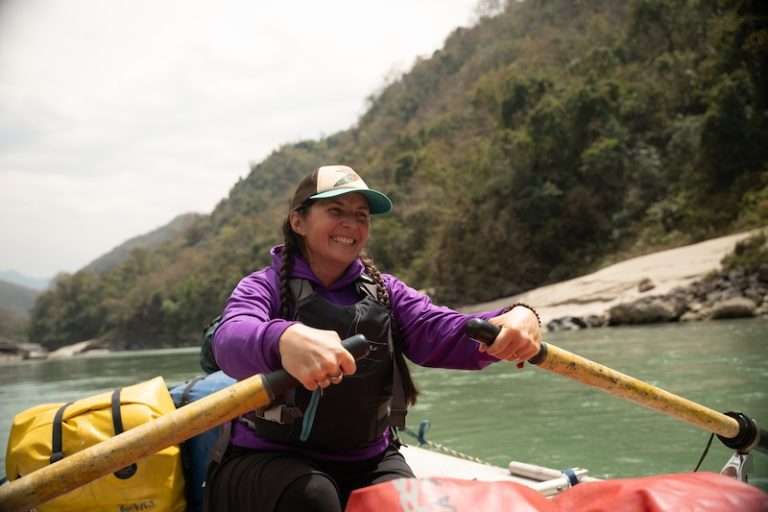
Adventurer, record-setter, and boundary breaker Darcy Gaechter is best known as the first woman to kayak the Amazon River from source to sea. The journey required her crew to paddle more than 4,000 miles across South America and took 148 days to complete.
Darcy started kayaking in 1997, and it quickly took over her life. Today, she and her partner Dawn own and operate Small World Adventures, a kayak guiding business based primarily in Ecuador. When she’s not working in Ecuador, Darcy plans her own kayaking expeditions, writes, and donates her time to the Ecuadorian Rivers Institute, American Whitewater, and Yakuchuri—an Indigenous youth kayaking and environmental leadership group in Ecuador.
Darcy holds a master’s degree in environmental history and is the author of Amazon Woman, an adventure memoir about kayaking the Amazon from source to sea, as well as The Kayaker’s Guide to Ecuador. She also works as a motivational speaker.
Welcome, Darcy. Thanks for being here.
Darcy Gaechter:
Thanks for having me, Anna. Although it makes me sound very old that I started kayaking in 1997.
Anna:
I hear you—I started in 1994. We’re getting older, but we’re still out there doing adventure stuff, and I love that. I like to start with the same first question for everyone.
When I say “discomfort zone,” what does that mean to you? How do you move through it?
Darcy:
For me, the discomfort zone is actually a positive place. The comfort zone can be too comfortable and boring, and being way outside of it can be too scary. The discomfort zone lives in that middle space.
If I’m in the right headspace, it can be a magical place—where I’m not comfortable, but not terrified either. That’s often where I find flow and perform my best. But it can go either way. If I’m not in the right mental space, it doesn’t work as well. The unknown of what might happen there is part of what draws me in.
Anna:
How do you get yourself into the right mental space?
Darcy:
That’s changed a lot over the years. When I first started kayaking, there wasn’t much room to talk about feelings or mindset. It was more like, “Who cares how you feel—just get in there and deal with it.”
As I’ve gotten older and more experienced, I’ve learned—sometimes the hard way—that mindset really matters. I’ve learned not to go into difficult rivers if my head isn’t right. It took some serious beat-downs to learn that lesson.
Now, when I get nervous, my mind starts racing. If I can’t slow it down and think clearly, I know it’s not the right day for me. I’ve gotten more comfortable saying, “You go today—I’m not feeling it.” That took a long time.
Anna:
That takes a lot of courage. Especially with all the “shoulds”—like, “I should want to run this,” or comparing yourself to others. Walking away can be really hard.
Darcy:
It is. I always tell guests in Ecuador that it takes far more courage to stand in front of a group and say, “I’m going to walk this rapid,” than to make a bad decision and run it anyway.
People often apologize for portaging, and I tell them there’s nothing to apologize for. It’s a strong decision. I do think things are shifting for the better—there’s less shaming than there used to be—but the pressure we put on ourselves is still very real.
Anna:
Absolutely. I also think women paddlers have carried extra pressure—especially in the 90s and early 2000s. It often felt like if one woman messed up, it reflected on all women.
Darcy:
Yes, that was very real. It’s easy to look back now and say that was silly, but at the time it absolutely felt true.
Anna:
And ego plays a role too. It can push us to step up, but it can also get us into trouble. It’s rarely black and white.
Darcy:
Exactly. Ego isn’t all bad—it just needs balance.
Anna:
On big expeditions, like the Amazon, how did you navigate ego and decision-making when the consequences were so high?
Darcy:
For me, expeditions have always been about moving downriver and getting the team through safely. I’ve never been attached to running every rapid. If walking one improves the odds of success for the whole mission, that’s an easy choice for me.
I’ll sometimes regret it later, lying in bed thinking, “I should go back and run that,” but in the moment, it’s usually clear. The goal is to get everyone through in one piece.
Anna:
When you train—mentally and physically—what does that look like for you now?
Darcy:
Physically, I kayak a lot. That’s my best training. Mentally, repetition is huge. When I’m consistently paddling, big features feel normal. When I take time off, they feel scary again.
Visualization has become really important for me. If I can’t visualize a clean line—if I only see myself crashing—then I know it’s time to walk. I also take time to slow my thoughts down and ask what I can and can’t control.
Anna:
It sounds like your mindset has shifted with age and experience.
Darcy:
Definitely. I used to just tell my brain to shut up and go. That worked—until it didn’t. Now I’m learning to listen to my brain and body. It’s frustrating sometimes, but I want a long kayaking life.
Anna:
That longevity piece is so important. I see people give up kayaking entirely when they stop wanting to run hard stuff, and that always surprises me.
Darcy:
I want kayaking in my life as long as possible. Even if it looks different.
Anna:
What has navigating discomfort taught you about yourself?
Darcy:
I’ve learned that I’m pretty even-keeled. That can be annoying—I don’t always celebrate big milestones—but it’s been helpful on the river. I can usually stay calm in scary situations and think clearly.
The discomfort zone is where I focus best. A little fear, a little nervousness—channeled into focus—that’s when I perform my best. That’s why I stay in this sport.
Anna:
Do you think that perspective was something you learned or something you grew up with?
Darcy:
Probably both. My parents encouraged us to try hard things and allowed us to fail. That hands-off approach taught me a lot about limits and resilience.
Anna:
How has travel and paddling abroad shaped you?
Darcy:
Travel builds mental flexibility. You can plan all you want, but things will go differently, especially in South America. It teaches you to improvise and let go of control.
It also puts your own struggles into perspective and reminds you how connected people are across cultures—especially through a shared love of rivers.
Anna:
How did kayaking—and the discomfort zone—help you write your book?
Darcy:
Writing required perseverance and vulnerability. The first drafts were very factual. Learning to put myself into the story was hard, but necessary.
Later, losing my dad to Alzheimer’s changed how I thought about sharing. Reading others’ stories helped me feel less alone, and I realized that sharing our struggles creates connection.
Anna:
That’s powerful. Thank you for sharing that.
Darcy:
It doesn’t come easily, but I try.
Anna:
Before we wrap up—what keeps you motivated as a guide and teacher?
Darcy:
What I love now is showing people Ecuador—not just the rivers, but the culture, the environmental work, the people. Seeing the country through guests’ eyes keeps it fresh and meaningful.
It feels like family down here. That’s what keeps me going.
Anna:
Thank you so much for this conversation, Darcy. I really appreciate your honesty and wisdom.
Darcy:
Thanks for having me. It was great talking with you.