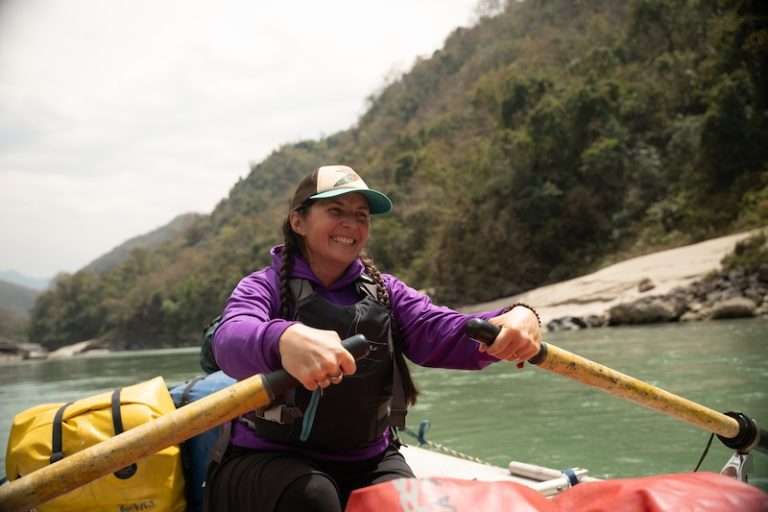
Anna
My guest today is Eleanor Knight. She’s kayaked all of the major rapids of the Grand Canyon at age 12, won a bronze medal in junior women at the 2023 World Freestyle Championships, won the junior women’s division at the 2023 Green Race, is a two-time USA freestyle team member, and placed second at the 2023 Junior Nationals. She’s now 18 and loves paddling and I’m really excited to have this conversation with her. She’s pushing the limits of paddling as a young woman and Eleanor, thank you for being here with me. I appreciate it.
Eleanor
Yeah, I really appreciate it. Thank you for having me.
Anna
Yeah, so I like to start out with when I say discomfort zone, what comes to mind for you?
Eleanor
Um, for me, discomfort is the state of kind of when you’re having fun, but then when you’re pushing yourself a little bit more to where you kind of have a little bit of anxiety and stress but it’s not like terrifying. So it’s just a little bit, um, a little bit more than having fun.
Anna
That’s awesome. I love that. When you find yourself in that discomfort zone, what’s your strategy for… I’ve heard you say, that when you’re in your discomfort zone, you want to get your head in the game, so to speak. So what does that look like to you or for you? What’s your strategy?
Eleanor
Well, usually the first thing I do is when I’m kayaking I put earplugs in because that just kind of blocks out the noises of like my fellow paddlers and also the noise of the river can be kind of loud and then I kind of just like run through each individual rapid and take things one step at a time instead of thinking about the entire river and the whole thing I have to get through, I think of each individual move and each rapid and just really take the time to visualize that.
Anna
Hmm. Yeah, that’s, that’s great. And when you say your earplugs and you mean, do you mean like earplugs like Doc’s earplugs to keep water out of your ears or your headphones like to listen to music?
Eleanor
Yeah, like water earplugs.
Anna
Yeah. Plus you’re protecting your ears, which is smart from like a young age. Cause so many paddlers that I know, cause we didn’t necessarily come up with wearing earplugs when I first started. And so a lot of folks are, you know, having, have what’s called surfers ear. So anyways, that’s great. Um, and
Eleanor
Yeah, exactly.
Anna
So what I’ve heard you also say that you really enjoy challenging yourself and putting yourself in the discomfort zone. So why is that?
Eleanor
Um, I really like to kind of, I really like the feeling of pushing myself and then either succeeding in the end and being really like, I don’t know, there’s like some sort of adrenaline rush and endorphins that you get when you do something hard and you succeed. And also, I mean I don’t enjoy failing, but failing kind of makes me, every time I fail I go back and do the rapid again or like I tell myself I’m going to do this better or I plan to make it better. So for me failing is not necessarily a bad thing, it’s just like a process of how I get better.
Anna
Mm, well said. Well said. When you so can you just describe what you what your experience of failing is? Like, what would that look like? Or maybe tell us about a time that you failed and then decided to use it as a growth opportunity.
Eleanor
Yeah, so I would say, so I went to the 2022 World Cups in Columbus and I didn’t really have any wave experience there. I could flat spin, but that was pretty much it. But I put a lot of like high expectations on myself and I was like, I really want to do well in this competition. And I didn’t. I did not do well at all. And it really sucked. But…
Pretty much like the day that I failed, I made a goal to myself. I was like, I’m getting a podium at the World Championships next year. And then just kind of like was a goal that I had for that entire year.
Anna
That’s awesome. And you did it. So congratulations. Yeah. So what was the plan you put into place? Because, and first of all, I love that it lit a fire under you. And I actually can remember a little bit different context, but when I was…
young, like I think it was, yeah, in my early twenties. And I took, I just started kayaking and I took an instructor certification course and I was paddling class, like I was padding, paddling the new and the upper galley. So I thought I was pretty good, you know, but then my instructor trainer was really pushing us to do, uh, maneuvers with precision, you know, and I couldn’t do them because I was used to like doing whatever I wanted on the river, like I could run class four rapids, but I wasn’t necessarily doing them with precision, right? Or making, you know, smooth moves. And I got certified in flat water. Like, so to me, I was like, oh, for sure I’m gonna pass, you know, white water. Like I got this, I’m a class four boater. And I got certified at flat water, which was really humbling. Same thing though is that it lit a fire under me and I started practicing all the techniques. And then I, you know, tried out for the Canadian freestyle team and made it. And really that’s how, you know, my career started in terms of competition and then later teaching. So it’s exciting for me to hear you say what you said, because one, it, I can, uh, I can relate and, and. It’s what put me on the path. And so you have so much possibility in front of you. And the fact that you achieved a goal in one year like that to go from not doing well at a competition to being on the world championships podium is awesome. So what was your process if you want to share with us? Like what did it take, like the minutiae, like the boring details of what it took for you to get there?
Eleanor
To be honest, I did not train that much. Since I live in Seattle, there’s no really access to waves very close to here. So pretty much from like that World Cup in October to March when Team Trials was, I didn’t do any freestyle. And then in March, I did Team Trials, so I was there for about a week. So that was good to like get to know the wave a little bit better.
But then I pretty much didn’t do any freestyle until July when I went to The Slave. And The Slave River is in the Northwest Territories in Canada. And I went there with Leif and Natalie. And they are very, very good freestyle paddlers. And so I got to learn a lot from them about technique. And just really like… They…
they taught me from like square one like I thought I knew how to flat spin they were like no you don’t know how to flat spin so they taught me how to just like surf the wave how to get on the wave like it was very it was very good learning experience um unfortunately it was cut short due to fires so I went home early but then I went to Skook which was amazing best wave ever
Anna
Yeah, yeah, it’s like Sookumchuck. For those listening who haven’t been there, it’s a tidal wave off the coast of British Columbia, and it’s awesome.
Eleanor
Yeah, it’s a pretty great place. So I was there and I actually invested in Bar Taj. Bartosch is a live at Lovett camp, freestyle camp. That was the first time I’d had any coaching, any like I’d never gone to Keener’s or anything like that. So that was also humbling because Bar Taj, he really, he wanted me to get better.
And so he wasn’t throwing out the like compliments that I was expecting. It was, it was very like, you know, you need to, in order to get better, you need to, um, have like constructive criticism. Um, so that was, that was a lot of fun. Um, yeah. And then after that, I went to worlds about two weeks.
Anna
Yeah, sounds like you got yourself some and you had a support network like your parents supporting you and getting some great coaching.
Eleanor
Yeah, it was the whole summer of traveling I actually funded myself, but they like, they’re very supportive. Like they the fact that they let me go to Canada with two people I’d never met is pretty cool. So I really appreciate them.
Anna
Awesome.
Yeah.
And sometimes I’ll pause and we’ll just cut the pauses out. So don’t worry about that. I’m just, I’m thinking about something.
Anna
Yeah. So when you say that Bartosz was giving you some constructive criticism, was that new for you to like receive that beyond the receiving end of that? Or do you have a lot of experience with that? And how, how do you take in feedback?
Eleanor
So my dad taught me when I was five, so he’s been my coach pretty much forever. So it was a pretty, it was a new experience because I think parents are a lot nicer when it comes to like, you know, give like.
My dad always has tips for me and I always ask him for advice and stuff, but in the freestyle realm he has a lot more to say about creek boating for me, so I’m used to that. But freestyle I was kind of just self-teaching myself and watching people. I never had really people telling me what I was doing wrong and stuff. And so it was… I was definitely like…
I was kind of shocked at first, just to hear how many things I was doing wrong. But I take feedback, or I take constructive criticism very well. I don’t take any offense to it. I don’t get mad at barterge. I just take it and I’m grateful for it and then I apply it to my kayaking. So, yeah.
Anna
Yeah, it sounds like you’re committed to being coachable in order to achieve your goals.
What has creaking? So the difference again for listeners, a lot of listeners are paddlers. Some aren’t creaking is river running. And you’ve done a lot of class five river running, which is the highest level of river running and is very technical and yeah, challenging. And then freestyle kayaking is surfing and on waves and in hydraulics and doing tricks.
What has, how do the two disciplines inform each other for you, like for your style of paddling or your mindset even?
Eleanor
What are your favorite things to do in your free time? Well, first of all, I love creek boating. That’s my favorite thing to do. I’ve also done it a lot more than freestyle, but I totally… So I… Sorry, backtracking. So during like this last year, even though I didn’t freestyle a lot, I was creek boating and that still had an effect on my freestyle kayaking, which was awesome. One of the main things I noticed was my forward stroke. So I don’t wanna like, like I feel like creek boating, you have to have a good forward stroke in order to get through holes and rapids. And in order to race well, you can have a bad forward stroke. I feel like freestyle, you don’t really need a good forward stroke cause you’re not really using a forward stroke while you’re on the wave. But it is so helpful when you’re coming out of that eddy into good wave to have a good forward stroke. So that was the first thing I noticed. Very, very important to have a good forward stroke. Also like my balance, I don’t flip that often when I’m creek boating cause I can stay upright, which is kind of necessary in freestyle. Like it’s okay to flip, but you don’t want to be flipping while you’re doing a trick, and then the trick doesn’t count. Yeah, and then… what was the third thing?
Oh yeah, like the other way around, freestyle to creek boating is just getting trashed in a hole and getting worked. I can hold out so much longer than a lot of my peers who just creek boat because I have that freestyle experience. I can just like hang out in a hole and I don’t get very scared until it gets to be bad. That’s, yeah. They definitely inform each other.
Anna
Yep. Yeah, that’s great. Thanks for sharing that. Why do you love challenging yourself and putting yourself in the discomfort zone, paddling hard rivers?
Eleanor
Um, I love the feeling of looking at a rapid, deciding if I can hit the line or not, hitting the line, and then afterwards. Afterwards, I feel like that feeling is pretty indescribable. It’s just like, I don’t know, you feel happy, you feel successful. After I do a class five run, I always feel like I had a successful day. I don’t know. It’s just, it’s just a great feeling.
There’s a lot of really cool places you can go to in class five and class four and three. But just kayaking and down.
Anna
Yeah, I agree. Running Rivers takes you to the most amazing places all over the world. Whitewater kayaking is super special in that way. What have you learned about yourself from kayaking and putting yourself in your discomfort zone over and over again?
Eleanor
I would say I’m very resilient and I am like I never give up ever which sometimes well I feel like it’s a good thing there’s just been so many times when I’ve been like stuck until dark at a river or like having no food or swam three times in a run and
I just keep getting back in my boat over and over and over again. If it’s a safe situation, if it’s not then I’ll hike out. But yeah.
Anna
Yeah. I love that resiliency. To me, you sound like a confident, self-determined, and you know, a lot of the media or I hear in the media that, and from books that I read, that young women, like it’s especially, it can be especially challenging right now for young women in with confidence like with smartphones and social media and comparing and so and it sounds like or it occurs for me like kayaking has really helped with your confidence is that would you say that’s true
eleanor
Yeah, for sure. I do have to say, I still have things that I’m not confident about and social media just… I’m actually taking like a couple week break from social media right now. Just deleted it. I’m not checking it. Because it’s… it definitely makes you feel like less good about yourself.
But kayaking is kind of this thing where if you’re running something hard, you can’t be unconfident. Like you have to be 100% confident that you will nail the line because the consequences are so high if you don’t. And because other people are relying on you in case they have a bad situation and they also don’t want to be in a situation where they’re going to have to rescue you in a- if it’s pretty bad. So you have to be… So I’ve just learned to be like, if I’m not 100% confident, if I’m not 95% confident, I will make it through this. I won’t do it.
Anna
Right. Yeah, that’s interesting to hear you say that it’s the environment, or it’s the environment, it’s your community that you’re with, and the skills that you’ve developed that kind of create this confidence, right? Or this awareness of, am I confident? I’ve got to step up. You know, this isn’t just about me, this is about…the community. So that’s, that’s really cool. And I think with social media, right, we can feel alone because we’re not really in community. We’re looking at a screen and comparing ourselves. And so it’s, yeah, important. What I hear most is that community piece too, and showing up not only for yourself, but for others and for your passion.
Eleanor
Yeah, kayaking is not a, it’s not like a one person sport. Like if you’re going with a crew, you’re responsible for them too. Like you should know, you should have the right equipment. You should have the knowledge of how to get out of that situation. It’s, yeah, that’s important.
Anna
I love to hear you say this and as a young woman, it’s very inspiring because when I was coming up, I feel like…
I maybe, well, I didn’t have as much confidence. And over the years, the decades of me teaching I’ve seen women not like being afraid to step up to like really be.
Um, I don’t know. I’ve just seen women not stepping up as much in the past. I’m not saying that this is and then not saying that it’s not changing in the past, not or feeling like they didn’t have the skill to step up on in terms of rescue and setting safety and all of that good stuff, you know, leading down hard, hard rivers. There were a few, of course, always. And I’m just, what I’m
It’s exciting to hear young women like you confident, you know your stuff, you’re prepared, you know, the equipment you need, you’re not, it sounds like you’re just ready to jump in and you would be confident jumping in with the rescuer setting safety. And I think that’s key because that is important for all team members when you’re paddling.
Eleanor
Yeah. Yeah, 100%.
Anna
Yeah.
Can you tell us about maybe a recent experience of you being in your discomfort zone and how you handled it?
Eleanor
Yeah, um, I mean it’s kind of a big one. It was a couple months ago, so it’s not like fairly recent, but it was a pretty big one. So it was kind of a whole epic actually. I was on the slave with a friend and a couple things we did wrong and other people did wrong, but anyway we ended up on the wrong channel of the river.
And so we ended up doing this rapid that two people have run ever. And one of them is annual Sarah Solis. And the other one is Leif Anderson who spends every single summer up there. Um, so we didn’t know we were doing it. We didn’t like, we, it was just blind. And so we got, um, we swam and we were underwater for about a minute. And then ended up on an island for 12 hours in the rain. So it was pretty scary, but I just remember kind of when I was on the island we just kind of like sat down and we were just very calm. We didn’t make any rash decisions. Well, he didn’t. I wanted to jump off the island and swim back, but that would have been really dumb. So we just stayed calm and just waited. Tried to stay warm.
Anna
Wow.
Yeah, so what was, I mean, being underwater for like a minute, that’s a long time. Yeah, so what was going through your mind?
eleanor
Yeah, it’s a long- Yeah, um, well, so I- so I dropped into the hole first, and I immediately- well, actually, I boofed the hole in my little playboat, and then the boil sucked me up and flipped me, um, backwards. And I don’t know why, I have no idea why, but I pulled immediately. Like, I guess there was some subconscious- thing telling me to pull, because I never pull immediately. I always hang out for like 20-30 seconds trying to work my way out of a hole, but I didn’t. And I’m really glad I did because, yeah, I probably, yeah, I probably would not have made it if I didn’t pull immediately. But I was sucked way down. And you know how you’re supposed to like go into a ball when you get recirculated? So I did that. But then…
I was just, I wasn’t popping up. I just, I just wasn’t. I was like, what’s happening? I opened my eyes, it was still black. I was like, okay. So I started to swim up and I swam and swam. And I did suck in water at one point. Luckily it just went into my stomach, but a couple droplets did go into my lungs, which was not good. But I was just kind of like, keep swimming, keep swimming, keep swimming. At one point I did think like, okay, this would be a terrible way to go, but I didn’t really think that was gonna happen. I don’t know why. I just kinda thought if I swam enough, I’d get up. I finally did. But it was close. It was definitely close.
Anna
Yeah, so what did you learn about yourself?
Eleanor
Um, well I don’t know if it’s about myself, but I learned to always scout.
Anna
Mm-mm. That’s a good one.
eleanor
Yeah, that’s a good one. And never go alone. Paddling. Don’t go paddling alone. But about my-
Anna
Mm hmm. Well, you weren’t alone. You were with your friend, right?
Eleanor
Yeah, I was with my friend, but he’d… Yeah, but like if we were separate, if some… We were separated for a bit, because he was on one side of the island and I was on the other and we had no idea where we were. It was scary. But still, like at this point, I still… Yeah.
Anna (26:56.077)
Right.
Gotcha.
Mm-hmm.
Yeah, so scout never kayak alone. Those are good.
Eleanor
Yeah.
Anna
Good things to learn.
eleanor
Yeah, and also kind of like go with people who know the run, maybe. Yeah. We thought we knew where we were going. We thought.
Anna
Yeah, I think as, or at least I can speak for myself, there’s been times as a young person where I was like, wow, I really made a really, that was a really bad decision. And thank goodness that, you know, nothing terrible happened in the moment. And then, yeah, like you’re saying, learn from it and move forward with it to hopefully make better decisions the next time. What did your, I know your dad is a long time kayaker. I used to, you know, we kayaked at the same time. I don’t, I can’t remember if he competed in freestyle or not for a while, but yeah, yeah. And, and so what did he, when he heard the story what was his response?
Eleanor
Well, apparently for like an hour, there was a lot of miscommunication, but apparently for like an hour my parents thought I was dead. Yeah, like fully. Because there was like no service and so Leif was trying to call my parents and be like, oh, we found them, but it got cut off. And it was like, oh, like there something and yeah. But afterwards, he was just, I don’t know, he was just kind of…
Anna
Oh my goodness.
Eleanor
glad that I was okay. There was no anger really.
Anna
Yeah.
Yeah, I’m sure he was. In his day, he was pushing the limits of boat, like class five boating too with Teo. So yeah, so I’m sure, you know, he, yeah, that’s, that would be an interesting conversation too to have with him. I’m just going through my mind. Yeah.
Eleanor
Mm-hmm. Yeah. Yep, that’s how you do it.
Anna
Okay, so do you have any techniques or strategies for when you get into your discomfort zone? Like, do you breathe? Do you do something else?
Eleanor
Yeah, I breathe. I try to take a couple deep breaths before a rapid or before a competition or something like that. And then I try to block out everything except what I’m doing. I don’t really… like at Worlds, when they called my name and like I didn’t really see the judges, I didn’t see my friends, I didn’t see anything.
I just like 100% focus on the wave. And another thing I do is break it down. Like I wasn’t focused on doing my first blunt while I was in the eddy. I was focused on making, getting out of the eddy and then paddling and making it onto the wave. And then doing my first flat spin. It’s like breaking it down is a good way to do it because it’s kind of like you check the boxes and it’s kind of satisfying.
Anna
Yeah. So it’s small, uh, hard moves and easy water, so to speak, or yeah, breaking it down.
I’m not seeing a whole lot of young women necessarily racing, extreme racing. Do you have any, I like. I guess theories on why that is. And is there anything you’d like to see change in the industry to support more young women? I don’t know.
Eleanor
So this is kind of where I may have a controversial opinion, some say maybe an unpopular opinion, from a lot of women. So yeah, I am one of the very few like young people doing it. And the reason is, it is a very, it’s, it’s like, I feel like it’s like the scariest thing you could do. You’re combining running class five, which in itself is scary. And in itself, you tend to break things down by like one rapid Eddie, one rapid Eddie or whatever. And then you add the fact that it’s a race. So there’s people behind you who might pass you.
There’s the fact that you don’t really, you can’t really eddy out. So you’re already like paddling hard, which is using energy, therefore you’re not breathing as well. And then also you’re terrified, so, which also lack of oxygen. And then you add the people watching, and the cheering, and the noises, and all in all to very, um.
It’s scary and it’s something that I think only people should do if they’re, if they fully want to. It’s not something to do to be peer pressured or to be like thinking that you have to do it because it’s like it could go really badly if your outside motivation is peer pressure.
And so that’s where it comes to my controversial opinion. I think that the kayaking industry should fully support young women racing, but I also, on the other hand, I feel like they shouldn’t… They shouldn’t like not… Like what I’m saying is, I feel like if the kayaking industry starts to push out things like…
young woman should come to the green race. Oh, we have a new junior women’s lot. People will feel more obligated to fill those slots and to like do it because we want the women’s class to grow and I feel like that way that means there’ll be outside pressures. So yeah, I don’t know if that made any sense.
Anna
Yeah. What I hear you saying is that, you know, people, young women, young men, anyone, it’s important to choose that you want to be doing, you know, kayaking at that high level. And that, yeah, it’s, you know,
You don’t want to, yeah, peer pressure people into doing it because they feel like they should or because they need to fill slots that are there. So I hear that. And I think at the same time, it is helpful to, for instance, at Green Race, you were the only junior woman there. And that wasn’t really talked about.
And I think that highlighting that, so you’re there, you’re choosing to be there, you’re stoked and you’ve trained, you have the experience. And so highlighting that, I think the industry organizers, media could do a better job of that. Not glorifying it, but highlighting it. Check this out. And so, because there might be other young women who see you.
And since they know, because you’re not just lumped in to women, you know what I mean? That they see you and then you can talk about that. Hey, this is my journey. This is what it takes. You know, you can do it if you want to, like if you’re motivated to do it. That’s where I see the industry. It’s like someone was saying at freestyle world championships in October that some folks want to make like space Godzilla’s score easier for junior women. And I think that’s a terrible idea because no one wants, no one wants to be given things. Why not keep it the same, but then have, you know, whether it’s, what’s the word I’m looking for? Development camps that where groups of junior women get really good coaching so that they can develop their skills. Coaching, cross-training, strength training, whatever it takes to be able to do. And I’m so glad because in the wider world of sports, we’re seeing a lot of women really break boundaries right now. And people are talking about women’s sports for women’s sports. That’s where I feel like the kayaking world is somewhat a bit behind the ball in just in highlighting the women and the young women that are out there doing extraordinary things.
eleanor
Yeah, for sure. I totally agree. And it’s been really cool to see, like especially there’s, I know a couple, a lot of women in the gorge doing some pretty cool stuff right now waterfalls and stuff and it’s cool to kind of like see the pictures on social media and stuff
Anna
Yeah, because when you can see yourself or people who look like you, then you’re like, Oh, cool. You know, look at them doing that. That’s, I could do that too. Yeah. Um, okay. I have one more question coming, going back to your really scary story. Uh, so when you, because you said you were really lucky to have made it. You talked about having a few drips of water in your lungs and, um, feeling like it was really close.
Eleanor
Yeah. Yeah, exactly.
Anna
So what, what like have you learned or has anything changed since then? I know you said like you have different strategies like scouting and all that. What I’m talking about is from a mindset perspective of being so close to death, like, wow. And because I think a lot of us as paddlers have had experiences not just like that, but like I’ve been stuck under undercut rock, like, you know, had to get out. So, you know, when you are,
Like there’s something that goes on when you’re like, dang, that was close. And for some folks, they give up kayaking because it’s, and I don’t blame them at all because it is super scary. Right? So for you, what makes you want to keep doing it when you had such a scary experience?
Eleanor
Well, it actually took me a couple days after that. So I did go paddling like later that morning when I got, you know, slapped a little bit and I went back. And it was really weird. I was terrified of water even touching my face. Like, I didn’t want to go. I was going class two. I was going class two. I wasn’t rolling.
nothing could touch me but then I after a couple days I was pretty much back to you know going in holes for fun and stuff but I think that the biggest thing that’s changed now and it doesn’t even have to do with like it doesn’t even have to do with the slave really at all which is which is the interesting part but I don’t do things at all unless I want to.
Um, before that instance, I feel like there was a couple times where I would do these hard rapids and consequential rapids because my friends were doing them or because someone was like, oh, like, no, like, you don’t like, I don’t know, you’re scared or whatever. And they would say things that I’d be like, I can do that. I’ll just show them up. I can do it. Um, but now I don’t do things unless I want to. So that’s the biggest thing.
Anna
Yeah. Thanks for sharing. What piece of advice would you have for folks listening on how to manage, not manage, how to navigate their discomfort zone?
Eleanor
Take it one little step at a time. You don’t have to go from running class two to running class five in a day. Start out by, if you’re on a class two run, maybe hitting the booth that’s a little bit bigger than you like, but that’s it. That’s all you do for that run, just one little thing. And then maybe the next time you hit the booth, but it’s kind of a whole this time, because it’s higher water. And then just like, keep adding on your smaller runs. And by the time you can hit like the hardest line on your local class two run, you know that you can move up to class three and be fine on it. Just keep progressing from there, just little steps.
Anna
Yeah, that’s great. Do you have any questions for me?
Eleanor
Well, I guess you made me curious about the rock you were under. What? Oh, there.
Anna
Mm. So we were paddling in West Virginia on a creek called Mill Creek, which is mainly a class four creek, uh, up to, and then it has like a 25 foot waterfall and then down below it goes into some like harder, like I think class four plus, I can’t remember five ish rapids. We were on the class four section and I believe it was after the waterfall.
and there had been like some floods. So there wasn’t too much that was changed. We were following our friend who lives there and who knows the run, but he hadn’t paddled it since before the water got higher. So we were like, you know, Blue Angel, and there was just a little rock that had moved and it sent all of us like one at a time kind of into this overhanging rock.
And I was far enough that I didn’t really see, like I saw my friend and he ducked on, like he went flat on his stern and like, you know, shoved himself under. And I did the classic, talk about like bad decisions, did the classic kind of like lean away as I was like getting shoved under. So I got chocked in there underwater and my paddle got actually stuck against the rock, like it was chocked also on the outside of the rock, like in between rocks on the river bed and the top of the rock. And so I was under there and I was stable and I didn’t know the run. So I didn’t know if this was like an undercut or whether it was just an overhang. And, but I couldn’t breathe. So there you are, you know, when you’re underwater in your boat and it’s stable, it’s like, okay, I can either stay here and drown or I’m going to, like in my mind at the time I was like, I’ve got to get out of here. I was very calm, not panicked, but so, you know, everything slows down and I pulled my skirt, I had my knees out, I was ready to jump out and I pulled on my cockpit and like, you know, kind of pushed off.
And my head came out of the water and I took a breath and then I got sucked under. And luckily it was more of an under, even though I got sucked under and then released and had to swim the next rapid, which wasn’t fun. But yeah, I was on a like adrenaline, you know, for the rest of the day and the rest of the night, like, oh my gosh. And yeah, I…
eleanor
Oh my. Yeah.
Anna
decided I needed to get back out, not onto that creek, but get back out on the river and keep paddling. And that really helped me. And it was helpful, again, community friends talked it through, talked it through with Andrew, my husband, he was my boyfriend at the time, who I think, I can’t remember if he was on the river, but anyway, you know, talked it through, which was really important to have.
At that time I was very grateful it was a supportive group because I have paddled in my very early years of paddling really hard class five in the nineties. It was not that supportive. So, so yeah, so that’s that story.
eleanor
Hmm. Huh. Yeah, that sounds like a terrifying experience.
Anna
Yeah, it happens in kayaking. And it’s funny because I’m thinking like as we, as you and I are talking of like, Oh, we’re really selling kayaking right now. But I think it’s important because, so it is part of it. And I would say I’m a pretty conservative boater because I’ve always had higher anxiety, I feel like I’ve had, I have higher anxiety than a lot of folks who paddle hard stuff and now in my career, I don’t like I’m definitely a class four boater, like stoked to be class four and enjoy playboating and run the green without the big three. And I have fun out there, right? And even though I get nervous, I feel like pushing myself and putting myself in my discomfort zone is really important for my growth. I don’t wanna get stagnant. And there’s also part of my ego that shows up because, and this is where I think, my ego can actually be a helper. You don’t wanna do things based on ego because that can lead to really bad decisions. At the same time, I want to be someone who paddles class four. Like that’s important to me. Like I’ve developed really good skill over many years and I know I can still do it. And so that idea of myself keeps me in the game.
Maybe not at the top of like, of when I was at the top paddling class five, but still at a level where, yeah, I’m pushing myself. So I think that even though folks listening might be like, why the heck would I kayak after listening to the two of you? I think you don’t have to run the harder stuff. You can have everyone’s level of challenge is different. So some folks feel really challenged on class two, which is awesome. And on class three, and you can have so much fun. And yeah, that’s what I’ll say about that. Sometimes kayaking is interesting because
eleanor
No.
Anna
It is scary and consequential, like you said, and it’s also so much fun.
eleanor
Yeah. Yep.
Anna
Yeah. And playboating is high fun, low consequence, which I like too. So there’s something for everyone.
eleanor
Yes. Yep, playboating is like, kind of, it’s kind of nice to start playboating, to like learn how to kayak, but not be scared.
Anna
Yeah, exactly. And we’ve already said the community is a big draw as well. There’s just really cool people who paddle.
eleanor
For sure.
Anna
Okay, I have some rapid fire questions for you. Okay, what’s a morning ritual that sets you up for success?
eleanor
Okay.
eleanor
Um, I wake up.
Get my clothes on, go run a mile.
Anna
Awesome. What’s a non-negotiable self-care practice?
eleanor (48:28.574)
I take a shower every night.
Anna
What’s your favorite motivational book or talk?
eleanor
Ooh, I loved, I don’t know if it’s called Atomic Habits. I read that, that’s a really good one. I also like the subtle art of not giving a, yeah, that’s a really good one too.
Anna
Oh, yeah. Yes, that’s a great book.
Anna
What do people get wrong about you?
eleanor
Um… Oh gosh… What if you… Oh, uh… I guess some people would think that I’m an introvert when I’m… If you get to know me more, I’m very much an extrovert.
Anna
Throughout the course of your life, have you been considered the favored to win or the underdog?
eleanor
Underdog. For sure.
Anna
Okay.
hard moves in easy water or flooding.
eleanor
Flooding.
Anna
Okay, I figured you’d say that. But you have also talked about hard moves and easy water. So I think there’s the two combined, you know what I mean? Yeah.
eleanor
I love floods.
eleanor
Yeah, yeah, but floodgates are just something else.
Anna
Yeah. Okay, what’s one word that describes your comfort zone?
eleanor
Um…
That describes my comfort zone.
Anna
Yeah, what’s comfortable for you?
eleanor
The Skycomish River.
Anna
Awesome. Freedom through discipline, or I do what I want.
eleanor
I do what I want.
Anna
In one word, what do you hope your legacy will be?
eleanor
Gosh, wait. Can you, I’m gonna think about it and then can you ask me again so it’s more of just like, like fast, okay.
Anna
Yeah.
eleanor
One word? Oh gosh. Like, what are some example words?
Anna
Well, some people have said kind, some people have said positivity, some people have said, uh, okay, what is it?
eleanor
Oh, I have one. I have one. Inspiring. Oh, I have one.
Anna
Oh, I love it. Okay. Eleanor, is there anything else you’d like to say to our listeners?
eleanor
Um, I’d say if you are a kayaker, it’s normal to deal with fear. It’s just, you just have to find ways to manage fear. And it’s also okay not to be the best. It’s perfectly fine to have fun, to just kayak to have fun. And it’s also perfectly fine to kayak to improve and to challenge yourself and to put yourself in a discomfort zone both are great ways to kayak. So just keep kayaking.
Anna
I love it. Where can people connect with you? I know you said you’re taking a social media break, which sounds very healthy. Where can people connect with you?
eleanor
Probably Instagram. I mean, I’ll be back eventually but Instagram is the main way. Yeah.
Anna
Okay, I’ll put your Instagram handle in the show notes. For folks, thanks so much for taking the time to do this, to sit down with me and have a conversation. I appreciate you and I’m stoked to see where you take your kayaking.
eleanor
Cool.
Thank you so much. It was great. Great conversation.