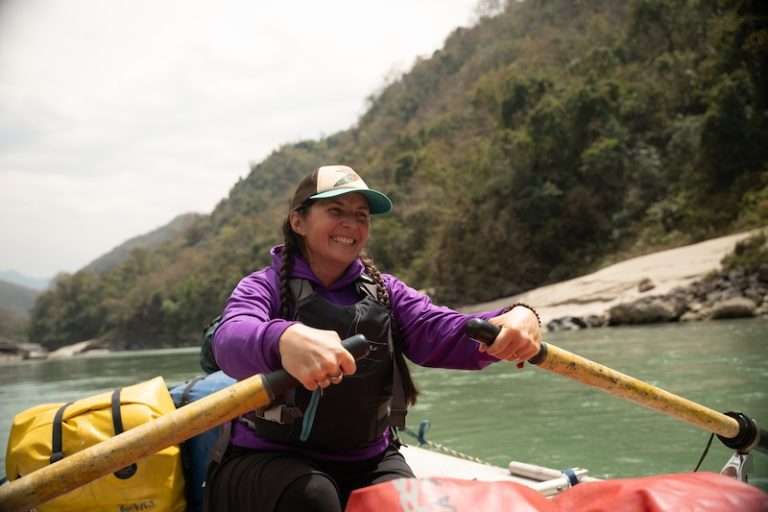
Anna
My guest today, Adam Herzog, is a lifelong whitewater kayaker, outdoor enthusiast, and family man who has paddled extensively in the US and Canada. He has raced the Green Narrows 15 times and consistently posted times under five minutes. He won the Jerry’s Battle Green Duathlon seven times. He ran ultra marathons for 10 years and retired from running when he completed the 100 mile, let me say that one more time.
He ran ultra marathons for 10 years and retired from running when he completed the 100 mile cloud splitter race. His proudest paddling accomplishments include running the Stikine at age 43, racing the green 11 months after a catastrophic and life -changing climbing accident, and getting his kids stoked on the outdoors. Adam retired from healthcare after 22 years in EMS and emergency and trauma nursing.
He now teaches whitewater kayaking and wilderness medicine for the Nolichucky Outdoor Learning Institute. I’m excited to have you here, Adam. Thanks for taking the time to be
Adam Herzog
Thank for having me. It’s an honor.
Anna
So I typically ask what my first question to guess is typically, what does your discomfort zone look like, feel like, or when I say discomfort zone, what comes up for you? With you, just want to, because in the bio we talked about, we mentioned your catastrophic climbing accident. And I think it would
And that was a huge discomfort zone, I think, and from having conversations with you on the side of the river since then. Would you mind telling us about what happened and then we’ll get into the discomfort zone?
Adam Herzog
Yeah, of course, the accident really redefined discomfort for me. In fact, I realized after the accident that I hadn’t ever experienced discomfort, at least not to that magnitude. So I was going to talk about it anyway. But in December of 2022, I was climbing at a gym and neglected to clip into an auto boy without realizing it climbed up to the top of the wall, it’s a 50 foot wall, and I just simply let go, not ever realizing that I wasn’t tied in. So that resulted in major multi -systems trauma. I had a skull fracture. I broke my back in several places. I had bruises in both lungs. I had a broken left wrist, broken right elbow and broken left leg and I shattered my right ankle. I’m trying to think if I missed anything. I think that pretty much covers it, but it was about 15 bones in total. I was very fortunate that I didn’t sever my spinal cord. So I didn’t have a paralysis and I was obviously very lucky that I didn’t die. I did have a pretty significant brain injury, but no blood in my brain, but just a really severe concussion.
Anna
Yeah, thanks for sharing that. That was, it was a shock to everyone. And yeah, I know. Yeah. And before the accident, you were one of the most hardcore people I know, I knew. And since the accident, you, the way you’ve come back is incredible, incredibly inspiring.
And I’m sure we’ll talk about it, but yeah, it was inspiring for me. And as Andrew, my husband says, when I told him that you were going to be on the podcast, he said, you’re about to have a conversation with someone who’s truly hardcore. Because I often joke with him about, poke him about being like one of the most hardcore people I know. And I don’t mean to, when I say hardcore, I’m
That’s not a negative thing. just thinking, you know, I think of myself more as a meandering person versus like so driven. Obviously I’m very driven in a lot of things that I do. but folks like you, folks like Andrew, who just go above and beyond are really, yeah, really fascinating and really interesting to me. And the way you’ve come back to, like you said in your bio, racing the green after such a traumatic accident was amazing. yeah, so what does, when I say discomfort zone, what comes up for you?
Adam Herzog
Well, thank you.
Well, the first thing is waking up in a hospital bed. My initial, I don’t remember the accident, but my first memory was waking up on a ventilator with a tube jammed down my throat and a machine forcing air into my lungs, tied to the bed, essentially naked. I, because I worked in healthcare, in fact, I worked for the trauma department that I was admitted to. I didn’t know what had happened, but I knew I was on a ventilator and I was intubated. And so that was, it was uncomfortable physically in terms of pain. had just pain globally everywhere from all these broken bones. And I think just taking a massive hit to like you have general inflammation when you take a big hit like that. And then the discomfort of the endotracheal tube was intense, but mostly it was just fear and not knowing what had happened and what had landed me there. The next thing I remember after that, they, you know, I went out again. I think they probably cranked up the sedation because I was flipping out trying to pull all my lines out. So the next thing I remember was waking up and this is a couple of days later, I was off the ventilator. I’m still restrained, you know, still tied to the bed and I was essentially naked. mean, I was, had a sheet over me and that was it. All kinds of tubes coming out of me and unbelievable pain. And I look around the room and I’m surrounded by my coworkers, you know, and because they were actually the people that I worked with were taking care of me now. So it was, it was uncomfortable again, physically from the pain perspective, but also really horrifying in terms of like, you know, that’s kind of, it’s a nightmare, you know, to wake up naked, tied to a bed, surrounded by your coworkers is a nightmare. And I think it’s especially a nightmare for healthcare workers because we see it every day. So we have had that experience of providing care. makes you really acutely aware of what it would be like to be on the other side.
Anna
Yeah, it sounds like what came to mind is like a Marvel movie, like, you know, the superhero movies where, you know, the superhero like wakes up, has no idea what’s happening and like, yeah.
Adam Herzog
Yeah, exactly. It was very surreal. There were some kind of consistent physical, again, physical symptoms of discomfort, the pain, but also really intense thirst was actually the thirst was so intense that it distracted me from the pain. Initially, like the first thing I just needed water, know, was like begging for water.
And then obviously the pain, but also the immobility. being, you know, a restrained to the bed and then also having splints on all four extremities, you really can’t move. can’t do anything for yourself. And with that comes a loss of autonomy that is severe and really striking. It’s like all of a sudden you, you you go from being a, know, fully functional human being all the decision -making capabilities that we have in everyday life to suddenly you can’t decide when it’s time to have a drink of water, when it’s time to use the bathroom, eat food, and even if you can decide to, you can’t actually physically do those things for yourself, so you’re really reliant on your care providers. So it’s really, I guess in a word, dehumanizing.
Anna
Yeah, that’s a big word. Yeah. So what did you do in the face of all of that, of that discomfort, that dehumi the feeling of being dehumanized?
Adam Herzog
It is, yeah.
Yeah, well, it was kind of interesting. As a teacher within the medical field, I taught paramedic students and nurses for a long time. dehuman, or humanism in medicine is a very consistent theme that you hear about it on podcasts like this that are healthcare based. There’s books about humanism in medicine, all kinds of.
information out there, you know, basically saying that humanism and medicine is good and dehumanization is clearly bad, but it was really interesting. I found that I had to dehumanize myself in order to
team to take care of me in large part because I knew everybody who was taking care of me. So it would have been just too awkward to continue to see myself as Adam the nurse, Adam the paramedic teacher, Adam the, you know, the kayaker. I really just had to see myself as a patient and that was it. And so I actually, to some degree, lost touch with my own humanity because I needed to allow the team to provide me with all the functions of life that you need in order to survive. So it was actually, there was like a specific moment where I was having really severe urinary retention. And so I needed a catheter to be placed and I was begging for a catheter to be placed. The person who happened to be at the bedside was a close friend and coworker. And he asked me if I wanted to get someone else to do it because it’s obviously a very private, intimate thing to go through. And I said, you know, no, man, I just need someone to do it. I don’t care who. And from that moment on, was, there was no…
modesty is a luxury that you just don’t have when you’re in a situation like that. So really redefined discomfort.
Anna
Yeah. What I hear is…a reframing of your identity and maybe a surrendering to what was reality. Like versus, you said you had to dehumanize yourself. And that’s interesting because what I hear is that it was a reframe of your identity. So you let go of your identity, not your humanity. I think it’s human. It’s very vulnerable surrender like that and be like, this is happening. I’m fully vulnerable and exposed and I’m trusting these folks to take care of me because I have no other choice. I don’t know if that resonates or not, but I really do hear. Yeah.
Adam Herzog
Yeah, absolutely. Yeah, yeah, it was, it was you know, a change in identity. It was temporary, you know, it got better and improved. And, you know, I got back to be myself again. But there were some, especially in the early days, you know, in the ICU and the first days on the floor that, yeah, I just, couldn’t afford to, it was basically kind of reduced to a much more primal state.
Anna
Hmm. Yeah, what did you learn about yourself through this, through walking through this very intense discomfort zone?
Adam Herzog
Yeah, I learned that I can overcome adversity is what I learned. I thought that I probably could, but honestly, I’ve had a very privileged life. And in the first world, don’t, many of us, not all of us for sure, but a lot of us don’t have to suffer a whole lot. So the suffering that I had,
impose upon myself recreationally what we call it, know, type two fun, which would be fun that isn’t really fun in the moment. But later when you look back on it, you’re like, yeah, that was, that was fun. Or maybe that was just a cool experience, but something like riding a marathon or whatever. I had put myself through those trials, you know, purposefully, but they were contrived. Like they were not, things that I had to do. weren’t situations that I was forced into. And I suspect that there’s not a whole lot of people doing like ultra marathons in third world countries because they suffer enough in their daily living just to survive. So to answer your question, what I learned is that I can’t overcome adversity when I have to. And I think that doing some of those things actually prepared me really
Anna
Yeah, that was going to be my next question is how do you feel like those, the type two fun, the contrived or chosen, we’ll call it chosen discomfort, chosen challenges help to prepare you for this unchosen one.
Adam Herzog
Sure, yeah.
Yeah, mean, well, the big there are many, you know, layers of irony in the in the situation from being a nurse that’s now a patient was one. But also I had just recently returned from the biggest guy can trip of my life to the Stikine River, which, you know, for those of us who aren’t familiar with this, kind of like people call it the Mount Everest of kayaking. It’s way up in northern British Columbia. It’s a 60 mile long, know, class five big water canyon. It’s really notorious.
And it had been a lifelong dream and I spent, you know, five plus years training for it really purposefully. The trip went off without a hitch. We really didn’t have any trouble. I mean, it was challenging for sure, but it was, I was very well prepared for it. And in hindsight, you know, I wasn’t really training for the Stikino. I was training for this fall.
But the kind of things I have been doing to prepare for this, the Stikine, actually was a lot of discomfort zone stuff, like, you know because when you’re on a river like the Stikine, you know that you’re gonna probably have to paddle some rapids that if you had an easier option to portage, you’d probably take. It’s very committing with super sheer walls. And so I would, if I was leading up to the trip, if I was paddling a river and maybe the water was high or was feeling a little uncomfortable with running a particular rapid. In most cases, in the years leading up to that trip, I would go ahead and do it because I wanted to simulate discomfort, the kind of discomfort I thought I might be feeling on the Sticking. So there was that kind psychological challenge. And then I was also doing a ton of physical stuff, weightlifting really hard workouts like high intensity workouts. I put dumbbells in my boat in the back of my boat and carry it up and down the hill in front of our house in the suburbs. I’m sure my neighbors all thought I was out of my mind. But anytime that I thought, you know, I don’t really feel like doing this today. I don’t feel like doing a hard workout pretty much always make myself do it, just to put myself in that discomfort because I figured it would be that way at the Stikine.
Anna
How long did you say you prepared for it? Like five years.
Adam Herzog
It was like a five year project. know, that river is tough to actually, you know, planned it a couple different seasons with Andrea, your husband, to go up there with him. And it just didn’t work out for, you know, it was COVID or there were fires or water levels weren’t right or family logistics were coming up. I kind of around the time I turned it was like in my late thirties, I was starting to get more serious about it. And then, you late 30s, early 40s, I was really trying to put the trips together each fall when the season happens and doing the work, the training. But it was, yeah, I would say five years of pretty purposeful training.
Anna
How do you stay motivated for training over the long haul like that, like five years for a goal?
Adam Herzog
Yeah, that’s a good question. Periodization, think, is the key and that’s a term that comes from fitness literature.
So I would have a few goals for the year, the Stikine, some of those years, the Stikine was a pretty concrete goal. Some years I knew it was going to be pretty, pretty lofty and out of reach logistically, but I would go ahead and have, try to have time set aside on the calendar. And then throughout the year I’d have a few other goals. So maybe Green Race would be one, Jerry’s Battle or something similar, or just like a big recreational goal, like a big.
Adam Herzog
And so I typically have like three or four of those a year. And so I would have three month blocks of periodization where you essentially have a lot of variability in the training to keep it interesting and keep yourself, keep you from wearing your body out by doing the same things over and over over and over again. And then like a typical block would be, you know, the first month you’d have
Week one would be like an easy week. Week two might be a high intensity week. Week three would be a rest week where you don’t do much at all. And then week four would be the, I think medium or low intensity, whatever is left. And you do that. The second month, you increase the intensity of each one of those weeks. And then the third month, the same thing. So after 12 weeks, you’re super fit and then you have…
some kind of goal like if it was for green race, you the last week or two before the race to kind of rest and taper and take it easy. I found that to be a really effective training tool to prevent burnout. And I also do other sports too, primarily biking and running. So, yeah.
Anna
Yeah, what I think is really important about what you’re saying, and I like to coach my clients on this as well, is because folks will say, really want to go on your Costa Rica trip or go on Creek Week, and I’ll do that when XYZ, like when I’m in better shape, when I have my role or something. And I always coach them, no, book into the trip whatever trip you want or whatever challenge, commit to it, register for the race, book into the trip, and then use that as motivation to reach the goal because otherwise there’s no accountability. And otherwise it’s like a random goal that may or may not happen sometime in the future.
Adam Herzog
Yeah, exactly. Right.
Yeah, I think it depends on the person, I do well with structure. I think a lot of people do. And having someone to be accountable to who’s a third party. I have been working with a personal trainer for the last five or six years. And it’s great because I feel like I really want to perform my best when I’m working with them. And it kind of keeps me on my toes.
Anna
Yeah. Yeah. And folks come to work with you for Kaia Construction as they work with me. And yeah. And I want to talk a little bit about that because I’ve had several conversations at the river seeing you when you’re teaching or, and I’m teaching and the identity shift that you coming back to identity coming back to identity shifts. Because I know that we’ve had some conversations where it’s new for you. Like we were talking about, I think it was Big Laurel and you were saying how, before, know, the Big Laurel is a local river to us. It’s a really fun class three and the higher it is, some folks think the higher it is, the more fun it is, of course, than the more challenging it is. I think you said,
Yeah, I never thought of it as that difficult until I was teaching out there. then the river takes on, it has a whole new vibe. And as instructors, I think that is important, right? Like paddling something for yourself versus when you’re out there creating a container for someone. And the other conversation we had was when you
testing out the upper green for teaching. Upper green is above the narrows. It’s a really fun, I love it for teaching. There’s about a 15, 20 minute hike out, maybe longer depending on how fit you are with your kayak. And so I always say that it would be as popular as the Nantahala if it didn’t have that hike out. But you were talking about how you had never run just the upper. Sometimes we run the upper into the narrows. It’s a nice and you had never done that and you were testing it out. Can you just talk a little bit because your identity has shifted? I do want to get to where you talk about how you came back to racing the green after being in the hospital bed, completely restrained and all that. First, we just jump into your identity as an instructor, how that’s different and what you’ve learned maybe on this journey?
Adam Herzog
Yeah, absolutely. A little background there. After I got back from the Stikine, which was in the fall of 2022, there was a pretty significant kind of letdown. It was like the post successful trip, but kind of a post trip blues a little bit.
because after you, especially a five year goal, that leaves a pretty significant hole. And I know that I’m well into middle age and I’m probably not gonna do anything that hard again. And I was thinking, how can I keep kayaking new and fresh and interesting and stimulating
And one thing that came to mind was to start doing some teaching. I had been, as I mentioned, had been teaching paramedic students for about five years in the hospital setting. So it wasn’t really didactic lectures. It was clinical skills. And I thought that would be pretty, pretty similar kind of experience to teaching kayaking. And so I started talking to my friend Scott, who owns the Noloshoke Outdoor Learning Institute about
maybe doing some teaching the following year, which would have been 2023. And so we had kind of hatched a plan for me to take an ACA class and slowly over a period of maybe five years or so kind of transition from the nursing and paramedic world to working, know, kind of sequentially more and more for NOLI.
And then I fell and Scott was one of the first people who came to visit me in the hospital. you would not have thought that I would be teaching kayaking within that calendar year. mean, it just seemed impossible. So we shelved everything. And then I had this really rapid recovery that I’m sure we can talk about more. I ended up taking the ACA class in the spring and…
I continued, I stayed on at the hospital. I did actually do another semester with my paramedic students, but it became clear that due to the ankle, I was not gonna, that type of work was not gonna be sustainable for me. I can walk and now I’m walking pretty well,
The nursing job I had especially was we we covered the whole hospital so we didn’t have a traditional nursing role where you sit in one place and the patients come to you. We had patients all over the hospital. So I’d have to cover, you know, we’d have pedometers on sometimes it would be like five to 10 miles and a shift. There was just no way I could do five to 10 miles on hard linoleum floors and have to hustle to get places and things. So.
I stayed on at the hospital doing some light duty work for all of last year and started doing more and more teaching as my recovery progressed and I was able to, you know, gain more proficient mobility. And at the end, I wanted to wait a full year to make any big life changing decisions. So I gave it a full year and a year to the day after my accident, I taught my last class at the hospital and
and I’ve been working for NOLI since then.
Anna
What has teaching taught you so far about yourself? Becoming like a kayak instructor.
Adam Herzog
Yeah, I mean, well, I think first, know, just taking the ACA class with Scott, I learned a ton about my own kayaking, which was really, it was kind of shocking actually, some of the, some of the improvements that could be made in my own paddling. It was cool. Like when you put yourself under a microscope, we were doing a lot was like, wow. So there was kind of a couple components to it. One was there was a lot of stuff I was doing correctly that I could not articulate. Like I couldn’t explain how I did this certain maneuver or whatever. And then there was some stuff that I was definitely doing incorrectly that I was able to correct. But spend the time with the students. You learn a lot about your own paddling and it’s really interesting to.
I’m into my second season now and I’m starting to feel a lot more confident and comfortable in the role. There’s always a learning curve with the teaching as well. But I’m learning how to pretty quickly identify little gaps in technique that it’s super rewarding to be able to say, you just need to turn your head this way make this small adjustment to see it click and work in real time is really, really cool.
Anna
Yeah. Yeah, that is really cool. It’s funny because I’m an instructor trainer for the ACA or an ACA instructor trainer. And I have had really great boaters. Actually, Andrew was in one of my ACA courses when he worked at French Broad River Academy. And it is always fascinating. It’s funny because a lot of times most skilled kayakers are the ones who are the most open to coaching, which I really appreciate. And there’s always something we can improve upon, right? Because we’re human. Even the best kayakers can learn things and sometimes they’re surprised by how much they learn. And then some folks, like my friend Dave, he was really grumpy at me because he was in one of my courses and he, you
He didn’t appreciate, well, it’s not that he didn’t appreciate it. He just got grumpy because I was being so core about his core engagement. And then later he thanked me because he’s like, I know I did so well at the green race that year because I took that course with you. So there’s some resistance at first and then they get through it. And then you have the folks who are like, well, I paddled the Akohi, so I should just be an instructor because I’m good. So it’s really interesting navigating
Adam Herzog
Yeah,
Sure.
Anna
And then the other thing that I love that you said this, because it’s so true. One of my clients just last week said to me, you know, wow, I didn’t, you know, we really worked on some, what she called little stuff, but it makes a huge difference. Also that realization for folks that you don’t have to have your mind blown by some new skill that you learn, but it is like you said, like look, just having folks look a certain direction or engage their edge a little more or plant their paddle at a certain angle makes a huge difference. these are the refinements that can make small refinements make big differences in effortlessness. Yeah. Yeah. So I do want to hear what motivated you. you did, you came back from, like you said in your words,
Adam Herzog
Absolutely.
Anna
you know, being on a table with tons of tubes and you really feeling like you needed to surrender and let people help you, you know, with brain injury and tons of broken bones. And then you are back paddling class five, you race the green, you’re teaching kayaking, you’re hiking out of the upper green with your boat. And I have clients who, you
And even myself, sometimes I get grumpy when I’m hiking out of the upper green, but you’re doing it with like hiking poles with like an ankle that, you know, doesn’t support weight that well and your boat on top. So yeah, what, like you really are a superhero. mean, is he like, you are like a Marvel character in the kayaking world to like, come back from that. So tell us, like, tell us about that journey.
Adam Herzog
Well, thank you.
Yeah, first of all, I don’t think of myself as a superhero. think I’ve just done, I think first of all, I had a lot of resources, I had a ton of help. Did not happen in a vacuum, but I think that my recovery is achievable by anyone with the same resources that they’re disposable.
Anna
I know.
Adam Herzog
So it really started right from the very beginning when I was getting shipped out of the ICU to the regular like orthopedic floor. My doctor, said, you know, doc, what’s the plan? And he said, well, you’re going to go to a nursing home for three months. And then after that, you’re going to sit in a rehab hospital and get rehab for three months. The reason being because
Physical therapy, physical therapist typically can’t work with someone with four broken extremities. We have four non weight bearing extremities. There’s just not a whole lot they can do. So the typical course of treatment or plan of care would be to go to a nursing home and sit in a bed and let the bones heal.
And then after that, you can go to a rehab hospital and we can actually start therapy. And when he told me that that is like the worst possible prognosis short of being paralyzed that I could have heard, it was so devastating to hear, to think about.
I mean, it’s one thing to be in hospital, but a nursing home is, you know, that’s where old people go. And so I think about being in a nursing home bed for three months just to get to the point where I start rehab was like unfathomable. And that lit a fire under me. So when I went that day, when I went down to the orthopedic floor, I said, you know, I’m just going to try to do, I said to myself that I’m just going to try to do any motion, any movement, any kind of mobility that I can in order to try to get things started. And so that day I said, I’m gonna do 10 leg lifts every hour that I’m awake. And I had an external fixator on my right leg, which is like big external skeleton. goes, it’s like rods going into your leg. And then I had splints on the rest of my extremities, but I would lift.
When I say a leg lift, mean like it was probably coming off the bed an inch, you know. And so I did that with each leg 10 times an hour for, I was probably awake for, you know, 15 hours. And 150 leg lifts doesn’t sound like a lot, but after having that kind of insult, it’s a lot.
And that night my quads cramped up and like seized onto my femurs. And, know, I was kind of a mess after that. definitely pushed a little too hard that day, but it really set the tone for me mentally that this like, I’m to do anything I can to avoid the nursing home. And that was just kind of the mentality I maintained. So I had to, you know, fight through a whole lot of pain and discomfort, but anytime.
I guess the progression kind of went from that, from just like any little body motion I could do to being assisted out of bed. And when they would get me out of bed, it was with a sling. And the sling really folded me in half like a taco right over my lower back where I had four or five fractures. And so the pain was just…
It was, hard to describe how intense that pain was. I would have to like spend the whole morning kind of mentally bracing myself for this, this move from the bed to the recliner. But I would do it. And one day in particular, I remember telling the staff, said, you know, get ready because you’re getting ready to watch grown men cry. And when they got when I was lifted up out of the bed in the sling, hurt like half as much. It was significantly better. It still hurt, but it was was bearable. And that was another one of those moments that was like, all right, this is progress. This is like, I’m hurting a little bit less and it’s like, I can kind of deal with it.
So there were a lot of those kind of moments kind of throughout. Like the first time I stood up out of bed, I had three to four people helping me and I was able to stand for less than five seconds before I kind of fell back into the bed. But five seconds the next day was 10 or 15 seconds and that turned into a minute and then, you know, five minutes and it just progressed like that, progressed like that.
I continued that kind of philosophy of just incremental, know, stepwise approach and I would push as hard as I could and sometimes I overdid it.
And continued even when I got home, would stand on one leg for the first day I could stand on one leg for one minute and then the next day two minutes and then five and then you know by the time I got cleared to use both my legs I was standing up on one leg for like two hours a day. Yeah, that’s how I kind of approached it. Little steps, but.
Anna
Yeah, you know what’s really fascinating to me is that really high performers and what you’re talking, yeah, really high performers are okay with incremental shifts or like you were okay with incremental shifts and let go or I don’t even know if you ever had an all or nothing attitude. Maybe you did in the past, but it sounds like that’s something if you did, you really had to let go of. Again, lot of in our culture, folks will say, well, I mean, I’ve had people say to me, well, if you’re not going to go for two hours, it’s not even worth getting on your bike. And I’m like, really? Because I can have a lot of fun and get something done in 45 minutes if that’s what I have. And that can be, I have found in my own experience that that attitude can be pervasive in the outdoor industry. Like it’s not cool unless you do like the longest, the best. And actually someone who’s, you know, who is as accomplished as you are and who has taken on the challenge, the level of challenge that you have in your life,
Big thanks. Yeah.
Anna
It’s almost surprising that you’re so willing that you don’t have that all or nothing attitude. And it’s a real testament to like the hard moves in easy water philosophy and where it can get
Adam Herzog
Yeah, yeah, yeah. Yeah, absolutely.
Anna
Yeah. Have you read the book Atomic Habits? Yeah, that’s a book. In that book, it’s like the bestselling nonfiction book of all time, I think. And in that book, he talks about the importance of 1 % improvement. If you can be 1 % better than the day before, then you’re on your way.
Adam Herzog
I’m not.
Really?
Yeah, interesting. Yeah.
Yeah, there were a lot of little things. Another really striking moment was
There was one day when I was trying to open a of ginger ale in the hospital, and I could not do it. I just was not physically able to do it. And then the next day I opened it by myself. And that was, it seemed like such a little thing, but it was, to me it was huge because it was objective progress. It was an objective measure of, I couldn’t do this yesterday, but now I can. And I just remembered I was going to say too, which was
I think that philosophy was kind of really beneficial for me because like when I got back into my kayak for the first time, I went from paddling at the highest level of my 30 year plus paddling career to having to get carried basically into the, you have my friends carry my boat and crutching down to the river.
And there was a frustration with that, I chose to look at it as an opportunity. So I thought to myself, you know, I was a little down after the Stikine and this is my opportunity to relearn how to kayaking all over again. Like I get to re -experience the process of learning again.
And I think that really helped because the first week was flat water one or two days and the next week was flat water maybe three days. And then the week after that, I was doing a little bit of class one to two and pretty quickly it got up to like the class three to four level. And so it really made super easy whitewater interesting again.
Anna
Yeah, I mean, it’s a testament to mindset and how you choose to view something. You can view it as a crappy experience or as a setback, or you can view it as an opportunity. And what I hear is you really viewed each step as an opportunity.
Adam Herzog
Absolutely.
The other thing that the whole process kind of, brought a lot of perspective because as I said, you know, I’ve got a nice life. I’ve got a lovely family and cool job and I get to do a lot of stuff that’s really fun. And it’s easy to kind of get bogged down in like the day to day. And one of my least favorite things was traffic because we have a lot of traffic in Asheville.
And so you spent a fair bit of time, you know, kind of fighting traffic on I -26 or whatever. And I used to really, that used to get to me a lot. And I remember being in the hospital bed and thinking to myself, I wish I was in a jam right now. You know, that would be amazing. And so it kind of gives you that sense of perspective that like, yeah, things aren’t so bad. So when even now, things start to feel a little bit tough, it’s like, yeah, this
Anna
Right? Yeah.
Adam Herzog
This is mild. This is a mild difficulty.
Anna
Right. So when you raised the green, how many months after your accident was
Adam Herzog
This little lesson here is about 11 months.
Anna
Yeah, 11 months. So you still have to be careful with your ankle and because you don’t want to, you know, re -fracture it or anything like that. So what, how did you prepare for the green race? I preface that because the green is steep and rocky. And so not only are you, you know, wanting to have a good race, you’re, you know, just paddling the green. can get bumped up against rocks. You can piton easily.
Adam Herzog
Exactly.
Adam Herzog
Sure. Right, right. Yeah.
Anna
So what was going through your mind like that day?
Adam Herzog
Yeah, so I, you know, kind of going back even a little bit, a few months earlier, I went back to the green pretty early, like five months out. and then that was kind of at the end of our spring. And so when the water got low, I just, I just stopped going. Cause for the reasons you just said, it’s just too much impact for me to deal with. And in the fall we got, you know, we had a little water before the race.
I went with a student actually who was racing, who wanted some training, or not really training, but just race course tips. I think that was a week before the race. And I paddled my creek boat and I felt really good out there. I was like, man, this is like, having fun. You know, I’m teaching, but I’m hitting all my lines really good. And then I went back a couple of days later, again, with my creek boat and just battled with some friends and I was running all the race lines and feeling fine. And so like I think the race registration cuts off at like Thursday evening and so Thursday afternoon I was like you know I think I’m I’m feeling good about this. I felt really good on the river. I was within control. My ankle felt fine. I’m going to go ahead and do it but I made one major concession which was that I raced a creek boat and the creek boat, I’ve got six inches of foam in front of my ankle. It’s got a bunch of rocker, so it’s much less likely to piton.
If it does, if it were to happen, it would be less likely to be catastrophic for the ankle with all that foam. And I just can’t outfit my race boat like that. My race boat doesn’t have the rocker profile, so it’s a lot more likely to be torn. It’s a lot less forgiving. And I never would have thought I would race the creek boat out there. I’ve just always been a long book guy and trying to be as fast as I can. But I had a great time. I showed up on race day. It was kind of funny because
Adam Herzog
when you race a short boat, end up, they push you in the back of the pack. And so my race start time wasn’t till probably 2 .30 in the afternoon. So I went to the packet pickup to get my bib at like seven in the morning. And instead of hanging out and getting nervous all day, I just went back home and sat in a hot tub and hung out with my kids and just kind of chilled and had like a pretty normal day. And then I went to the upper put in cause I still wasn’t hiking at that time and paddled down the green and pretty much got to the start line right when I was supposed to start. So I basically did like, you know, the green lap that day and did it pretty fast. I was happy with my time. I did a 5 .02 in my short boat and had a pretty solid few seconds spin out of gorilla. It probably would have maybe put me under five minutes, I think for sure. So I was happy and I was smiling and relaxed and just had a good time.
Anna
That’s awesome.
Adam Herzog
Yeah, it was fun. was a day. was pretty loud when I came through. People were, I was, I was feeling that energy for sure. It was like, it’s always loud, but this was, it was intense. Yeah. That was, the crowd was, was feeling that.
Anna
It was intense. I just got a little teary -eyed because I was there. I paddle in to watch the race. I love paddling in at the notch. Yeah, everyone was going nuts. Just so stoked for you. It was just, yeah. Yeah, that was cool. Yeah. Do you have a question for me?
Adam Herzog
Yeah, yeah, was a big deal.
Yeah, I was a little choked up at the finish line there for sure.
Yeah, I do. How do you handle it when your students are comfortable with situations that make you uncomfortable?
Anna
Hmm. Like in a sense, like an example would be if they want to run something that I’m like, Ooh, I don’t know how this is going to go.
Adam Herzog
Yeah. Yeah. the thing with Kai and structure, think, you you want to allow people to push themselves. mean, that’s the whole point of probably, you know, a lot of your teaching and the podcast and things is like, you you want, can, you can learn a lot and achieve a lot in the discomfort zone, but there’s also, you can overstep it for sure.
Anna
Yeah, it’s a good question. I believe in people making their own choices powerfully. It’s very rare that I’ll say, I really don’t think that you’re up for this run or that this run is a great run for you right now or rapid. Especially in Creek Week, which is my class three, four, class for women. The last day we run the very bottom section, we hike up to Little Blackwater Falls on the green and paddle down. I like to be very realistic with… I like to explain like I always go over, so this is what we’re going to do. This is the river. This is the rapid and here’s what it looks, here’s what it is, here’s what can happen, these are the types of moves you need to make, and then leave it up to them. And interesting, on one Creek Week, I had an instructor who got really nervous because…
There was one woman who we had looked at Toilet Bowl and Hammer Factor and one of the women, the only woman who was really, we were like, yes, like she is totally dialed for this. She decided to walk because she didn’t feel up for it. And the four others who were, you know, question mark, you know, they were like, we’re doing it. And,
That particular instructor was really nervous. like, don’t know, I’m not comfortable with this. And I said, okay, I hear you. And I feel really good about everything that I just explained and went over. And I was very clear that we can’t do anything for them between running Toilet Bowl and Hammer Factor. They have to be self -contained. They have to know that if they swim over Hammer Factor,
Anna
or where they need to swim, if they swam after toilet bowl or that they need to roll. And we have someone at the bottom. I always bulk up the instructor to student ratio that day. So we have someone at the bottom, we have someone in the middle, we have someone at the top. And I was like, if they’re choosing, I really need to trust that they want to do this. And this is the last day. we’ve been progressing incrementally.
We have a good sense of everyone and the group atmosphere. what I could do, so with that, I asked her, like, this is my program and I would like for you to trust me. And I know in order to do that, you need to do what’s best for you. So where do you want to be positioned? And I really appreciated her for telling me, for expressing that to me. And she said, I want to be in this position.
Adam Herzog
Sure, yeah, of course.
Anna
I want to sit in this setting. was like, okay, great. That’s awesome. You be there. And everyone had great lines. I was questioning myself because my co -instructor had questioned me, which is fine to be clear. I’m a team player. I want folks who I’m working with to express themselves
And there’s times when I have a conversation and we change the plan, but I had felt really good about the information we had given. so, but it did make me question myself. And there have been times when I’ve been like, my gosh, please don’t swim. know, like people choose things and it’s a little high on the river, you know. And I think every instructor, because we’re not perfect. So there’s going to be
when we are in situations where maybe it’s like, my gosh, you know, high alert, like I hope this goes well. But of course, I would never take people on a river that I was not comfortable being able to perform a rescue. At the same time, you can’t control the river and you can’t control people.
At some, you it is risky being a kayak constructor, you know, and you do the best you can. I have gotten more conservative in my choices the longer I’ve been out there. So yeah, I don’t know if that answered your question. That’s kind of the process. I think communication is really important. Like the more, the clearer you can be with people. What I don’t ever want is for someone
Adam Herzog
Yeah, I believe
No, does. Yeah, absolutely.
Anna
to come back and say, well, I wasn’t clear on what could have happened. as a group, I kind of also get people’s like, okay, I want y ‘all to nod in agreement that you understand what I just told you. Yeah, because sometimes we can take that for granted and making that accountability piece is having people hold themselves and each other and all of us as a group accountable. Like we’re in it together.
Adam Herzog
the consequences.
Anna
so everyone understands, I think is helpful.
Anna
okay. You ready for rapid fire? yeah. Go for
Adam Herzog
I did have one more thing I wanted to say about discomfort and comfort and overcoming discomfort is typically think of as a goal.
It’s, you know, overcoming discomfort can lead to complacency. And that’s really what caused one of the things that caused my fall. I was really afraid of heights and I started climbing a little bit with my kid and my wife. And within, I guess, a couple of years, I had completely overcome that fear through exposure. actually remember telling Andrew
I used to be afraid of heights, but then I realized I wasn’t afraid of heights. was afraid of the fear of heights. And, and so I, I became so comfortable, particularly in the gym that it led to a high degree of complacency, which led to a lapse that caused me to have this catastrophic accident. sometimes, we’re uncomfortable because there’s a stimulus that we should be paying attention to.
Anna
Yeah. Yeah. Thanks for that. Yeah. Yeah. Discomfort is not bad. That’s, mean, that’s the point of this podcast too, is that, and I tell my clients, the fear is never going to go away. Our brains are trained to assess threats and opportunities. It’s not about the fear going away. It’s about having strategies. And like you said, acknowledging, I need to pay attention.
And now what’s the strategy I’m going to use so that I’m not overcome with the fear that it stops me from performing.
Adam Herzog
Yeah, it’s just like the other side of the pendulum. A couple of weeks before I fell, I was climbing with my wife and we were doing fall practice at the gym. And I would climb up, fall, climb up, fall, climb up, fall, just like that. And I was doing it on the same draw every time. Well, the rope got hot. The friction from the fall practice heated the rope and the sheath broke.
I never know ropes don’t break ropes don’t break. Well, they will if you do that. And that what it should have been like a red flag. Like you’re getting way too comfortable. And this setting you need to, you know, realize that it doesn’t matter if you’re inside or outside 50 feet, 50 feet. But I ignored that, you know, that huge warning sign. cause I was just like, I was normally when you do fall practice, you either change draws or you wait a little just like so casual about it. was like, I’m in the gym. can’t get hurt.
Anna
Right. Do you, have you forgiven yourself for that?
Adam Herzog
You know, it’s, yeah, it was a stupid mistake. It’s changed a couple of things philosophically for me. One is that I no longer judge people for doing stupid things because I did like the stupidest thing that you could do. So now when I see a video online or something in person of someone doing something that is objectively a bad idea.
Like for example, I saw someone showed me a picture they took of someone holding a baby at like the Boise Wave, holding the baby in the water with no life jacket. Parent didn’t have a life jacket, baby didn’t have a life jacket. And it’d be really easy to look at that picture and say, that’s insanely stupid, that person should. But the thing is, is that if that…
adult knew that if they dropped their baby, their baby was going to die or if they slept, the baby was going to die. They wouldn’t do that. So they have a high degree of ignorance because they don’t understand movie water, but that doesn’t mean that they are stupid. And so now when I see things going on that are like questionable, I just, I just don’t judge. used to be really judgmental about those types of things and quite vocal about it too, but I don’t, I don’t judge people anymore know, those kind of mistakes are blatantly obvious in hindsight, but in the moment, it’s really hard to see.
Anna
Yeah, yeah, for sure. And we’re all human, so we’ve all done them. Yeah.
Adam Herzog
Exactly. exactly. We’ve all and most of time when we make those types of mistakes we get away with it. But once in a while it gets you.
Anna
That’s right. Yeah.
Yeah, and then it’s really easy during the times that it gets us or gets someone else to be judgmental and easy to forget of all the times that, you know, it could have been close for us as well.
Adam Herzog
Yeah, yeah, exactly. We have like a confirmational bias there for sure.
Anna
Yep. Yeah. Yeah.
Anna
This is an awesome conversation. I appreciate it. Okay. I feel like I could talk to you for another like hour, but yeah, I know. Okay. What is, so we’re into rapid fire. So the idea is like one or two words or a sentence. Okay. What’s a morning ritual that sets you up for success? Nice.
Adam Herzog
Yoga
Anna
Sounds good. Okay. What’s a non -negotiable self -care practice?
Adam Herzog
hydration.
Anna
You know, Shane Benedict just said the same thing. That’s awesome.
Adam Herzog
Really? Interesting. See, I told you I haven’t been listening, that’s why, that is interesting.
Anna
Favorite motivational book or talk?
Adam Herzog
Man’s Search for Minion by Victor Frankel. That one, I read it while I was in the hospital. It’s a Holocaust survivor book and boy, sure gave me perspective. It’s like, you know, I don’t have it so bad. I got people waiting on me hand and foot and I’m in a nice soft bed with warm and plenty of food. Yeah, it’s a good one.
Anna
Yeah, yeah. What do people get wrong about you?
Adam Herzog
that I’m adventurous.
Anna
Really?
Adam Herzog
Yeah, I’m not that adventurous. I tend to like pick and choose adventures that I’m pretty sure I’ll be successful with.
Anna
So you like adventures that you know the outcome.
Adam Herzog
I like very, I like controlled adventure.
Anna
Okay, throughout the course of your life, have you felt like the underdog or the favored to win?
Adam Herzog
I’ve been in both and I think I find motivation in both roles.
Anna
Hmm. Hard moves in easy water or flooding?
Adam Herzog
For me now, it’s 95 % hardness in easy water, but 20 years ago it was just the opposite.
Anna
And you do like the Nolichucky at flood stage, right? I mean, you put it out there that you hire a driver or a shuttle driver. Right?
Adam Herzog
I do. I really like it.
Noli, four laps. 13 ,000 CFS. It’s good day.
Anna
Okay. What’s one word that describes your comfort zone? Freedom through discipline or I do what I
Adam Herzog (01:00:55.304)
Freedom through discipline.
Anna (01:00:57.65)
In one word, what do you hope your legacy will be?
Adam Herzog (01:01:02.672)
You already said it, that’s hardcore.
Anna
That is definitely your legacy already done. just have, I hope you have many more years to add to it. Anything else you want to tell our listeners, Adam, about the discomfort zone or facing fear?
Adam Herzog
No, it’s just that one.
Anna
Hmm. Great. Well, thank you so much for taking the time. really appreciate you and really, yeah, it was great. Thank
Adam Herzog
Thank you for having me. you’ve been big inspiration for me the last couple of years, so it’s been a pleasure.
Anna
Thanks.