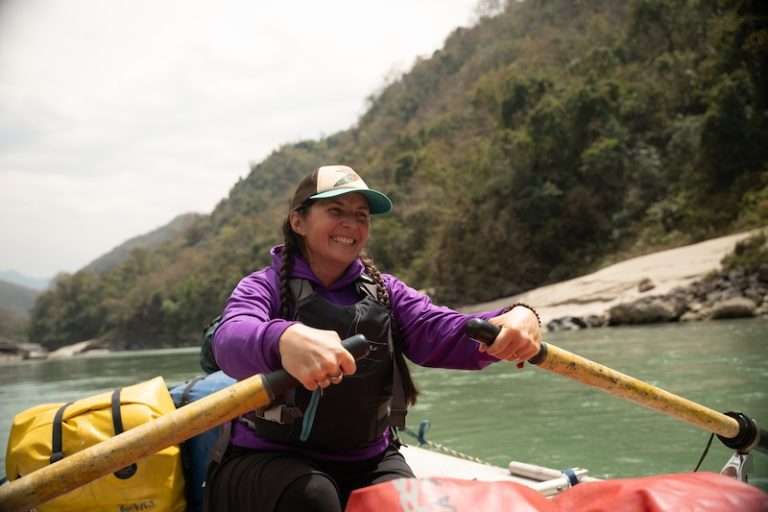
Anna
My guest today, Arnaldo Cespede’s life has always been surrounded by water. He started whitewater kayaking at the age of seven in his hometown of Turialba, Costa Rica. He competed in freestyle kayaking and was on the Costa Rican Solemn team for seven years in which he competed internationally. Arnaldo studied business administration with a focus on the tourism industry. and is the co -founder of Amazing Vacations Costa Rica, an adventure travel company that offers whitewater adventures, multi -sport weeks, and custom vacations. He’s an ACA whitewater kayak and SUP instructor, and he lives in Turialba with his wife and three adventurous sons. Bienvenido, Arnaldo. Si estoy muy contenta que estes aquí. So thank you, appreciate you.
arnaldo cespedes
Thank you so
arnaldo cespedes
Yeah, super happy to be here and stuck a little bit of a discomfort.
Anna
Yes. You and I have actually lived through a couple of really uncomfortable moments together and maybe we’ll get to that later. But for now, when I say discomfort zone, what comes to mind? What does your discomfort zone look like, feel like for you?
arnaldo cespedes
I could feel anxious, I could feel doubt as well. At the same time, fear. Yeah. That’s the first things that come to my mind.
Anna
Yeah, and when you’re feeling doubtful and fearful, where do you feel that in your body anywhere? Is there a sensation, like a physical sensation?
arnaldo cespedes
Yeah, in my stomach for sure. It started there. Yeah, and I can feel my hands a little sweaty. You know, I think that’s what I can notice where I can feel it.
Anna
Yeah.
Yeah, and when you start to feel that, what is your strategy?
arnaldo cespedes
I feel like deep breathing, you know, really helped to calm down and bring the heart rate down a little bit. I pretty much go from there, you know, that’s my first thing to do, just to slow down a little bit when I’m feeling anxious.
Anna
Yeah. And some people, especially whitewater kayakers, when they think of slowing down, they’re like, what do you mean slowing down? Like I’m in the middle of a rapid. And you’ve run some big stuff and are an accomplished boater. So can you just say more about slowing down? I know you mentioned breathing, so you slow down your breath. Is there anything else that you try to do?
arnaldo cespedes
I don’t know if this is the right word, but talking to myself, you know, like really, really give myself a good positive notes behind of why I’m doing this and how I prepare myself to be doing what I’m doing right now. It really helped. So I feel like that really in the middle of a rapid, you know.
If I already have my line, already have my markers and I know what I’m doing. So I try to really give myself positive feedback as I’m going down.
Anna
Yeah, that self -talk is so important. I talk about that a lot with my clients as well. It’s really important to notice how we’re talking to ourselves because I know I can catch myself talking to myself as if worst -case scenario is going to happen and focusing on, yeah, what are you telling yourself even when it’s like plan B.
coaching yourself because when you’re out there, really, we are our own coach. I’ve had clients and you’ve probably had clients too because you’re a teacher and a coach as well who have said, I wish I could have a little headset of your voice in my helmet. We really have to be that for ourselves out there in the white water.
arnaldo cespedes
Yeah, I’m sometimes, you know, at the beginning when I was start racing, slalom, being more focused on that sport. Like if I touch a gate, I was like throwing my paddle. knew, you know, I mess around. So I was not in my game anymore. So I had a sports psychologist when I joined the team. And I think that was a game changing in general, not only racing like going kayaking with my buddies, scouting a rapid, simple like that. You already have some strategies to prepare your mind for the situation.
Anna
Yeah. Yeah, I’m really glad you brought that up because I don’t think I’ve talked about that with anyone yet on the podcast. I can just see it, this vision of you touch the gate and then you get all pissed off and you throw your paddle. I have seen, I have experienced that. I don’t know that I’ve never, I don’t think I’ve actually thrown my paddle, but I’ll just get really mad at myself and give up.
I have seen many people, clients, peers do that. And I understand the feeling because we’re human, know, it is frustrating and especially if we tend to have a like a perfectionist streak. It’s like that all or nothing attitude of, I messed up. So I may as well just give up because I just suck, you know? And so do you, when you have…
I don’t know if you’ve had a client or a friend, I you’ve talked about it with yourself, you have a, you know, a sports psychologist really helped. When you’ve had to coach someone through that type of maybe reaction, what do you tell them?
arnaldo cespedes
I feel like I, what I tell people most of the time when it can is like, close your eyes, you know, like we went through a rapid, we scouted, maybe it’s still missing the line. You know, I really tell people to really look back, analyze what you can, you, you did and how you can improve that. And then we can discuss and talk about it and giving feedbacks after that right away.
And on top of that, I really like the idea of closing your eyes and really see yourself doing it because that really helps to break it down into your mind and then see your life better.
Anna
Yeah, visualization is super helpful.
arnaldo cespedes
Yeah, I feel like that really helped for me, really visualizing the forever.
Anna
So beyond white water and white water kayaking, what other areas do you feel discomfort in in your life that really come to mind?
arnaldo cespedes
Sometimes meeting people at first, you know, I can feel it. This thing for sure. Right now what I’m trying is like, I’m learning how to play an instrument and start racing in the ocean, stand up paddle racing the ocean. So those are completely out of my comfort zones, but I’m just trying to…see myself going through, you know, learning a new skill.
Anna
Yeah. Yeah. And reading the ocean is similar, but so different. I love being in the ocean, like stand up paddleboard surfing. So what do you, what have you learned about yourself from learning that new skill of like being in the ocean?
Arnaldo Cespedes
It is, it is my favorite.
We go back to the kind of like the sports psychology strategies that I had because I feel like when I did a long distance and I was in the ocean by myself that was my first long distance and I’m surrounded by water you know not normally in the river I have the shore a little bit closer so for sure I was I was feeling a bit anxious you know I was looking around I was like all right this is just me out here you know…
I my best and I can feel like how my legs are getting tired. was the ocean was a little choppy. I had a little bit of headwind. So so many things come to your mind at that point. And the only thing I was able to do is just giving positive thoughts, you know, that I was able to do it. Come on, you train yourself. You’re here. You got this. Keep going. Keep the pace you’re having right now and move on.
Anna
Yeah, yeah. And does that work for you that, you know, those affirmations and positive self -talk?
arnaldo cespedes
Completely, 100%. I was able to finish the race. I was exhausted at the end. I think mentally I was tired, physically as well. And that was the, I think the point when I decided like, all right, if I want to do a long distance race, I need to really prepare myself better for these situations. So it was really cool.
Anna
Yeah, yeah. Yeah, I think that the more that we prepare, I mean, that’s a good point. And I tell folks this as well. Like you can’t expect to be able to slow down in the middle of a rapid or calm yourself in the middle of a rapid if you never practice it in other areas of your life, if you don’t prepare. Like if you don’t practice, like you’re saying visualization, you can’t just get to the river and only visualize.
like when you’re nervous at the river, or at least I can, I guess I can only speak for myself, but it’s much better if I sit quietly in like a nice room, no distractions and practice that. Then because I’ve practiced it in that area or like in a calm environment, then I can bring it to more stressful environments. Does that ring true for you as well?
arnaldo cespedes
Yeah, 100%. Yeah. think like if you, if you train yourself, you know, even before at home, you can do it at home. It’s nothing wrong with it. You just start building that strategies for yourself. then when you are in that specific situation, you already know what to do or what are the steps you need to follow to make it happen.
Anna
Yeah. Would you say you dedicate quite a bit of time to your mental fitness, so to speak, compared to your physical fitness?
arnaldo cespedes
I haven’t to be honest, I haven’t done much these days, but when I was racing, I was able to really work on it. You know, I remember Laura, which is, she was my sports psychologist at the time, you know, giving me different tasks to do. like before the race, the day before the race, just completely blank, don’t think about it, don’t think about the race, go see a movie, do something completely different because sometimes we get like over thinking, you know? And we are already tired mentally even before the race and we’re not able to rest properly. And then we are not on the shape we want to, you know, for the race, we’re not in the best. We won’t give ourself the best performance we could if we don’t take the time to rest and completely just think in something different.
Anna
Yeah.
Yeah, yeah, that’s good advice.
I’m curious about something, another point of discomfort, or I think it’s a point of discomfort. I know it has been for me. So, I speak three languages. I learned French when I was growing up and I’ve learned Spanish. I cheat with you and with Walter because I speak more English. like going through learning a different language and learning to communicate in a different language can be so uncomfortable because
You know, you can be really smart in your and communicate really well in your native tongue. For me, that’s English. For you, that’s Spanish. And then when you’re trying to express yourself in a second, third language, it’s hard to find the words and it’s really uncomfortable. And you might not sound as smart or whatever.
And I know for me, that can be really uncomfortable. So, and I know you’ve come and you’ve spent time in the States and you’ve done some rough guiding, some racing. And so what has that been like for you?
arnaldo cespedes
yeah, I mean, same, same, you know, sometimes I think I’m saying what I really want, but probably I’m not using the correct words, you know, so sometimes I need to look back and stop for a second and say, like, wait a minute, did I say, know, properly what I really mean to? But I think I got to a point, Anna, that I was like, you know what?
If I don’t try it, if I don’t make mistakes, mistakes will come, right? So people will correct you and then you move on. know, like we cannot just get stuck in one specific spot and just be scared all the time because we need to get out of our bubble to grow. know? So I think when I went to North Carolina for my first time, was… back in 2012. I speak not much English and I was feeling a little bit nervous and stuff, but I get around and figure out. Yeah, and I have really good and close friends now from that experience for sure.
Anna
Yeah, yeah, definitely. I think traveling and communicating in different languages and putting yourself out there really, you know, it helps to kind of foster a sense of that we’re all more alike than we are different. And that people, most people are great and want to be helpful. And there can be some really funny interactions, know, like body.
like trying to explain things with your hands and pointing and being able to communicate and even if it’s not communicating perfectly, for me being able to be in conversation or listen to conversations, it’s a whole new depth of understanding of someone’s culture, even someone’s personality to be able to listen to that and understand in their language. I it’s really cool.
arnaldo cespedes
And we can bring it back to the river, you know, like, probably I don’t speak the same language sometimes when I go boating with people from other countries, the vocabulary on the river is pretty much the same, you know? So even though we speak different language sometimes, we can still go around and have a good time, you know? So just be open. You have to be open to really…you know, and enjoying the time and share time with the other people.
Anna
Yeah, yeah, absolutely. I was just kayaking on the Ocoee River in Tennessee with Marc Lyle. I don’t know if you know who Mark Lyle is. He designed the RPM. And when I was coming up, was like, he was kind of like my, he was on Team Dagger when I first got into Team Dagger. Actually, I should have him on this podcast too. But he is awesome. And he was saying that like just, you know how, people from all over the world who paddle probably have more in common than like regardless of where they live or grew up or you know what they do from that river connection. You just yeah that was the just this weekend so you’re reminding me of that. That’s cool. Yeah and that’s what I love you know taking you know I take a group to Costa Rica every year. I have been doing that for years with you and Walter and everyone at Amazing Vacations. And it’s such an amazing experience to be able to travel. I encourage everyone who paddles or whatever sport, whatever you love to do, take a trip. Like you said, Arnaldo, get out of your bubble, take a trip, go to a different country, experience different culture, different food, different rivers different people, and it’s such a rich experience. So fun.
arnaldo cespedes
So yeah, think it will open your mind to keep traveling and seeing these beautiful places that, know, a kayak can take you. So for sure, take a trip.
Anna
Yeah. Agree.
So you talked about your sports psychologist as helpful in like helping you move through discomfort. Are there any other mentors for you in that area that have been important to you in your life?
arnaldo cespedes
On that area specific, think my sports psychology was the game changer for sure. 2010, I dislocated my right shoulder and I thought that was the end of my kayaking career. I was like, all right, this is it. So it was a really hard time for me because I love being out there on the river and kayaking and I’ve been doing it since I was a kid. So I feel like this is just part of me.
When I dislocated my shoulder, I was going through a really hard time mentally. I was planning my trip to Chile at that time and I missed it. Anyway, one day I was walking around town and this guy, Phil Coleman from Frenchville, he looked at me and called me and he’s like, hey, what happened? then he told me like, injuries will come and go, you know, that is
I went through so many injuries in life and kayaking. But you have to be… You will know when you’re ready to go kayaking again. Okay? But don’t push it. Just listen to your body. And when you’re ready, up here, go. But don’t take the risk by doing it earlier because you’re just gonna get…
worse, you know. And I keep those words in mind. I was doing everything, you know, the doctor, the PT says to me until they clear me out. And then I was like, you know what, I’m going to start paddling flat water, see how my arm feels. And I went from there. I was like, you know what, I feel strong. I think I can go boating now.
But I took that time to really, know, like a couple months to really mentally be ready to go.
Anna
Yeah. Yeah. I think what you’re saying is really important because I feel like most folks will experience injuries and, you know, I’ve had clients who get really down and also I’ve seen folks who haven’t waited and they do make it worse or they make their recovery time longer. And it is worth it. Just like you said,earlier in the conversation, like that rest is so important. Sometimes we think, no, and especially if our identity, like you were saying, you’ve been kayaking since you were a kid, like that was part of your identity. Like then you go through this, well, what do I, who am I if I’m not kayaking? And that can be so hard. like, you know, what I hear you saying is like, and what Phil told you is like, have some patience, you know, look at the big picture.
Easier said when you’re older and you’ve lived through some of this, harder when you’re younger and like you said, it’s the first time, your first big injury. So I think that is so important. Andrew as well, when he injured his back, he had to take eight months off of kayaking and same thing. He’s been doing it since he was like a baby pretty much. And that was really hard for him, but he approached his healing
like he approached like training for the green race almost, you know, like it was more of a training regimen like rat, like yoga, walking, stretching. And he was able to recover fully just like you and be like, you know, yes, I’m going to go kayaking again. so I think, I think that’s, it’s a great, it’s, it’s important for sure. There was something else I was going to,
say that came to mind. and also what I notice now, because I’ve guided several trips with you in Costa Rica, and you are very dedicated to your stretching and yoga practice. seems like when I see you, at least when we’re on trips, you either come to a yoga class or you’re doing your own thing and you take the time.
So is that something that you incorporated after that first injury or is that something that’s come a little bit later?
arnaldo cespedes
Actually it comes and it just reminds me of a coach I had in France. he is French actually. I was in Argentina training with the Argentinian slalom team and we were stretching and the coach will say like, all right, we’re about to go in the water. I want to see you guys, you know, touching your toes with your fingers. And if you were not able, he will let you down for 20 more minutes until you’re.
for stretching enough before going kayaking. So yeah, so I think, you know, I keep, I just keep that, you know, and I feel when I wake up and I do a stretch, I feel way better. If I can stretch after boating as well, you know, just the body really appreciate it.
Anna
wow.
Yeah, yeah, for sure. And I know you’ve been paddling with your sons a lot lately. And before we started recording, you mentioned that taking them on the river can be a discomfort zone for you. Do you want to say more about that? Like, what’s it like? Because you started as a kid, so obviously your dad or your parents encouraged you and brought you to the river, and now you’re doing that for your kids. So what’s that like?
arnaldo cespedes
it’s been great, great adventure, you know, it’s hard when you don’t have other kids kayaking, you know, to really, so they can see and kind of have that, how you say like a fair kind of like competition between them, you know, like when you see someone doing something and then you are like, if he can do it, I could do it, you know, is different with a kid and an adult, right? So it’s been slow, but I’ve been progressing. They’re having fun. I’m not the one that I like to push my kids to really, you know, until they feel scared because that’s not the point for me of kayaking. My point of kayaking is go and have fun out there. So if they don’t want to try a row one day, I will say like, you don’t want to try a row? It’s okay, we’ll try another day, you know?
but going out now that there is two kayaking and the little one, is going, he’s almost fine, but he’s sitting behind me on the back deck, you know, he’s holding from the handles. and I have the other two in the water, you know, of course I don’t take them to, class three. I’m just going to class one, maybe a two. but for sure, you know, like seeing them out there, you can feel a little bit discomfort, you know, like, because as a kid, I had some experiences too, and I don’t want them to kind of experience those, or at least I want them to experience those in a different way when I’m there, I can assist them now, you know, I have better skills to really work with them. But yeah, for sure, I can feel a little bit nervous when I’m out with her, even that I don’t show them, you know, when they…
at a swim, you know, I go smiling and trying to pretend that everything is okay, you know, but, and I don’t show that to them. So they, don’t build that fear as much. but they, we get back in the cage, we analyze real quick, you know, what happened, why you flip and then we keep on going, you know? but yeah, I can feel, I can feel discomfort for sure.
But it’s been nice and then, know, growing up, I’m getting better at packing for sure.
Anna
Yeah. And right in their backyard, you know? Yeah. There’s so many great rivers right there. Yeah. Well, that can happen too. I mean, if I’m honest, like guiding and teaching kayaking, you know, sometimes someone takes a swim and I’m like, my gosh, that was, that was a bad swim, but you don’t want to go and be like, that was terrible. You know, it’s like, all right, you got this. You know, that’s kind of our job as a coach, not to sugar coat things, but to, you know, also,
arnaldo cespedes
Yeah, yeah, totally.
Anna
Because, and I talk about that when I’m training instructors, the importance of regulating our own nervous system to have that self -awareness, to not let that get… Because if we’re nervous, that’s okay. It’s not ideal. If you’re taking someone and you’re nervous about the river, you might want to rethink what you’re doing. But it’s okay to sometimes feel nervous or to get like, boy, this is…
a little sketchy as, but you don’t want to show that to the person because you want to hold that container for them. And I’ve been on rivers where I’ve seen trips, you know, with leaders who are like yelling at people and screaming and like throwing like a million ropes. And it just elevates, like it elevates the fear for everyone. And I think
It’s really important as leaders on the water to be self -aware and to be able to manage that for ourselves.
arnaldo cespedes
Yeah, and also like you’re the one, know, like as a coach, you’re the one that can manage the risk better, you know, the environment where you are. knowing the people skills, you can play with that, you know, a little bit and make it safer even, you know, we might feel discomfort in one or two rockets here and there, but you set up the safety and to…best you can to succeed.
Anna
Yeah. Yeah. And I know you’re a really great coach and teacher. what’s your best, I don’t know if there’s any instructors or leaders listening, what’s your best leadership advice for moving through discomfort?
arnaldo cespedes
I think you have to be patient and you have to give space, you know? Sometimes, you know, like after, you know, having a hard time on a rapid swing, you maybe, you know, what exit and you get all your things together. I feel like you need a second for yourself, you know?
And I think as a coach, need to give that space to people. And after that, you feel that it’s a good time, I think you really need to kind of read a little bit, you know, your students, understand when it’s a good time, probably to give a feedback and go through what happened, you know. But I think every scenario could be a little bit different. But I think Be patient and give space is important for me.
Anna
Yeah, yeah, that’s really good advice. I know I’ve caught myself launching into feedback too soon. I can be guilty of that. And when I notice I’m doing it, I always am like, okay, back away, know, paddle away, just, you know, calm down. So yeah, no, that’s good. So what have you learned about yourself by putting yourself in discomfort, whether it’s travel, learning a new language, kayaking, stand up paddleboard racing?
Anna
Like what have you learned about yourself?
arnaldo cespedes
that is gonna be okay. And it’s okay feeling uncomfortable, know, it’s part of it, but everything is gonna be okay. Just as before, know, just go with it, you know, do the best you can and everything’s gonna be okay, you know because you need to understand sometimes you’re not feeling comfortable but you’re going to gain so much after you know that the rewarding feels so good after you know in any scenario you know so yeah
Anna
Do you have a question for me?
arnaldo cespedes
for Anna right now. You know like for other kayakers out there learning or just you know being in that skill level when you are at the top of a rapid and you feel discomfort what are your first thoughts?
Anna
Hmm. Well, my first thoughts are, it can range, it depends on how nervous I am. Sometimes it’s like, why am I doing this? Like, do you really want to do this? And then I listen for the inside answer. And if it’s yes, then I like clear my mind. It’s not that I think,
clear your mind. It’s more of like, I funnel everything into my vision. At least this is how it occurs for me. So like I think of a rapid like on the green like a boo for consequence, the rapid that I don’t love. And every I’m nervous at the top of that rapid every time. And it’s like a super teeny slot, like the middle entrance. And so once I’m like, okay, I’m going because I’ve heard that internal yes.
It’s like I lock my eyes on exactly where I need to be. And my body just, I’m very present with my body and putting my boat where my eyes are looking. That’s the best that I can describe it. And not thinking any thoughts besides like, there’s the slot, there’s the rock, I’m taking a stroke now. It’s not like I’m saying this to myself, but these are kind of like what’s going on.
So I guess like a lot of presence, try and drop the thoughts and just get present to what’s happening in the moment. And I noticed like when I don’t do that is when I totally bifaline. Sometimes I get performance anxiety. every time I’m on the Paquari and we’re running lower wakas, I’m like, I don’t want to mess up in front of Arnaldo.
Like seriously, I think that sometimes. And then anytime I’m thinking that, I mess up, you know? And then if I’m just looking at where I want to go. That’s why I had such a hard time competing too, is because I had way too many thoughts about like what other people think. And I’ve said this before on the show. Obviously it’s still ongoing. And it’s something that’s something from my…
being a kid or whatever, you know, we all have these things that kind of follow us around. So it’s good practice. Yeah.
arnaldo cespedes
Yeah, yeah, totally. And now that you talk about that, you know, I feel like, know, like kayaking is an individual sport, but we are out there to support each other. know, like, you really know the crew that you are with, you know, when you’re running something and you really have to trust in the people that you are with, you know.
We are there to support, you know, even if our brain or our mind is playing with us a little bit.
Anna
Yeah, absolutely. Absolutely. And I always do feel that. Like, it’s funny because at no time do I not feel supported by you. And yet my brain, my mind just goes there. You know what I mean? Like at no time am I like thinking like, Arnaldo’s judging me, thinks I’m a crappy kayaker. It’s more of a thing that I have, you know? And in fact, you know, like I mentioned at the beginning of the show, you and I have kind of experienced some, some
arnaldo cespedes
Thank you.
Yeah, yeah.
Anna
really uncomfortable situations together. And I’ve always really appreciated your, I feel like you’re a very grounded person actually. Like, know, that space you talked about giving people, I feel like you can give space without disconnecting. And I think that’s really valuable. Like you don’t give, you don’t like,
Okay, I’m going to give space. I’m going to go do my own thing and just think about myself and thank goodness I don’t have to pay attention to the situation or person anymore. You know what I mean? Like you’re able to give space but still give the vibe that you’re present and there. And I’ve always really appreciated that for sure.
arnaldo cespedes
Thank you.
Anna
Yeah, yeah. Thanks for that question. Okay, I’m ready. Are you ready for rapid fire questions? So these are just questions meant to be answered in like a few words or sentence. All right. First one is what’s a morning ritual that sets you up for success?
arnaldo cespedes
All right, here we go.
coffee and stretching. Yeah.
Anna
Nice. What’s a non -negotiable self -care practice?
arnaldo cespedes
going to the river with my family.
Anna
Yeah, do you have a favorite motivational book or talk that you really like?
arnaldo cespedes
No, to be honest… Yeah.
Anna
That’s okay.
totally fine. Okay. What do people get wrong about you?
arnaldo cespedes
I feel like sometimes people think that I won’t share what I know about kayaking sometimes. Yeah, yeah, yeah. I mean, share what I’ve been learning through the years of kayaking, you know, and I really like to see people succeed, you know, like when they’re learning something new or improving.
Anna
really? They think you’re snobby?
arnaldo cespedes
I really, that’s something that I really enjoy. So when I can help on that case, it’s a worry for
Anna
Hmm, nice. Okay, throughout the course of your life, have you been considered or sorry, throughout the course of your life, do you consider yourself the underdog or the favored to win?
arnaldo cespedes
Most of the time favored to win
Anna (40:46.152)
Okay.
arnaldo cespedes
Yeah.
Anna
And then, let me see, hard moves in easy water or flooding.
arnaldo cespedes
Hard moves in easy water
Anna
Okay. What’s one word that describes your comfort zone?
arnaldo cespedes
my comfort zone.
Anna
Mm -hmm.
arnaldo cespedes
being out on the river.
Anna
Yeah, nice.
arnaldo cespedes
Sorry, I said more than one word, but yeah. I don’t think we’re ready.
Anna
That’s okay for, yes. Okay, freedom through discipline or I do what I want.
arnaldo cespedes
It It depends on the scenario, but I think freedom through discipline.
Anna
Okay. In one word, what do you hope your legacy will be?
arnaldo cespedes
Joy
Anna
Mm, that’s great. Is there anything else you want to share with listeners?
arnaldo cespedes
that enjoying every single minute that you’re out there doing, whatever you’re doing, you know, out in the mountains, on the river, at the beach, but really enjoying, those times, you know, like for yourself, you know, look back and see where you’re coming from. And, and you know, what really appreciate what life is being bringing to you.
Anna
Hmm. When you, do you have a practice that helps you really feel that joy?
arnaldo cespedes
I think when we are, when I am in a quiet place, you know, like, feel like I take, I like to take that time for myself, you know, like just walking out with my cup of coffee, you know, when I’m on a overnight, you know, and take a few, a few minutes to, to meditate, to just maybe sit in silence and really appreciate what’s around me. that’s.
That’s something that I really, I take it.
Anna
Yeah, yeah, that’s great. Thanks for sharing. I also love being in beautiful places. like when I think of beautiful places really inspire me. like, you know, thinking of jungle camp on the Pacuari, know, Costa Rica has so many beautiful places. I mean, everywhere, there’s so many beautiful places in the world, but just talking to you and…
I’m looking forward to going, you know, getting to Costa Rica in January. So many beautiful places that I find can be so inspiring and especially along the river like that, like in the jungle with all the bird sounds and maybe you’re lucky enough to see a sloth and the blue morpho butterflies and the beautiful water and the waterfalls. So obviously I’m encouraging you all to come to Costa Rica with us.
arnaldo cespedes
Yeah, go boating.
Anna
Yeah, because it’s so beautiful. Yeah, pura vida, right? Yeah. Okay. Gracias, Arnaldo. Thank you for being here. Thanks for taking the time. Appreciate you.
arnaldo cespedes
So nice to share with you, Anna. See you soon.