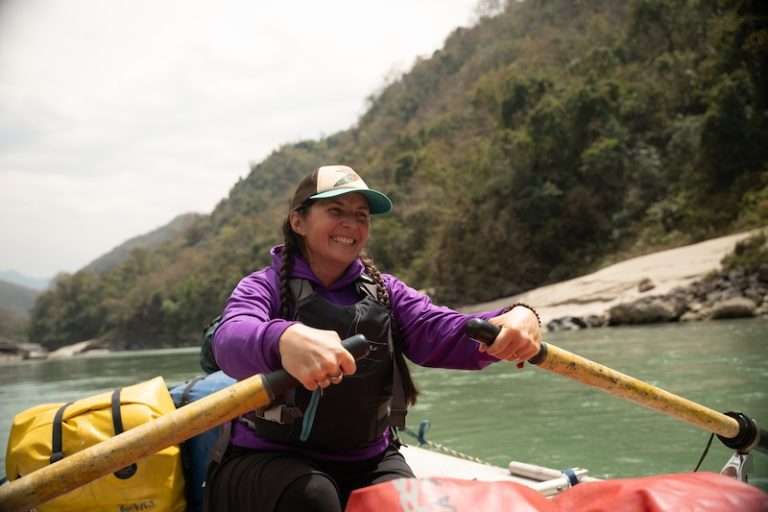
Anna
Welcome back to the show. This is a solo episode where I’m exploring a theme that is inspired by my friend Clay Wright and something that he said many years ago. And that is that anyone can get to the bottom of a rapid because the water flows downstream. So you don’t have to particularly have any skill or navigate well to get to the bottom of a rapid, you’re going to end up there anyway because that’s where the water is flowing. And he was saying this in the context of being thoughtful about how you want to navigate the flow, how you want to feel at the bottom, and learning the skills in both paddling skill and mindset to feel content and empowered when you are at the bottom.
Again, we can’t control everything that happens to us. At the same time, we can do our best to learn how to navigate and to take action. And I love this metaphor for life because we’re all going to get to the end of life. That’s the way time is flowing. And when we get there, right, how do you want to feel when you get there? And how which has you ask, how do I want to live today? Because our lives are made up moment to moment, day by day. And so I think that just like we learn to navigate the flow, and more than learn, we learn to navigate, also take action to navigate, we make moves right in the rapids to navigate. And we can do the same thing in life. And all of us who have paddled, if you’ve paddled a ducky, a pack raft, a kayak, a canoe, raft, stand up paddleboard on any type of current, you know that if you don’t do anything and you just let the current take you where it wants to take you, you can end up in some crappy places. And the same thing in life.
Right? If we’re just going with the flow and at first that might be like, yeah, I’m just relaxed. So just go with the flow. And there’s definitely some benefit in going with the flow for sure at times. If that’s our only strategy though, then sometimes we end up you know, not actually asking for what we want or need. We end up not being in a place that we actually want to be in because we were just going with the flow. And so I think this thinking about this metaphor, like approaching life, navigating life, right? Like you’re navigating a river or a rapid being intentional and taking action and focusing on where you want to go, not not on the obstacles in your way can be helpful. And when we learn how to paddle, it’s really, mentors are really important, right? Whether that’s friends, know, people who are further along than we are, people who know how to read water, who can give us tips, whether that’s a coach, an instructor, you know, again, a group of friends.
This is really important, especially in whitewater kayaking, right? Because you don’t want to go out there on your own, and that’s a lot less fun. And so in life, right, you we think of like instructors and coaches for only sports things, but coaches, there are, yes, I can’t stand the term life coach. I feel like that’s a lot of the work that I actually do with my clients. And it’s really powerful stuff. It’s amazing what they accomplish when I can bring in a different or bigger picture or different perspective. And so yeah, there are life coaches, there are therapists, right? There are mentors, maybe at work you have a mentor. There are, I think it’s, you know, when we’re doing, even though kayaking is an individual sport, it’s very rare that someone’s like, I’m gonna learn this all on my own, right?
But it’s funny because in life, sometimes we have that idea of like, we have to navigate it on our own, you know, by ourselves. And that’s just a story. And there are, it is good to get support and to be able to ask for support in our lives and have, yeah, have that different perspective.
You know, there’s also for, you’re going to learn how to navigate whitewater. You need to get out there and actually practice, right? Especially, you know, the edging, the angle, creating a relationship with the current. It takes time and, and it takes commitment and practice and, know, having a structure to, whether that’s your calendar and you actually schedule the time on the water. Sometimes when we have goals in our lives, we kind of keep putting them off. And there’s that kind of cliche saying a goal without a plan is just a wish, right? Like a goal without a strategy and a plan is just a wish in our head. I talk about how when people say,
Someday I’d love to go on a trip with you or someday I’ll take instruction from you or whatever it is. That’s like a pipe dream, right? I always encourage folks to commit to the trip or commit to whatever it is you want to do and have that motivate you, right? To get into action.
Yeah, instead of it being a wish somewhere out there, commit to it, put some skin in the game, so to speak. And I know that can be scary, because you have to put down a deposit or you have to commit to your friends that you’re going to do it or whatever it is. That is a good thing, because you let that future experience pull you forward.
Right? So you can say in kayaking, sometimes people have a goal to paddle a certain river by the end of the season. Well, then they reverse engineer their strategy from there to know, okay, well, by this time I want to be paddling this other river and practicing these moves to then move to this and then eventually to that goal. Right? So there’s always like, I’ll do it when I’m in better shape. I have more money.
have more time. It’s like, no, go ahead and put some structure in place now, commit and let that pull you forward into navigating your life.
Another thing that I think is important is, you know, being scared and doing it anyway. We, as a paddler, as any outdoor adventurer knows, this is part of the deal if we love, if you love outdoor adventure and love paddling. You’re going to be scared. And if you, you know, want to learn to make a move that scares you, you’re scared and you do it anyway.
And that’s part of like letting go of the outcome, right? At some point, we can’t be so attached to the outcomes in any area of life that the outcome, the fear of the outcome stops us from taking action.
And it’s really helpful if you have a awesome crew, a supportive crew, right? That’s huge on the river because you literally are counting on those people to help you if something goes down. And in life, you want to have a supportive crew, right? Who are you surrounding yourself with? What are their goals? Are they aligned with who you want to become? I think surrounding yourself with a really strong and supportive crew is key on the river and in life. And then consistency, know, and hard moves in easy water, right? Small consistent actions over time. You know, we want to let go of that all or nothing because it could be easy. Like you’re in a rapid and you miss your first move. It could be easy to be like, screw it. I missed my first move. I’m just going to give up. Everything’s going wrong now. And then things will probably go even worse.
Whereas, yeah, you miss your first move, like, I missed that first move. And then you immediately look to where you want to go, plan B, and you don’t give up, but you keep going. And that can help you navigate, right? Yeah, it’s plan B, C, D, and that’s okay. And practicing the consistently over time, right, is key.
So if you have a big goal, again, that’s the importance of reverse engineering and committing so that it motivates you to do something every day or however many days a week, you need to do that to get to where you wanna go.
And I think in all of this, all of this is pointing to a holistic approach, right? That how we approach kayaking is how we approach life and vice versa. And part of what I love about the work that I do is helping folks see the connection between the mind and body and paddle.
And that, you know, it’s really hard to be paddling well if you’re not sleeping well, or if you’re not nourishing your body, or if you don’t have self-awareness as to what you’re actually really afraid of. Or if your body really hurts, I’m actually nursing a hip and back, like some, an injury that’s been around, overuse injury, and man, it sucks to, you know, be in pain most of the time. And so right now I’m choosing to not paddle so that I can give my body a break, right? So having that self-awareness and taking action in terms of yoga and, you know, body work and chiropractic and PT. And so it’s hard to paddle well when you’re in pain, just like it’s hard to do your best when you’re in pain in life.
And, you know, that’s where the self-care piece comes in. Also, what does your morning routine look like? Morning, a strong or thoughtful morning routine can really set you up for success, both in your body and your mind. So all of these holistic, how are you setting boundaries? Which I’ve talked, I did a whole solo episode a while back about boundaries, how boundaries are like riverbanks. So all of this holistic approach is important to consider when you’re thinking about how am I living? And when I’m at the end of my life, when I’m at the bottom of the rapid, how do I want to feel about how I lived? How do I want to feel about how I navigated and the effort I put into and the people that I surrounded myself with and the big goals that I went for and the courage that I cultivated when I was afraid, but I did it anyway. And I think this is a good reflection and I wanted to offer it up on this episode. And I hope this sparked a little bit of motivation or inspiration and sparked some reflection for you. And I’d love to hear about it. So, you know, you can DM me or PM me on social media. You can send me an email. I’d love to hear your thoughts on the theme of this episode and the actions you’re taking in your life and on the water to navigate powerfully.
Thanks for listening. Hit the subscribe button if you haven’t already. And if you would like to learn more about my coaching, my mental agility coaching or mental agility mastery eight week course that’s coming up, both are resources that can help you navigate your life and the river more powerfully. So please reach out via email.
Anna at mindbodypaddle.com or on socials. can DM me, PM me, and be happy to chat with you about these programs. So thanks again and see you next episode.