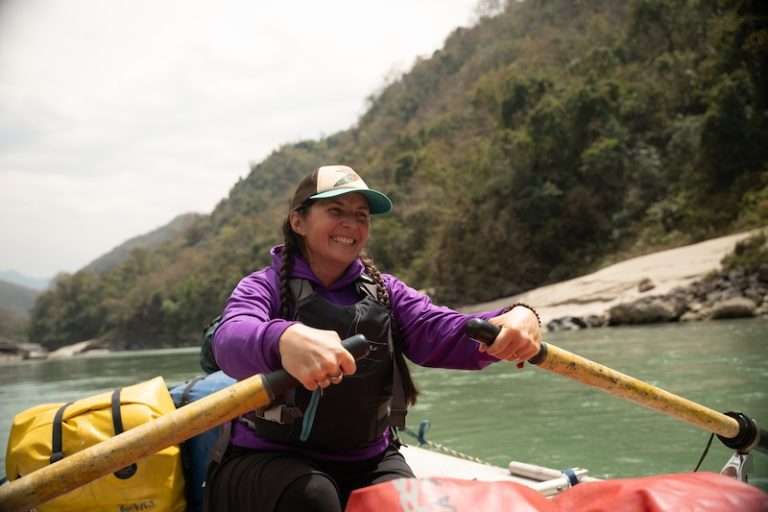
Anna Levesque
Hello, welcome back to the show. This week I’m doing a solo episode all about leaning into rocks, leaning into the hard. This is a really important river lesson, lesson from the river, for the river and for life. So in whitewater kayaking, if you get up, when you get up against a rock sideways, because you couldn’t avoid it or didn’t see it or…
you know, whatever happened that you’re up against a rock, if you don’t want to flip over, you need to lean into the rock. We talk about like hug the rock, love the rock, so that you lift your upstream edge, the edge of your kayak facing upstream, so that the water flows underneath your boat, continuing to create a small pillow against the rock that you can stabilize on and then push yourself
off and around. Our instincts though, especially as beginner paddlers, is to see a rock and be afraid of the hardness, like the rock might hurt us, like we might hit that rock and it might hurt. And so our instinct is to lean away from the rock. What that does is dips our upstream edge down into the water, the water grabs it and flips us over. And then we’re actually more exposed to rocks.
potentially under the water. It depends if the river you’re paddling could be really deep and there aren’t that many rocks or it could be more shallow and there are rocks, you know, on the bottom. Maybe it’s a shallower river. And so sometimes our instincts, sometimes that instinct of leaning away from the hard actually makes it harder, right? Actually, yeah, makes the challenge harder.
puts us through a more difficult situation. The same thing in life. What we resist persists. it can, when we find ourselves facing a tough situation or going through a tough challenge or challenging, choosing to go through a tough challenge, because we want to grow, we can find ourselves leaning away, leaning away from the hard, wishing it were different, complaining, not wanting to be there, wishing things were different. And that is like leaning away from the rock on the river and getting flipped. It can prolong the suffering and actually, to be honest, create suffering that is unnecessary.
Whereas if you lean into the hard with mental agility strategies, right, to lean into the hard, one of the most effective strategies for me in leaning into the hard is breathing. So box breathing, three count breathing, or simply taking one conscious deep breath in through the nose and out through the nose even, but training your
your breath work, right? Tuning into your breath and understanding the power that your breath has to activate your parasympathetic nervous system and bring in presence, focus, relaxation, calm, right? If you’ve ever tried a cold plunge, I know for myself,
The only way I make it through it is with box breathing and it really, really helps. Or if I’m at the top of a rapid that is really, I find really challenging, I take a deep breath, right? Or if I’m in a challenging conversation, I also tune into my breath and take deep breaths. The other thing is if you’re in a challenging situation, another mental agility strategy to lean in to
the hard is to ground yourself. Feel your feet on the floor, right? Tune into your body. what in paddling, I know on past episodes of this podcast, I remember Benny Maher said that he tunes into his hands on the paddle, right? There’s many different ways to ground yourself in the present moment. I like to feel my butt in my seat, in my kayak.
Yeah, and if I’m off the water, I tune into my feet on the ground. Another helpful strategy for me is to separate fact from fiction, separate fact from story, right? So there’s the facts of what happened or is happening, and then there’s the story that I’m telling myself about what’s happening. And…
Most of our suffering is in the story that we’re telling ourselves about what’s happening. And, you know, I remember I was coaching a client maybe last year or the year before, and she was really nervous and she was paddling and didn’t see a rock in front of her, got up against it and actually managed to like get up on it and got stuck. And I was coaching her from just slightly downstream, you know, to shimmy,
and scooch and get herself off the rock. And at first she was really nervous and wanting to give up. Like, I don’t know what to do. This is scary. And then when I was talking her through it, she finally came off the rock and her first words were like, that was so scary. That was, you know, yeah, just that was really scary. I was really nervous. That sucked. And so a very negative story around it.
So I stopped her and said, let’s just tell me factually what happened. And she said, well, I was paddling and I totally missed my line. My paddle stroke sucked and then I ended up on this rock. And I stopped her and I said, okay, that first part was all story. What just factually happened? And she said, I was paddling, I got stuck on a rock, I got myself off the rock.
And now I’m paddling down. And I was like, exactly. When you just go through the facts of it and you take out the story, it then gives you an opportunity to reframe what happened. Like you could also look at that as, wow, I’m so stoked. I got stuck on a rock and I was really nervous and I was able to get myself off. And that was really empowering. You see?
The story that you’re telling yourself about what happened could go either way a lot of the time. And if you break it down to the facts, it offers you an opportunity to reframe.
The last mental agility strategy that I’ll mention here today is when leaning into the hard, ask for help and allow others to contribute to you. Leaning in, asking for support. And I know some of you who are wetwater kayakers, I know I’ve experienced this where I’ve gotten stuck on a rock and I was having quite the time getting off.
and a friend paddles by, grabs the front of my boat and pulls me off. And I’m so grateful that they were there and they could pull me off. And so that support, support systems, asking for support and allowing that support in is another important strategy. So there are many, many strategies. I’ve talked about four here today, know, breathing, grounding.
separating fact from story and asking and receiving support. So just like we lean into the hard, lean into the rocks so that we can lift our upstream edge and move around the rock, stabilize and move around the rock, in life, if we stop resisting the hard and lean into it,
we can find a way through the challenge. We can find a way around the challenge. We can find a way through the challenge. And it might look different than we thought it would look. And…
there are always new possibilities, right? There’s always new possibilities and a way forward. And when we lean into the hard, at least in my experience, those new opportunities and new possibilities open up. If I lean away from the hard, it’s easy to get stuck, right? To get stuck in my own stories, to get stuck in the complaining and the resisting. So I hope that this episode inspires you to lean into those rocks, lean into the hard and find your way through. You’ve got this. And thanks for listening. Thanks for tuning in today. And I look forward to being with you next week. I’ll be back with a guest. And
Have a great week.