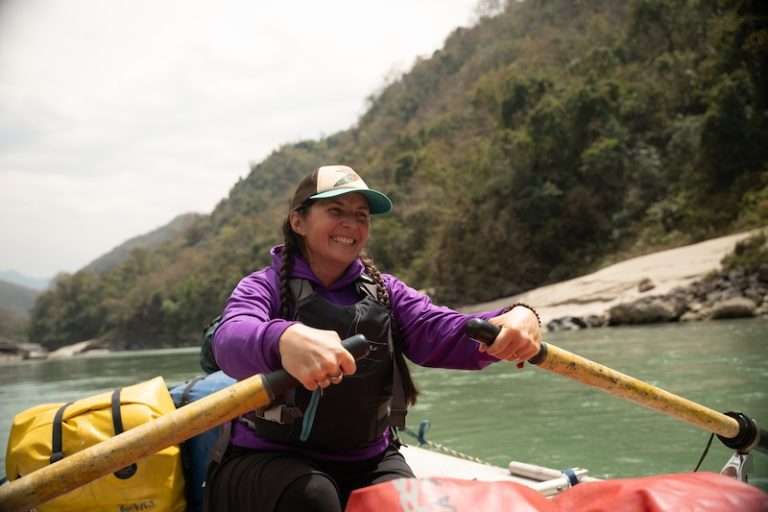
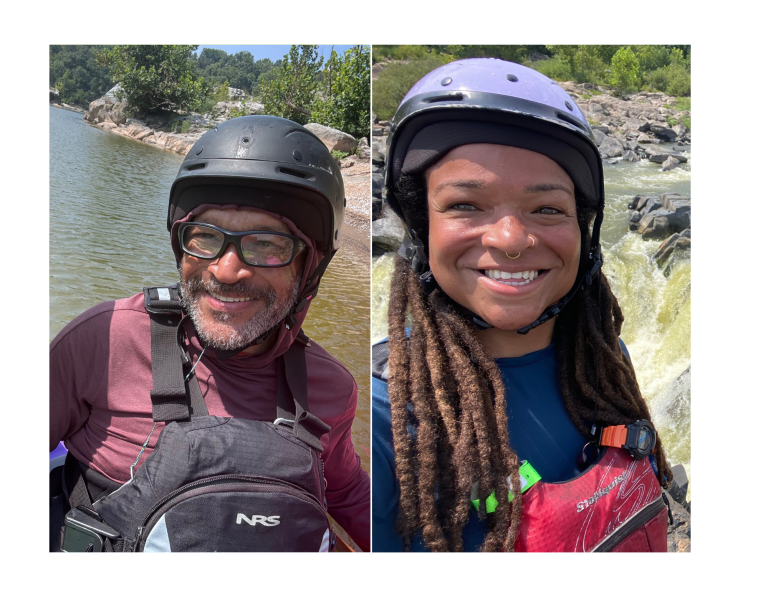
Anna Levesque: My guest today, Ruby Williams, is a Quartz Valley tribal member and Kuduk person raised in Happy Camp, California, along the banks of the Klamath River. Her kayaking journey began in 2022 with Paddle Tribal Waters First Cohort Trip, where she learned the fundamentals of whitewater kayaking. That experience was the beginning of a much larger adventure, preparing her for the first full descent of her home river, the Klamath, a 310 mile journey. Since then, she’s been honored to travel and train with Paddle Tribal Waters Academy in Chile, and to join World Class Academy in Canada and Africa through scholarship opportunities for her senior year of high school.
These experiences have deepened both her love for the sport and her connection to her river, her culture, and herself. She’s now attending Fort Lewis College, continuing her education while staying rooted in her passion for rivers, community, and indigenous leadership. Welcome, Ruby. Thanks for being here.
Ruby Williams: Thanks for having me.
Anna Levesque: Exciting. Will you please introduce yourself in your native language?
Ruby Williams: Yeah, so Ayukii- (Hello), Nanithvuy uum (my name is) Ruby Williams. I am a Quartz Valley Tribal Member and Karuk person, raised in Happy Camp, California, along the banks of the Klamath River.
Currently, other than living in Fort Lewis right now, I live mostly in Happy Camp, California.
Anna Levesque: Thanks for being here. I’m excited. I’m grateful that we met on the Maine Salmon River trip a couple of years ago. It was so fun. To get started, I always start with the same first question, which is: when I say “discomfort zone,” what comes up for you? What does that mean for you?
Ruby Williams: Obviously not being comfortable. Being in a spot where you’re a little antsy, a little jittery. Almost having a different mindset in a way. Sometimes discomfort is good and sometimes it’s bad. Learning to decide whether it’s good or bad really just takes a lot of practice. I’m dealing with that a lot, being so new to kayaking. Sometimes it’s a good feeling, sometimes bad, and it’s up to you to decide in that moment or later.
Anna Levesque: Can you give me an example of good discomfort for you?
Ruby Williams: A good discomfort is like running a new rapid. You’re scared to run it, and then you go down and realize, oh, that was easy. That’s always a good discomfort—knowing when something’s hard, then conquering it, and saying, yeah, I did that.
Anna Levesque: What about bad discomfort? What does that feel like for you?
Ruby Williams: Probably getting down to the bottom of a rapid and thinking, I never want to do that again. I’m walking it every single time. Nine times out of 10, I’m walking that. If you’re not having fun, then what’s the point?
Anna Levesque: You just recently completed a 310-mile paddle down the Klamath with Paddle Tribal Waters. Congratulations! There must have been some moments of discomfort during that journey.
Ruby Williams: Yes, thank you. There were definitely a couple of moments. The Klamath thankfully doesn’t have a lot of whitewater, so I was comfortable much of the time. But one of the sections that was supposed to be very discomforting—the Big Bend section—I decided not to run. The day before, my friend Kia had a scary swim and it really shook all of us. We were all new to kayaking, just kids, and watching a friend get pinned upside down even for less than 30 seconds felt like a lifetime.
I remember crying, thinking, oh my god, you’re my best friend, don’t do that. That was a big moment. And then the next day, having to choose whether or not to run Big Bend was a really hard decision. I was the only girl in our small group of four who was ready to run it. It was a tough choice, but I’m glad I didn’t. We all took a reset day instead—went swimming, rested, just enjoyed being together. It was what I needed.
Anna Levesque: When you say reset day, it sounds like you just focused on fun and being together. Was there anything else that helped you reset your mindset?
Ruby Williams: I remember sitting on the beach, admiring where I was, what I was doing, and who I was doing it for. I took time to slow down, because before that everything felt so fast-paced. That moment of reflection was huge. And also, we went to the gas station for some comfort food, which helped too!
Anna Levesque: Tell us a little bit about the expedition itself for context, in case listeners haven’t heard about it.
Ruby Williams: Two years ago, a group of 12 of us signed up for a program to do the first full descent of the Klamath River. Our river had been dammed for over a hundred years, so this was a huge opportunity. We trained for three years through Paddle Tribal Waters Academy and World Class Academy. We went to Chile and the Pacific Northwest to prepare for this 30-day trip.
For me, it felt like a protest too. One of my mentors told me: “For you to be a Native kid, alive and thriving on your river, says something. A lot of people can’t say that.” That really stuck with me. It was about more than kayaking—it was about showing that Native youth can reconnect with our rivers and thrive.
Growing up, I’d always heard the Klamath was gross and polluted because of the dams. We weren’t meant to swim in it. This expedition broke that stigma, showing it could be a source of joy, connection, and cultural pride again.
Anna Levesque: What was it like on the river for those 30 days, especially being with the same group of people?
Ruby Williams: We’d already spent a lot of time together at the Academy, so we knew how to navigate being with each other. Of course, there were some clashes, but it felt like family—you butt heads and then come back together. We were able to be vulnerable, talk it through, and move forward. That’s what made it work.
Anna Levesque: What have you learned about yourself through kayaking and stepping into your discomfort zone?
Ruby Williams: That I’m a lot more scared than I thought I was. I always grew up tough, trying to keep up with the boys. At first I wanted to run everything. Then I realized, I don’t think I want to. I’ve learned it’s okay to be scared. Kayaking is a challenge-by-choice sport, and if your crew doesn’t respect your choices, you’re paddling with the wrong people. I’ve learned that admitting fear takes strength.
Anna Levesque: That’s powerful. Do you find strength in admitting you’re scared?
Ruby Williams: Yes. People often want to hear, “I’m not scared, let’s go.” But saying, “I’m scared, let’s scout, let’s slow down,” shows curiosity and awareness. There’s strength in that. And I’ve been lucky to have amazing mentors who encourage me to paddle at my pace and trust myself.
Anna Levesque: What advice would you give to young paddlers about finding supportive mentors?
Ruby Williams: If people are rushing you into things or not respecting your decisions, they’re not the right mentors. You want people who ease you in, who support your pace. That’s how you grow safely and joyfully.
Anna Levesque: It sounds like kayaking has helped you grow in confidence and leadership. How has that shown up for you?
Ruby Williams: It’s night and day. My instructors and parents say I’ve matured so much since starting. I’ve developed confidence and leadership, and I carry that with me everywhere. My parents and my community have been so supportive, and I want to give back by helping other Native youth reconnect with the river, maybe even start a paddling club in my hometown.
Anna Levesque: That’s amazing. What about using your voice as a young Indigenous leader?
Ruby Williams: At first it was terrifying. My first public speaking was at the White House, which was wild. I was so nervous. But practice makes it easier. Now I feel much more comfortable sharing my story and encouraging others. It’s about showing up, practicing, and remembering why I’m doing it.
Anna Levesque: I love that. Do you have any final advice for our listeners?
Ruby Williams: Go outside. Go kayak, go into the woods, just get out there. Bring your friends too. You’ll have way more fun than sitting behind a computer or phone.
Anna Levesque: Love it. That’s great advice. Ruby, thank you so much for being here and sharing your story. You’re an inspiration.
Ruby Williams: Thank you. This has been awesome.