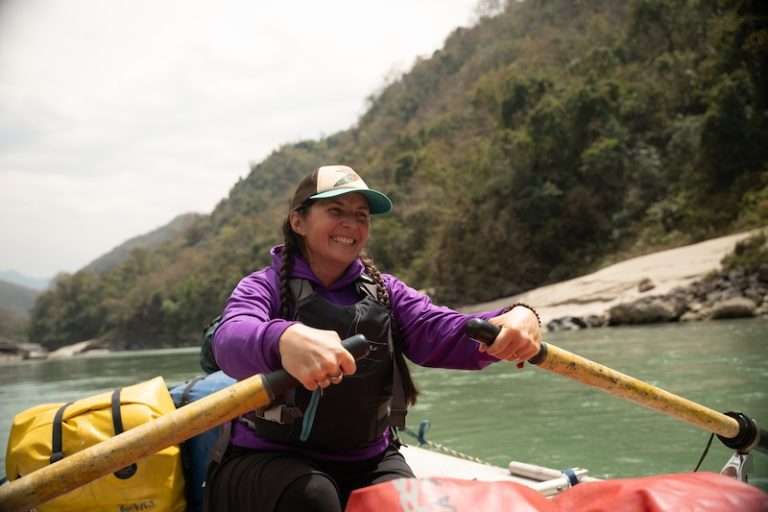
Anna: My guest today, Khalid Kure is a 21 year US Air Force veteran and F-16 jet engine mechanic who now channels his passion for service into leading team River Runners Columbia, South Carolina chapter. Born and raised in Queens, New York and having lived several years in Ecuador.
He brings a unique perspective to connecting with people from all walks of life. A proud father of five, he helps fellow veterans heal, connect, and discover new strength through kayaking and time on the water. An adventurer at heart, Khalid believes the outdoors is one of the best classrooms for building resilience and community. Whether guiding a first time paddler down a river or organizing events for veterans and their families, He’s dedicated to creating experiences that challenge comfort zones and change lives. Thanks for being here Khalid. I’m excited for this conversation.
Khalid: Thank you for having me, Anna. Appreciate you very much.
Anna: . So I’m going to start off with when I say discomfort zone, what comes up for you or what does that mean to you?
Khalid: Anxiety, for sure. Some type of anxiety, , something in front of me, a task that I don’t usually do or even a task that I usually do a lot of and always feel the same way, , and also knowing that right after that, it’s just a level up. You definitely just level up after that.
Anna: Mm-. And how do that? How have you learned that you definitely level up by, , jumping in, walking in, paddling into your discomfort zone?
Khalid: through life and my career as an Airman in United States Air Force. There’s so many different branches, everybody has their own job, so many different lives and every single person is another world. And in my world, it was definitely a discomfort zone. Coming out of my house at 17 years old, being around a bunch of guys. that you never met before, , and learning to work as a team to complete the mission, , that that right there is very discomforting. , just looking back and seeing the trajectory of my life, , that what I felt before that. And I remember so clearly in the bus on the way to basic training, I met this young fellow and he is he tells me he and I’m really nervous. I don’t know. I’m like, take it easy, man. We’re just going camping. And he looks at me like, oh man, you’re right. This is a mind blown. It’s like, I thought that way. And then we just go in camping, man. That’s it. And seven weeks and we’re done. And then came something else, learning to do your job as a jet engine mechanic. Oh man, imagine you’re dealing with millions of dollars worth of equipment and the tools and all that stuff.
Anna: Mm.
Khalid: , that’s definitely something that brought a lot of discomfort, , but but and going through it and finishing those tasks. That’s how you level up, , you see behind you like after a rap and you look behind you like, I went through all that, I did it, that now I’m in the next level. I can keep going. What else is next? .
Anna: .
Anna: Mmm. Mm-.
Anna: , , I love that you’re what I also hear you talking about is how being a person who commits to something and completes it like finishes strong builds confidence. And that is something that I try to motivate, , my clients. And I know you were in mental agility mastery eight week course last year. And I don’t know if you remember, but at the end, like towards the last week, I’m always reminding people finish strong. You you want to know yourself as someone who completes something because I think as humans, sometimes we can get lackadaisical when something’s almost done and be like, oh, well, this course is almost done. This rapid is almost done. This river is almost done. I’m just going to not pay so much attention or Maybe people won’t miss me if I don’t attend the last session or whatnot. And it does make a difference because when you don’t complete things, then you’re leaving unfinished business. And then if you go through life, just not completing things, I think that it actually drains confidence and it does get in the way of upleveling. Like you’re saying, like going to the next level. So I appreciate you bringing that up.
Khalid: 100%. , regret, regret is the worst feeling in the world. It really is regretting that you could have done something to help somebody. You could have done something to help yourself. And now you’re in a situation where you wish you wouldn’t be, , and that’s, , that right there, when it comes to Team River Runner, for instance, right. I, I, tell my fellow volunteers.
Anna: .
Khalid: , that probably never been in the military before. I tell them, hey, listen, when you believe something is way too hard for the brand new veteran in the water, don’t even bring it up. Don’t even ask them because as a veteran, I’m telling you right now, you ask anybody to do something in the military, they find it extremely hard to say no. , and sometimes I know certain things that people can do. So that’s when I ask, hey, you want to go down this rapid? It’s not that hard. it’s a, , it’s like a two. I know you can do it, , then we go through it and they do awesome. But if I were to put him down, , through a number like a three, , that’s, that’s not good. , especially knowing that they can’t do it, , that’s what I wouldn’t even offer. Offering veterans to do things is it’s really like. You’re telling them, hey, do this in their mind. It’s not really an offer. It’s more of a, what is it, let go.
Khalid: Well, how would you say this, Anna? Like, it’s more of a, like,
Anna: a challenge or a…
Khalid: challenge. Correct. No, a challenge. Yes, a challenge. even for the veterans out there in the water, like I have to be very careful because these requests are really challenges to them. , it, .
Anna: Mm-. , that’s really interesting. It’s something I’ve had to learn as well, talking about being in a discomfort zone. And first of all, maybe just say a little bit about Team River Runner for folks who might not know the organization. And then I have a follow-up question for you.
Khalid: Yes. So Team River Runner was founded in 2004 and we are a nonprofit veterans organization where we take veterans out to the water, , with any type of issues they may have, even if they don’t have any issues, , any military active duty, , or reserve guard, if you’ve ever been in the military, you can come to us. Basically, what we do is we have all the equipment possible. All you need to do is bring yourself as you are and an extra extra clothing so that could change into after you get wet. But definitely bring a bottle of water. And we instruct you in whitewater kayaking. We have also different chapters. We have around 60 chapters nationwide. We have chapters that only do rafting. We have chapters that also include stand-up powderboard. So some chapters get together and they ride bicycles. , mountain biking or they have so much fun. So this is for veterans with any type of disability. I’m talking about any type. We will work around it. We will work around it and take you out there and teach you. started 2002. , quick story. I was in the saloon of Riverwalk and I go there. I used to go there every day for running. I just run, especially when it’s really hot. The canopy is dense. It’s just so nice. You run in the shackle the whole time.
Anna: Mm.
Khalid: So after a few weeks just running there and seeing people in the water, it was kind of like, wow, that’s really an attractive thing to look at. Some people getting in this water that I wouldn’t dare to get into. And I’m walking back to my car and I see a good friend of mine, Charles Bray, and he has a playboat on his shoulder. And I didn’t even know what a playboat was at that time. I know. So I look at him like, hey, buddy, let me ask you something. You think in an inflatable boat, like a pack raft might work that going down this river and he looks at me like, uh, I don’t know. It’s very rocky. And sometimes it’s very strong. I think you should get something like a hard boat. Oh, . And he’s like, are you military? Like, yes, I am military. Listen, funny you ask. I got, I’m in this non-profiganization. It’s called team river runner. And we train people. We train veterans on how to run these rapids.
Anna: you
Khalid: You interested? I’m like, yes, I’m interested. , at that time, , just coming out of COVID and all this stuff, , we were stuck in our homes for a long time and it was like such a blessing. It was such a blessing and it just took off from there. Like, forget it. I never stopped. . I had to, I had deployments. had TDYs. There were some days I couldn’t show up because of work, but
Anna: Mm-.
Khalid: man, they really worked around my schedule. They helped me out. , if I couldn’t make it on a Wednesday, I would ask, hey, can I make it on a Saturday with you guys? Are you guys doing anything? , come on, come on over. , they’ll bring the equipment over. They do anything you need. It was quite amazing, the camaraderie that you find with Team River Runners. , they’re such a, they’re so helpful. They’re just awesome, awesome people that are there for you.
Anna: .
Khalid: And a good friend of mine, Dennis Osborne, he told me one day, he’s like, you’re rare, man. We don’t have a lot of veterans that show up and just don’t stop coming. A lot of people come by, they train for a bit, they learn something new, and then you don’t see them again. Sometimes you gotta call them in, come back, come back, and then they come back. But I just kept on with it. I kept on with it. And I wouldn’t stop.
Anna: Right
Khalid: Talk about discomfort. Like, I was petrified of the river.
Anna: , that which is surprising. mean, it’s surprising. Well, I know I because I’ve worked with you. So I and I’ve worked with Team River Runner. It’s a great organization and I’ve led some instructor training certifications and you’ve earned your instructor certification and and you do just go for it, which is so fun to watch and you love it so much. And and your
Khalid: I was scared.
Khalid: Yes, ma’am.
Khalid:
Anna: trajectory, you said, actually, , when I started paddling, I was the same way. I paddled every day I could and that’s I got good really fast. And it goes to show like when you really get lit, like you’re lit up by something and passionate, you can really go for it. back to at some point, I want to talk about the discomfort of me as a civilian working with veterans. However, right now I really want to focus on, and by discomfort I mean nerves. Like I was nervous working with veterans because I don’t have that experience and I didn’t know if you all would relate with me. And of course we’re all human and it’s been amazing. So it surprises me, coming back to your story, that you were petrified because watching you, you just go for it. So.
Khalid: .
Anna: And so you started in 2022 and it’s 20, as we’re recording this is 2025. So really it has been a short window and you’ve accomplished so much.
Khalid: Thank you. Thank you. Yes. Man, was I scared. Lord, like I was so scared and just a lot of anxiety that my legs will go numb in the boat. . It was that’s and I was like, I’m in it. I got to go through it. , I got to follow. just I would just follow people, , and just follow the instructions. What they would say was like, look where you want to go. Look where you want to go.
Anna: Mmm. .
Anna: Mm-.
Khalid: And man, that speaks volumes, does it not? Like, look where you want to go. Like that’s incredible. , and I would just emulate, emulate the person in front of me, their strokes, I will look at their hips, the way they’re moving and just go for it, ? And through time, I’m not going to lie, like I wanted to cry at times in that river, ? And it was like one or two type rapids. Like it wasn’t even that bad, but That was the discomfort zone that I really wanted to saddle through and see myself on the other side. , I wanted to see myself.
Anna: Mm. Is that what you would visualize? , I love that. Gosh, that’s so powerful. So when you say I want to see your, I want to see myself on the other side. By the way, before that, I hope you adjusted your outfitting if your legs kept falling asleep because you can adjust it. Yes. .
Khalid: Yes, the hips, hips, right? No, it was they always gave me bigger boats. They always gave me the biggest boats they had. It was just the nervousness. It was just the… .
Anna: , got it. . That’s so funny because it happens to like all of us at some point. It’s a it’s a weird it can feel it’s a different position. anyway, I love that you are talking about how to visual I don’t know if you didn’t use the word visualize but see yourself on the other side. And it sounds like that really motivated you. So did you visualize like what does what does seeing yourself like on the other side? What does that look like? Is there a practice that you do to see yourself or is it a feeling like what is that for you?
Khalid: My biggest goal was to be there for the veterans. That was my biggest goal. So that was like, to me, right there, that was the top. And how to get there.
Anna: Mmm.
Anna: So you join not just for yourself of improving and having fun, but also you saw an opportunity to be of service.
Khalid: Correct. Yes. That was my number one motivator right there. The veterans. And then from there, I made a mental plan. How can I be more of service? And I said to myself, well, I need to be, I need to become an instructor. . So little by little, , I started going to every single meetup that we had, , and like I said, even to deployments, I remember I was in Germany and we call that a deployment by the way, in the Air Force. . And, ,
Anna: Mm-, I got it.
Khalid: We were there for like three months and I’m a technical sergeant E6 and at a certain point they kind of don’t want you to do certain tasks. , it sounds like, it doesn’t sound right, but there’s a little bit of a… the time when you gotta just also level up at a certain time, , gotta do other things and then just do the basic stuff. Well, I’m just a type of person that nothing is too much, too small of a task for me. And if I see my airmen sweeping, mopping, I’m there with them, period. I do what I need to do. I do what I need to do first.
Anna: Mm-.
Khalid: So I can make them look good. And then I go directly to them. And I remember helping them clean up the shop. Because we do that every day, know, for it. When we do working as a general mechanic, everything has to be so clean. , you can’t leave anything out because of dangers, , that something gets sucked in the engine or left inside the engine and destroy a million dollar worth of equipment. So I remember myself just sweeping and then practicing the role in my head and just. going like that. And they’re like, what are you doing, man? Like, I’m practicing. Let me tell you, that right there was so much help. I was, I didn’t touch a kayak for like three months. And then the first time back, I went to one of the, my first pool session and I rolled the very first try in the very first time. And I was like, I can’t believe it. , just practicing this with a broom. . And , no, please.
Anna: Hahaha
Anna: .
Anna: Amazing, right? I love that. What you’re pointing, go ahead. No, no, go ahead.
Khalid: So, and visualizing is so powerful. Visualizing where you want to be and what you want to do. I visualized myself helping veterans and I knew what I had to do and I just kept with it. Now I’m an instructor, , and thanks honestly to everybody around me, my own family, they definitely supported me. They pushed me, .
Anna: Mm-.
Khalid: And, but sometimes, , some people will be like, Hey man, if you’re too scared to do something, just chill. And now that that’s another thing, , you say that to anybody in the military, mostly I can speak for them saying that to somebody that now like, , now, now I’m to have to do it. , it’s, , it’s not . Like I got to do this, , it’s just something that it’s personal. It becomes a challenge. So, so definitely this, this was a challenge. This was a challenge.
Anna: Ha
Anna: .
Khalid: to be where I am now, it was very important to me. It was extremely important. Like you say, Anna, sometimes you gotta say no to certain people so you can say yes to others.
Anna: Mm-.
Khalid: And that was one of those situations. Sometimes I know I can’t make it there because I got to go. I got to go practice. I got to go practice. What are you trying to do? Like I’m trying to become an instructor so that I can help my veterans. And and now, , there are times we’re a team. We’re a team. Sometimes people can make it to, , Wednesday at four o’clock at the Saludal River. , and I’m sometimes the only one.
Anna: Right.
Anna: .
Khalid: And it’s rare that I’m the only one, but it happens, right? Everybody’s working, everybody’s doing something. And I’m out there with a couple of veterans, beginners, and I’m teaching them. And I’m able to do that alone. That’s amazing. That’s just amazing.
Anna: .
Anna: . , I love it. I love your passion. mean, you’re really passionate. So what is the drive? Why are you so passionate about helping veterans?
Khalid: Cause I know what they’re going through and I know what they go through.
Anna: Mm.
Khalid: We veterans, anybody in uniform, we’re really easy to talk to. It’s not hard. It really isn’t. It really isn’t. You say thank you for your service and we say back, thank you for your support.
Khalid: Some of us, you We have this demeanor that my wife says that I have. , like I’m not approachable and that’s so not true. I don’t know why in the river, especially, oh my God, my friends, like when I go to the Whitewater Center, where’s Khalid? Oh, he’s back there talking to somebody. Oh my God, he doesn’t know anybody. We’re here, like how is he talking to people? And that’s the community that I love. The paddling community is amazing. It reminds me so much of veterans. Cause veterans are really easy to talk to, just like the pattern community. are people on the river, very easy to talk to. Cause it’s this thing where everybody’s going to go through the same thing and you want this person to support you. want the person on the left and to the right of you, you want to know that they can help you in a situation. And that’s how the military is. The people to the left and to the right of me, I know that I can help them and that I have their back. They know that I have their back and I know that they have my back. That camaraderie exists on the river. And if you’re a veteran that misses that camaraderie, come out. Find us. We’re not hard to find. Absolutely not. You can find us. River Runner.
Anna: .
Anna: , that’s great Khalid. Thank you for sharing. It’s so true on the river. It’s a quote unquote individual sport because you’re in your own kayak or whatever craft. But it’s absolutely not an individual sport because you’re always working as a team for safety, decision making, fun, Having fun, encouraging each other. , so.
Khalid: .
Anna: Kayaking is like wonderful. think that’s one of the reasons I love it because I have my own craft and I’m captain of my own craft and I get to share the river with amazing people and have fun and work as a team at the same time.
Khalid: Yes, especially if you leave the eagle at the door. Or let’s say in this case, if you leave the eagle on land, man, you’re to have such a good time. know, look, I’m still swimming. I’m still swimming because I’m trying new things every time. I’m trying new things. , I’m getting into holes more often. , and that’s a 50-50 for me. , I’m getting at 100 % a 50-50 for me. OK, I’m getting in a hole.
Anna: Mm.
Anna: Mm.
Khalid: And yes, the anxiety comes up, , and all this stuff. But at the same time, I, every swim, I learned something new. Every swim, if I would have just held in, I just held on a little bit longer. If I would have just, , done this angle, this edge held that edge a little bit longer. And if I would have just paddled out of it a little bit better, a little bit more powerful, I learned something every single time. And.
Anna: Mmm.
Khalid: You got to think of it almost like a mountain bike, like a bike. , , we fall off our bikes sometimes we get off our bikes sometimes to rest. Same thing in a kayak. , you could turn over and swim. And that’s just a little break, man. It’s just a little break.
Anna: Sure.
Anna: I don’t know if I would call swimming a break, but definitely after the swim, sitting on shore for a second, that can be a break. . Well, and also your roles really good. I, for some reason, the, what keeps popping into my mind is, that day that you moved a pillow, big pillow on the front rock on French broad. was at a great level. And I think you did flip right in the swirly Eddie behind it and you rolled up.
Khalid: Yes. 100 % yes.
Anna: And in like, , big water was great. It was so fun. You were so stoked. Everyone was so stoked.
Khalid: That was the last and that was right after a big swim. You remember that swim I had? And I was upside down and I remember Scotty Kuhn, was like, bro, and Sean Eggie, like, were worried because you were underwater forever. And in the video, you could see me going down river for like maybe, holy moly, like a quarter of a mile upside down. So everybody was like, I could only imagine how worried they were, ? And it was me just chilling. Honestly, it was just me just chilling upside down and just thinking about things and no,
Anna: .
Anna: Right.
Khalid: And that was my break. was, cause we were, that was like on the fifth or sixth day of the mind potty paddle, right? Or the instructor enhancement course was the, I think it was the instructor enhancement course that I did with you. And I just, I pulled out and , and I just started and they’re like, man, but right after that, I think that was the best we’ve ever done in my life. I hope I can redo it one day. And I was the last one down that rapid and the way I just, couldn’t believe it.
Anna: Mm-. , on that. I can’t remember which one, but .
Khalid: I remember Sean Eggy coming to me and he’s like, oh, Big Sarge. And then I flipped over. And I came back up. , it was amazing. It was amazing. Good time.
Anna: Hahaha
Anna: That’s so great. . Just love how you’re really bringing forth like, and I’m sure listeners can hear it, like the joy, the stoke of kayaking and being out there and, and , , some people are like, this, , . So I, know some folks, clients of mine that can be really hard on themselves and they’ll say, , I didn’t have a great day. I rolled. I had to roll a couple of times. I’m like, what are you talking about? Like rolling, we learn how to roll so we can use it. It’s a self-rescue technique. If we didn’t need it, we wouldn’t learn it, right? So it comes in really handy and it is much more fun. And I speak from someone who I can be pretty hard on myself too. It’s way more fun to reframe that and to just, , , great. Instead of, saying like, I had to roll twice because whatever I messed up a line being like, wow, great. My roll is so great. It was a, , clutch time, clutch move. I rolled and I was up and going and awesome. Like pat myself on the back. I have a great roll, , much, much more empowering. .
Khalid: Yes, for sure. For sure. I mean, it took me such a long time. It took like three years to get my role, ? man, look, never, I only thought this, I never felt it. But I thought like, my God, I think that they’re just gonna kick me out of this pool one day, because I can’t, I just can’t get it. I just can’t get it. And then one day, but they, know, our volunteers, they’re just amazing. I worked with every single one of them, ?
Anna: haha
Anna: You
Khalid: All of them gave me very good advice on my role. Look, do this, do that. And man, every time, every session, I took one thing, then another thing. And I kept taking little things until now I have my own way of teaching other members on how to roll. I got my little boy, Alejandro, he’s rolling. , . And it’s just practice, know, that’s most of it, practice and getting your butt in that boat. That’s the most important thing.
Anna: That’s great.
Anna: , , absolutely. And you mentioned your son, Alejandro, and also I know you’ve shared the river with Isabella. And so what is it, because I know you’re passionate about being of service to veterans, and I’ve also seen you be really excited to share the river with your family.
Khalid: Oh Lord, yes. mean, Isabella, she stopped paddling after a bit, but Annabella, my little one, my very, very little one. . She, she paddles with it. She asks me, sometimes we’re in the car. It’s like, Papi, I got this feeling. What, what is it, babe? I to be in the river. I want to go out there. , like, wow. That’s, , I couldn’t even imagine what she feels. Cause I know, I know actually what she feels, ? When I pass by any river, I swear.
Anna: Annabella, .
Anna: Mm-.
Khalid: by any river, it’s just, I feel empowered. I feel this excitement, just, man, look at that line right there. That would be amazing to do right now. But no, I gotta go somewhere else. But then when I get to the river, it’s just exhilarating, honestly. I never thought that I was gonna feel that way for something that had a mind of his own, for something that no one can control, which is the river.
Anna: Mmm.
Anna: Right? A life of its own. .
Khalid: Life of its own, yes. And teaching my family, my kids, we’ve gone to the lower green and man, Team Riverrunner has been such an awesome, awesome nonprofit for us. Last time we went to the lower green, we took three veterans. No, it was like four veterans and four instructors and every veteran had an instructor. And we also had an instructor for each of my kids. . So we had, . We had Nicholas, Annabella and Alejandro. Every one of them had an instructor, , and then it was, it was awesome. It was a really good time. It was just, I even made a video on it. It’s in our Facebook group page, , but,
Anna: Wow, that’s a good ratio right there.
Khalid: It was such an awesome time and the kids saw the camaraderie between us and how it is that you rescue people. And they see those things. You may think they’re not paying attention, but they are paying attention. They all had dry hair days. It was amazing. It was such a good time. And they didn’t want to go, by the way. They were like, no, no, we got to take all this equipment with us. I no, trust me, I got you. We’ll go. Just chill in the car. I got everything. I was tired after all.
Anna: Mm-. . hehe
Anna: , that’s awesome. And , a lot of your volunteers are civilians. Some of them are veterans like yourself. Is there a discomfort in bringing civilians in to facilitate or volunteer? What is that like for you all?
Khalid: So right now I’m working with a civilian, right? That she is a trauma counselor. And I remember the first day I was on the phone with her, like, , we’re going to go to this river, we’re going to do this and that. , are you taking a sit on top? I’m like, no, we’re not taking a sit on top. We are going to try to learn to hang with the rest of the veterans, , because that’s what it is. Like, if you are a volunteer,
Anna: Mm-.
Khalid: You need to learn how to hang with the rest of us. And, and, her name is Lori. She’s amazing. Awesome. Awesome. And I, I, I test her. I test her. I asked her questions in front of everybody. She answers back. , she, she, she’s learning so much, know, and I’m, I put her in a discomfort zone. , I put her in that discomfort because I need her to learn, , and man, she’s learning. She is learning so much. Every time we go out there
Anna: Are you talking about like learning kayaking or learning how to communicate with veterans or what? Can you say more about that?
Khalid: A little bit of both, a little bit of both for sure. , cause there is a certain way you speak to anybody. , you, got to, as an, an instructor, not just in the water, but also in the military, right? I teach CPR and tactical combat, casualty care, and among other jet engine mechanics certifications. And I’ve been doing that for like two years now. And so the military teaches you how to teach how to instruct people and.
Anna: Mm.
Khalid: the very first thing you’ll learn is that you cannot teach everybody the same exact way. You can’t. Something might work for this person, but this other person might need a little bit more work. And that’s something that you get better at through time. so teaching Lori on how to be a kayaker so that she can volunteer and help us, I feel like I’m teaching a part of myself how I used to be.
Anna: Sure.
Anna: .
Khalid: And she’s doing awesome. She really is. She really is. And we’re not used to civilians. I’m going tell you right now, we’re not. But because of her credentials and the things that she’s capable of, she’s already helping people. On the water, she’s already helping people and veterans that are with us because they ask the question and she’s right there, , I can help you with this. I can help you with that. So that’s an amazing thing. And right there, that just gives me even more of a
Anna: Mmm.
Khalid: want to get more volunteers.
Anna: . And volunteering and working with Team Runner is awesome. As I mentioned, I have no military experience and I’ve really enjoyed working with veterans and it is a learning curve. I remember Sean being like, you give too many options, , or it was something I’m paraphrasing. , just tell us what to do.
Khalid: Yes.
Anna: And I actually pushed back a little bit. was like, no, I’m not just going to tell you what to do because that’s not my style. One of the reasons Team River Runner brought me in to work is because of, , my style partially and, , the, the mind, body paddle aspect, the holistic aspect of it, of how I, how I train instructors, how I teach or create space, hold space, all of that. and, and. then I also started to understand when that’s really actually beneficial and when to open it up. And it’s been such a joy and , meaningful for me to put myself in that discomfort zone and to learn again, I think if I’m being honest, depending on how you grew up. You might have, it’s just like with any group, you might have ideas about veterans. You might have, like you said, like they’re easy, , you’re easy to talk to, but you, some people might be intimidated. I don’t know. You have ideas about, you can group people, whether it’s veterans or kayakers or whatever group that you lump together and label. You can label them and, listen or see them through a certain lens. And it’s really, it’s been really important and meaningful for me in my life, especially in the last decade to challenge myself, to work with different folks, to create networking with different folk, people who are different from me, who have different life experience. And you mentioned living all over the world and traveling. I’ve always loved that. And there’s ways that you can do it where you live. Also, think it’s really important.
Khalid: There really are that you gotta definitely look around. There’s so many things around you you have no idea until you look. When I first got orders to come here to South Carolina, I was bummed. I was like, man, what is there to do over there? Because coming from Florida, coming from Homestead. And I got here and I was stuck in my house for a long time and then COVID hit and all this stuff. But then I started going out more and I started.
Anna: Right.
Khalid: seeing the parks in this area is just amazing. The things that you find, , and going back to what you were saying about Sean, right? , just tell somebody, just tell them what to do. Sean and I come from an era that now is like old school, , like the early 2000s in the military was extremely different from what it is right now. Extremely different, , to sometimes I got to, I got to stop myself and be like, , it’s not.
Anna: Mm-.
Anna: Mm-mm.
Anna: Mm.
Khalid: 2004 anymore when I first came in. There’s a different approach that you got to take with people because, , this new generation is different. This new generation that we have.
Anna: Right? Mm-.
Anna: Mm-.
Khalid: For some reason, a lot of us think that they don’t know anything, but that’s so not true. This new generation has such a wealth of knowledge inside of them that if they were asked, they will comply. They will do. , we sometimes have a tendency to think, , , this is my house. Welcome to it. And this is how we do things.
Anna: Mmm.
Khalid: I’d rather open the door at times for sure. Open the door and let people show me a new way. know, and I do that sometimes. . So this is how we’ve been doing it forever. What’s your take on that? Well, certain cure, certain cure. . I think that maybe we can do it this way. And I’m like, wow, I never thought of it that way. Let’s do it your way, man. Let’s do it. And look at that. We finished things faster and things are like looking better, , and what else do you have? You have this person that you empowered.
Anna: Mm-.
Anna: Mmm, that curiosity.
Anna: Mm-. , absolutely. Absolutely. So what, if you could sum up, well, you’ve already answered that question. I was going to ask you, what have you learned from being in the discomfort zone? But you’ve already answered that question that you can level up is what you said, . . . So another question for you is what is, you talked about your visualization strategy. and I wanted to come back to that in that you were talking about doing your role with the broom, , practicing, which is so great. And I also just want to emphasize that because I think some folks think that the only way you can improve your kayaking is to be on the water. And absolutely, as you mentioned, getting your butt in your kayak and paddling is super important. And you can also do a lot off the water, right, when you’re focused to whether that’s working on your mindset, visualizing, working with a broom, right, to go over the different motions. So I think that that’s, I love that point. What is, go ahead.
Khalid: Going back to that discomfort, so you also say, I wanted to put something out there. Before I hit, let’s say a rapid, like recently we’ve had flooding. It’s amazing right now. We usually practice at a thousand CFS at the Saluda River. Where we practice is at the Saluda River Walk. And mill race, mill race is extremely broad and there’s so many features. You can do laps on mill race all day and hit something new, find something new and swim a whole lot too.
Anna: Mm-.
Khalid: When, like, what I think about before I hit a very hard rapid, I have this mental toolbox. . In each drawer is, it’s something else that I use. It’s a tool. So I opened the first drawer, , and that first drawer is like, me getting a prayer and like, Lord, help me, help me with this task I have at hand, , that’s the say the first store. And then the second drawer is my happy place. , I remember you teaching us that so clearly. And my happy place, I’m going share this with the world, is on Veterans Day weekend, I always find myself camping out with the kids. And it’s the little ones that I go out with. And we’re in a tent and it’s raining outside and we’re taking an afternoon nap. man, that is my happy place right there. Cause it’s, it’s, it’s not so bright. It’s nice and gloomy and we’re just all resting in a place where I feel safe. So that’s my happy place there. And then I opened another drawer and I hear your voice. I know I hear your voice. Just looking, looking back and saying, don’t be afraid of it. Wow. Like that, that alone, Anna, you have no idea how much I use that one.
Anna: Right.
Anna: Mmm.
Anna: .
Khalid: a whole lot, even with my veterans and my volunteers, , I just look back and say, hey, don’t be afraid of it. , that’s that’s so simple, right to the point. And that right there just stayed with me, , and then I opened another drawer and I hear so many different people. I hear Charles Bray, , my good friend telling me, hey, man, get in the setup position. Just immediately get in the setup position. , you roll over and meet, just get in the setup position. ,
Anna: Mm.
Khalid: And you’re Sean Eggy, , telling me, your head in the sky, sit up straight. , if you get stuck in a hole, , work your angles, lean forward, lean back and see what happens. So that toolbox definitely follows me everywhere, , cause it’s all in here. And depending on the task, I open the drawer that I need.
Anna: Mm. Mm-.
Anna: , that’s great.
Anna: . I love that. Thanks for sharing that strategy. And it sounds like, , you’ve picked up strategies, which is also so important along the way, why it’s important to, to learn with an organization like Team River Runner, take instruction or, , get tips, paddle with great people because it does build our toolboxes. So I love that. Thanks for sharing.
Khalid: your work.
Anna: Kaleed, do you have a question for me?
Khalid: How have you been dealing with, like I know a little bit of it, With mentally, mentally your back issue.
Anna: . , that’s a good question. So when I look back, so I pushed myself over the edge right before Women’s Paddle Fest, which is a big event. It’s like 100 women and I host with the Nantahale Outdoor Center and I’m kind of the face of the event. It’s so, so fun. So many women come and it’s just like a great vibe. And I was in so much pain. Like for me in my life, the sciatic pain going all the way down to my foot, I mean, and it was relentless and I didn’t understand what had happened. So I didn’t understand the different positions. Like I knew that standing and walking felt a lot better. So I was trying to do that, trying to sleep. my goodness. But it’s amazing how resilient mentally I could be. And I know you are. I’m, , listeners, you can be, , when you’re in pain and you still have something that’s important to you and you want to show up for people. And so that was really wild. Mentally, I also noticed though that it was harder when I was in so much pain to get outside of my own mind. and not go down the spiral of, my gosh, I really messed myself up. Like I’ve really worked myself, like what’s gonna happen? I can’t get in my boat. know, and that is, can, so what works for me is kind of like what you were talking about earlier, seeing yourself on the other side. I’ve really started to, and I continue to, What will it feel like to have more freedom in my body and my mind? I talked about this on a solo episode recently about my healing. really bringing, for me, what I like is the feelings, like bringing the feelings up in my heart’s pace of gratitude. What does freedom in my mind and freedom in my body feel like? And I’ve really been focused on that, and know, and then putting my body in positions that feel good and that do create freedom, like walking for instance. And then,
Anna: Mentally, , it’s really hard to be looking on social media and like all my friends and especially I’m supposed to be on the Ottawa right now my favorite river my favorite waves amazing people and Just seeing people having so much fun and surfing and It can be easy to be like my life sucks right now But that’s absolutely not true again looking at the big picture like wow, I’m so grateful that I have an amazing space to heal, have amazing practitioners that I see. I’m really consistent with my PT. I love walking around my neighborhood. I have an amazing husband who’s so supportive. know, like looking at a statement like, my life sucks, like I’m missing out. It’s like, , it might be missing out and I am sad about it and having faith that other opportunities will open up. that I’m learning and growing and that when I look around, my life is actually very rich. So that’s what’s helped me.
Khalid: gratitude.
Anna: Gratitude, yes, always.
Khalid: Yes, for sure. That definitely helps the soul heal. really does. Knowing what you have right now in front of you. imagine so many people that don’t even have a home to live in. Just recently, I was put through this program. was called Transition Assistance Program. So it’s for the military. And people are getting out.
Anna: Mmm.
Anna: Right?
Khalid: So I got 21 years in already and I’m starting to like look for a forever home and this is my forever home right here. And I want to stay here in Lexington, South Carolina. This is where I have my family and I don’t want to move from here. So I took the big step of joining the guard at McIntyre. So that’s where I’m going to be next. And just that alone, know, that
Anna: Mmm.
Khalid: kind of put things into perspective, like, what is it that I have right now that’s more important than what I want? It’s my family. And so 100%, I made this move so that I can stay here. And the choices that we make for sure affect us in the future. Even the things we tell ourselves now will affect you in the future.
Anna: .
Anna: .
Anna: .
Anna: That’s right. And that’s why you better focus on it’s more powerful to focus on what you do want. Like, look where you want to go. How we started out at the beginning of this episode. , look where you want to go. . Love it. . Are you ready for rapid fire? . So these are supposed to be answered in one, like one word, one’s not really one word, but a sentence, , like short answers.
Khalid: Look where you want to go.
Khalid: Valley.
Anna: So what’s a morning ritual that sets you up for success?
Khalid: My morning prayer.
Anna: What’s a non-negotiable self-care practice?
Khalid: Lenten tea in the morning.
Anna: Lemon tea. Love it. . What’s a favorite motivational quote, book, talk or song? Lots of options.
Khalid: , you changed that one up. He gave us more after. , so definitely my favorite book right now, for now, The White Water Philosophy by Doug Ammons. I love that book. It’s really good. It talks a lot. One thing that I love is the fact how he states that the rules of whitewater kayaking are rules made by God.
Anna: Mmm. Mm-.
Anna: Mmm.
Khalid: This is not rules made in a basketball court or for tennis. No, no, these are rules made by God that you got to follow in order to be successful on the way out and through it.
Anna: Cool. Thanks for sharing that. . What do people get wrong about you?
Khalid: I’m not approachable. Like I said before, my wife, said, you got this face sometimes, , but then somebody talks to me and I talk for hours, , I make friends quickly.
Anna: It’s true. It’s true. . Throughout the course of your life, have you considered yourself an underdog or the favorite to win?
Khalid: an underdog 100%. Like, man, , I consider myself the underdog, but because of that, because of that, I fought even harder.
Anna: .
Anna: , , hard moves in easy water or flooding.
Khalid: That gave me strength.
Khalid: So, hard moves at EC Water for me to instruct and teach my veterans. And for me too, to teach them how to flow. And then flooding for sure, so I can test my bravery, test my techniques.
Anna: Mmm. Yes, I would say that’s true. Like you go for it for sure. That’s awesome. . What’s a word that describes your comfort zone? And you might have already answered this with your happy place, but maybe you have something else. So word that describes your comfort zone.
Khalid: word that describes my comfort zone. Several. You telling me, just looking back and saying, don’t be afraid of it. And then Sean Agui telling me, do what you came here to do.
Anna: .
Anna: Mmm. Mmm.
Khalid: He said that right before a competition that I had that he came competed with us. Short story, the day before we had like 5,800 CFS at the Saluda Riverwalk. And we’re trying to do exactly what the competition told us to do. We’re gonna catch certain eddies, square eddy and then go behind that rock, easier said than done. I swam every single time I got caught in this hole called dumbass. I don’t think I had a single run. without swimming. was horrible. My knuckles were busted. was and then the day of the day of Sean is like, you want to do a practice or like, no, I don’t want to do no practice run. I got three competitions I got to do today. I got one with my daughter going doing the straight shooter down the race. Then I got to do the ice man. Then I got to do the other the other competition. That’s like a biathlon triathlon where you got to also swim in the water. I’m not broke.
Anna: man, brutal.
Khalid: What happens happens. And no joke, I go down that river with my daughter. And then it was a it was a duo ducky. I am Tiffany, Eddie helped me take the boat up to my truck and she is so strong. What a strong lady. She we took it all the way to the top of the hill. We put it down. And then when I came down like, hey, Khalid, you’re up. Like what? , you’re up like right now. Right after Charles Bray. I’m like, oh, God.
Anna: my god.
Khalid: And no joke, just the minute I was, my arms were burned, just tired. The minute that they said, go, I just went, I went for it. And my Lord, remember that time I was telling you about that, third man syndrome where you’re not, you’re in a situ, you’re in a situation where you don’t know what to do and you’re stuck. then somebody shows up. Some people say that they can see this person. I’ll do what they say. can hear them. Well, Lord.
Anna: Mmm.
Khalid: I had every voice in my head telling me so many different things for every little detail that I was doing. , that was more than third man syndrome. That was a lot of stuff going on at the same time. And it helped me. It helped me. went for the first, , but before that, Sean Eggie just told me, , he stopped me in my tracks. I was going over there. He looked at me in my face, ran my eyes. He’s like, do what you came here to do. And I took it as an order, as an order, like.
Anna: Mmm.
Khalid: Yes, sir. So I got in my car and I performed that day. I finished the run. I grabbed, I caught all the eddies and I was extremely excited at the end. I got caught in the hole, got out of it, but finished it. And that was just the first time I completed it. I accomplished it. It was crazy.
Anna: Mmm.
Anna: That’s awesome. So great. , freedom through discipline or I do what I want.
Khalid: You gotta do one before the other. You can’t be 100 % of anything. You just can’t. , can’t be 100 % agreeable with everything that anybody can tell you, but you definitely have to have discipline so that you can have the freedom to do what you want later.
Anna: Love it. , in one word, what do you hope your legacy will be?
Khalid: Empowerment. Empowerment. I want to live forever like ripples through time and space in people’s minds and hearts. I want them to learn from me and I want to learn from them. But when I’m far and gone, I want everything that I teach to be passed down to the next generation and further down forever.
Anna: Mmm.
Anna: Thanks, that is powerful. Thanks Khalid. Is there anything else you want to say to our listeners?
Khalid: Yes, I want to tell you guys, everybody, you’re not alone. You’re absolutely not alone. There’s someone out there that is there to help you. You just got to find that person sometimes. Sometimes you got to make moves. Sometimes you got to look where you want to go and make those moves to get to that person, to get the help that you need. And for my veterans out there, I love you.
Anna: Love it. Thank you so much, Khalid. Appreciate you.
Khalid: Thank you, Thank you, and I appreciate you.