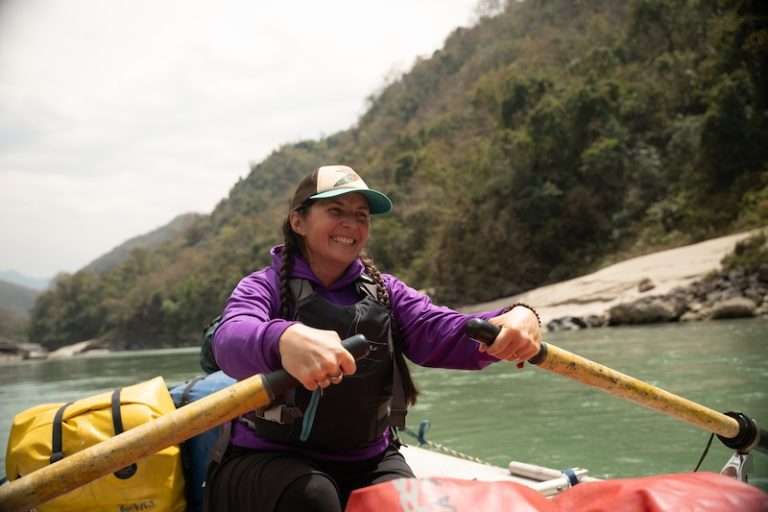
Anna Levesque: My guest today, Valerie Bertrand, is an internationally accomplished paddler from Quebec, Canada, who has been based in Geilo, Norway, since 2004. A former Canadian national team athlete and current Norwegian national team paddler, she has competed at the highest level across five disciplines: freestyle, slalom, creek, rafting, and kayak surf. Over a career spanning more than two decades, Valerie has achieved podium results at World Championships, World Cups, European and Nordic competitions, and national championships. She is a two-time world champion, winning both the Freestyle Squirt and the Kayak Surf World Championships in 2007.
Alongside her own competitive career, Valerie has built an extensive background in education, coaching, and athlete development. She holds a master’s degree in physical education with additional studies in kinesiology, nutrition, science, and technology, as well as qualifications in personal training and physical conditioning. She has worked as a teacher and sports pedagogue and has been head gymnastics coach for Geilo since 2018.
She is an instructor and educator for the Norwegian Canoe Federation and the International Canoe Federation, co-leading freestyle youth development camps. Her combination of elite competition experience, academic knowledge, and practical coaching experience gives her a broad perspective on performance, movement, training, and long-term athlete development. When not kayaking, she is most likely to be found traveling and training with her kids, or kiteboarding and surfing along the coasts of Norway and Denmark.
Welcome, Valerie. That is quite a bio. I’m so excited to have you here.
Valerie Bertrand: Thank you very much. Likewise, thanks for having me.
Anna Levesque: My first question for you is, when I say “discomfort zone,” what does that mean for you, or what comes up for you?
Valerie Bertrand: I guess the classic answer would be a general lack of control over events or time. But for me, the real discomfort comes from a lack of control over my own feelings. When feelings take over both your physical body and your ability to think or make rational decisions, when you’re fully out of control, that would definitely be it.
But I must say that this definition has been changing over time too. I’ve never been a scared person on the water, for example, or very much in life. I’ve never been scared of too much until I had kids, I suppose. But now the definition is more like a blown-up version of FOMO, fear of missing out. What I mean by that is losing the ability to do the stuff I love, or to accomplish the things I would love to accomplish. For example, if I’m injured, because that’s been happening a little too much over the past couple of years. Or being scared of not being able to keep up the same rhythm I’ve been holding the entire way, because of aging, or because something suddenly happened. So it’s fear of missing out, but a blown-up version of it, in the long term.
Anna Levesque: Thanks for sharing. I love your answer because it’s actually a very unique answer. I think it’s one of the first times that fear of missing out has been brought up, and also focusing on the emotional side, your discomfort zone being losing control of your emotions. So when you say you lose control of your emotions, is that a tendency toward anger, or sadness? You say you don’t really get scared. Is it nerves? If you’re willing to share where your emotions have the most tendency to go off the rails.
Valerie Bertrand: Again, I’m not really a scared person. I don’t really panic. Even when things get complicated, chaotic, or completely out of hand, either in life or on the water, I’m usually a person who stays calm. Things definitely get chaotic, but I don’t panic. I’m usually not the one screaming in the background. I’m the one trying to reason everything out.
But I guess it’s when feelings suddenly bubble up. It’s not very visible, because I don’t scream it out. I don’t shake. My heart rate doesn’t rise that much. It’s not a panic moment for me. It’s more like there are so many things going on in my mind when things get difficult, options one to a hundred that I need to sort out. It’s like there’s a fire in my head of decision making that suddenly gets really, really hard. And from there, the panic sets in in the body too. Again, not in a form that’s really visible to other people unless they really know me, but more like a chaos that sets in inside.
And then it’s like, where does that come from? Wait, wait a second. Let’s go back. Let’s breathe. Let’s regain control of the situation. So I guess it would be the feeling of panic that sets in when something gets uncomfortable or hard.
Anna Levesque: It sounds like it’s in your mind, like an overwhelm. The description of a fire in your mind is really interesting to me, because I’ve studied Ayurveda, which is based on the five elements, and that heat, that fire of too much going on in the mind. I think a lot of folks can relate to that. I can relate to that. So when you say take a step back and breathe, is breath your main strategy for settling and grounding?
Valerie Bertrand: It’s a yes and a no. Yes, I try to breathe, but for me, panic sets in really high up. I feel it like a headache, a massive, massive headache. And from the headache comes confusion, because of the chaos.
So the first thing I’ve learned to do when discomfort really sets in is to close my eyes and try to calm down the headache. Get to a quiet place, close my eyes, sleep. Don’t look at a phone, don’t get distracted, just be with myself for a little bit and try to sort things out. Because one chaos leads to another. You have so many options that turn into paths, and you’re like, no, no, hold on, this is not realistic. This is never going to happen, so why am I even spending time thinking about it? So I’m sorting out the ideas that shouldn’t have been there, that aren’t even an option in this case. For some reason everything comes at once, so I’m making space, headspace, to clarify a bit and calm down the feeling of chaos. Narrowing it down to what’s actually feasible, doable, and reasonable at that point.
Anna Levesque: I love that you said put down your phone, because when a lot of us feel the chaos, it’s easy to zone out by scrolling. Sometimes it’s hard to be with our thoughts and that revved-up emotion, and we want to distract ourselves. So I love that you’re talking about taking time for yourself, being with yourself, resting, and even sleeping. If I have a rough day, and sometimes I do, I’m like, I just want to go to sleep. I just want this day to end. I love sleep, and I feel much better in the morning. There are lots of studies showing that sleep is our brain’s natural way of sorting out thoughts and experiences. So I think that’s very cool.
A lot of our listeners are paddlers. Does this ever happen when you’re on the water? We can catch an eddy and take a breath, but we can’t really go to sleep if we’re on the river. So if it does happen when you’re on the river, or in the ocean, or in the air, whatever you’re doing, how do you sort through it in the moment?
Valerie Bertrand: I’m a really down-to-earth, realistic type of person. So I question myself: is that even a scenario? If the answer is no, it’s very unlikely to happen, then that’s off the table. I don’t have to think about it ever again.
For example, I like to look at a difficult rapid from the bottom up, to see if I can find a landing before I even look at the start of it, and whether there’s a possible way out of things. If I’m looking at the bottom of a rapid and I see a big, nasty undercut, but the exit is far away from that undercut, then the undercut suddenly isn’t my problem anymore. Yes, it’s a dangerous place to be. But is there any reason for me to end up there? No. Then it’s not a problem anymore. So I try to be really realistic and sort things out that way. That option isn’t even there, so that worry doesn’t affect me anymore. I’m very selective in what I choose to let in and what I opt out of.
Anna Levesque: I love that. I often coach my clients to separate fact from story. There’s the fact of what’s there: yes, there’s an undercut. And then there’s the story you’re telling yourself: oh my gosh, what if I get there? I could miss my line. But the fact is, like you said, it’s not actually in play. So always separating the story we’re telling ourselves from what is actually there, or what actually happened. I think that’s so valuable. Go ahead.
Valerie Bertrand: I remember when my kids were younger. When kids are young, they’re not fully developed when it comes to reasoning, so you need to teach them, or lead them through the process. For example, reading a rapid. My son would make up these horror stories about each rapid we’d see, and we would break it down in pieces.
Sometimes there would be areas that were like a five out of ten. Maybe this could happen, but maybe this is also going to happen. Are you going to make it through? Fifty percent chance. Honestly, you’re pretty light, so you might actually get stuck. But we would be really realistic about it. And then we’d go, okay, if you go through, you go through, and you’re happy. If you get stuck, what are the consequences? Well, there’s an exit on that side. Okay, well then, it’s not really a problem anymore, is it? Or maybe you end up swimming. So how’s the swim? Do you see any rocks around? Is it flat after? What are the consequences of swimming here? It’s actually pretty deep, the water is warm, and the shore is right next to it. Well, that’s not a problem anymore either.
So we would break down each part: what was scary, what was dangerous, what wasn’t dangerous but was causing him a bit of tension. And then we’d make our decision based on that. If the answer was, “Well, I’m not really comfortable with that,” all right. We’ll start lower down, or we’ll paddle around it, or we’ll watch. Making it simple.
Anna Levesque: That’s great. Simplifying. I love that.
You’ve been competing for a really long time. You were competing when I was competing, back in the late ’90s and early 2000s. My discomfort zone was competing. I loved everything around it: the people, the community, the training, the amazing places. I didn’t love the actual competition so much. That is definitely my discomfort zone, to be seen, to have everyone watch me. But you’re still competing, and you seem like you love it. When I saw you at the World Championships in 2023, when I was announcing the women and junior women for the live stream, you seemed to really still be loving it. Do you get nervous when you compete? How do you manage any nerves, or how do you approach competing?
Valerie Bertrand: I guess it’s nervous, yes, but I think it’s more like excitement. And I learned that in surf kayaking. I had somebody stepping in as a coach, not very officially, a guy from the US who taught me something. I was a bit nervous when I competed in surf kayaking for the first time, and I had zero idea what I was doing there or what the game was exactly.
He taught me something really, really strange. We were out in massive swell, massive waves, and he would tell me, “Look at the cloud. It looks like an elephant.” And I’d be like, what does the cloud have to do with anything we’re doing? I understood it afterward, not really on the spot, because he kept doing those kinds of things. “Look at the reflection on the water and the bubbles moving around.” And I’d be like, I am stressed out of my mind right now. Those waves are massive. Afterward I understood: he was actually just trying to distract me.
So I’ve learned how to turn my nervousness into excitement. You said it: I love to compete. I love the challenge. I love to challenge myself at doing things that are just a little bit hard. And I love to have competition, to have good people in the eddy.
It’s kind of a secret strategy, which won’t be very secret after this maybe, but the first thing I do when I see the heat list is pick my positive person. Who’s the person in my heat I can get some positive energy from? Usually somebody I know well, or somebody I’ve been competing with for a while. There are a lot of fun people out there, so it’s very simple to find one person. It’s not to suck up their energy. It’s to feel the same vibe, the sisterhood, the high fives and the “go girl,” pushing each other. I have so many good, positive experiences from that.
And let’s say I don’t have a person. Not because people are mean, don’t get me wrong. Sometimes it’s just a heat full of people you’ve never met before, and it’s really hard to get that intensity from someone you don’t know. You can’t just hug everyone you meet. It’s not a good idea. So then I’ll spot people on shore and find my positive vibe there. Having Noah in Columbus, for example, was a blessing. It was so much fun to have him out there cheering me on and genuinely being there with me. It was really, really good.
Otherwise, the sisterhood. There are a lot of positive vibes in that eddy, if you just look for it. And if not, it could be a judge. I remember looking at Charlie right before my heat, I think it was in Plattling, and I was like, I’m terrified. And he just looked at me with his beautiful smile, “You’re fine,” with the thumbs up. And I was like, okay. And then I could go. Just looking for the positive, that instant of a smile or a cheer or a thumbs up or a high five, whatever. I look for those moments intensely, and I fire up on them. I absolutely love it.
And if I don’t have that, I’ll listen to music. It had better be a good song. And I’ll just go and sing it as I go. I look for positive vibes around me. That helps me.
Anna Levesque: For sure. Listening to you made me think of when I won the bronze medal at the World Championships way back in 2001. I felt so good, I was paddling really well. And what made a difference was Andrew, my now husband. We had just started dating, and I loved his energy. He would sit down at the front every time I was competing, and my good friend Chris from Australia would too. I would look at them before every ride. I couldn’t really recreate that every time, because I think I was too specific with the people. I love what you’re saying about looking at your heat list and picking someone. But it really worked, and I love that strategy. I’m stoked you brought it up. And having that super support, like you said with Noah there in 2023, your son, for those of you listening, can be so helpful.
Valerie Bertrand: For sure. I still remember from the old days of the Teva Mountain Games in Vail, Colorado, watching EJ. Long before he would compete, he would be next to the water coaching everyone, supporting everyone. Anyone doing something cool for the first time, regardless of level, he didn’t care. He was always nurturing and helping all his competitors, basically. And I would be struggling with the thought: isn’t he going to compete against those people? Why would he want to help? We never talked about this, EJ, but I really thank you for showing the world that it’s actually possible. I think he actually got a lot of energy out of that. It motivated him. For a long time I really admired EJ for doing that, for just being there for everyone. And I think he gained a lot for himself doing that as well.
Anna Levesque: Speaking of that, you’re coaching youth development camps now, and you seem to love to coach. In terms of the discomfort zone, have you seen any patterns with youth and their discomfort zones? What might be holding them back, and how do you address it?
Valerie Bertrand: Well, when it comes to teenagers, there is no such thing as patterns. Lesson number one: all teenagers are very different. But it’s a nice challenge to try to crack it, to find ways to help them out. You don’t always succeed. I don’t always approach them the right way the first time. But I try to learn from their reaction, from the way they either progress or make a new mistake, because things can get really personal sometimes. I try to learn and adapt really quickly. I genuinely want to help all the athletes I’m coaching, whether in kayaking or gymnastics, or the kids I’m teaching at school. I have a genuine will to help others in the best way possible, and the best way possible will be completely different from one person to the next.
Anna Levesque: I have a follow-up question. When you say sometimes you don’t approach them the right way the first time, that must be uncomfortable. Making mistakes, quote unquote, can be really uncomfortable. So how do you navigate that as a coach, when you think, crap, I just said something and it was not well received, or it’s not working?
Valerie Bertrand: Reading the signs is really, really important. A typical mistake, quote unquote again, would be about what the athlete needs, especially in competition, when the heat is on and they’re nervous and they forget everything you told them, or they forget their plan, and things really get heated. Saying something a little bit crooked, or too much, or too little. Your ratio of mistakes at that point is going to be really high as a coach.
So I try to get a little ahead of that in training, a couple of days before competition, by being upfront with the athletes and asking them directly: what is it that you need from me at this point? Some of them, especially teenagers, won’t know exactly what that is unless they’ve gone through it before. Some will say, “I’m really afraid of not being able to do that trick.” Okay, well, let’s not plan on doing that trick just yet, or let’s save it for a little later. The sooner I get an athlete to help me find out what they need, the sooner I can adapt and be that person.
Some people will need, “Yay, this is your time!” They’ll need that extra excitement right before they go do something. That goes for gymnastics, or any sport for that matter. And for some, the excitement and the nerves are already super high, and you’re going to need to land them. For them, it’s about finding a routine, finding everything that person needs: water, a little snack right before, making sure they have their gear ready a long time in advance, to remove all the possible stress you can control. And then go over the plan again, make it down to earth and realistic for them.
There’s a motto I live by as well: so what, now what? So what? You didn’t land that loop, or it didn’t score. Now what? Try to be really quick at resetting yourself for the next one. In kayaking, if you miss your loop, it won’t hurt you physically. It’s going to hurt your ego. In gymnastics, if you miss your double and land halfway crooked on your head, that’s going to hurt you for a very long time. Or if you land a little crooked on one leg and snap something, the consequences are huge. So you want to be super, super focused. And if something goes a bit crooked, unless it’s an injury, they need to be able to reset very quickly so they don’t go into panic mode and get injured on the next one.
They usually have three series of whatever they’re doing. So if it happens on the first series, or in kayaking on the first ride, you have to zero out every thought you had about the first one and make a new plan for the next one coming up. Then repeat that plan, and make a new plan. So I’m trying to teach my athletes in general to be good at resetting, but it’s very, very hard. You get a lot of frustration. I’ve had a lot of swear words thrown at me over the years. “I can’t do this!” And then tons of words come out.
Anna Levesque: What you’re saying is really important. The first part, about asking someone in competition what support they need: that translates to anyone listening who’s in any outdoor sport you do with a group. It translates to the group you’re paddling with outside of competition. Getting to know what people need, and how you can support them.
For me, I don’t like the “rah,” the cheering, before I do anything bigger. Back when I competed, I liked very much to be grounded, inward looking, and focused. So when people are cheering, I think they think I’m mean, because I just look at them. I don’t want that super high energy. And I’ve boated with folks who are super high energy. It took me a minute to realize they’re not wrong, because that’s what they need. But I need something different. Being aware of that, that we’re not all having the same experience. We haven’t all had the same experiences growing up. We have different factors. So I think what you’re saying is so important for the paddling community in general. Don’t assume that everyone is like you. Don’t take offense when someone doesn’t want to act the same way you do. Approach it with curiosity. Then paddling groups can be more cohesive.
And what you’re saying about resetting, gosh, that is so important. I was terrible at it. Terrible at it, which is one of the reasons why I hated competition so much. I would just be so hard on myself. I’m a recovering perfectionist, and I know this about myself: my brain goes to the worst-case scenario and all the stories. I’m no longer in the facts. So I love “so what, now what.” For me, it wouldn’t be “so what.” It would be, “I’m a terrible kayaker. Everyone was watching me. I can’t do it.” That was part of it. And I think what you’re saying is so important for river running too, being able to reset. I’ve learned how to do that in river running, because I don’t feel as on the spot as I did competing. What you’re saying translates outside of competition as well, for sure.
Valerie Bertrand: Definitely.
Anna Levesque: What have you learned about yourself through putting yourself in the discomfort zone, competitively or as a coach? What’s the biggest thing you’ve learned about yourself?
Valerie Bertrand: A very big question. Well, with aging, you train smarter, not harder. I’ve gone through so many injuries over the years. My quota of injuries is absolutely insane. But I’ve gotten better, even though I hate it, at training what I can, when I can.
For example, I’ll take my last one, a collarbone injury from a crash in training with a gymnast. It took me eight months to recover. That was a very, very big patience test for me, someone who is not good at sitting still. But as soon as I could move my arm again, I spent a lot of time with a ball, regaining my reflexes. Because this accident happened in gymnastics, and if I don’t have good reflexes, I’ll struggle coming back as a coach and grabbing people at the split second when I need to. I don’t want to feel like I can’t grab them, or that they’ll get injured because my reflexes are too slow. There was nothing else I could do. I couldn’t train physically. I couldn’t run. I couldn’t go fast while that thing was still broken. But I could start playing with reflexes, small things. Silly things like that.
Or when I had a massive concussion a couple of years ago, my last one, a very big one, I struggled with balance. So I trained balance and focus points for a long time. Quickly changing head direction and focusing on something, then changing direction again. Working on focus points with my eyes. Something I would never have considered training before. I would not even have called it training at that point. But this was the only thing I could do, and the only thing that really mattered at the time.
At the freestyle worlds in Columbus, I was just making a comeback from that, and I was still very, very dizzy. If the Columbus worlds had been held in a hole where you keep tumbling, I would never have been able to follow. Luckily it was on a big wave, so I did one trick at a time. I could not do any combos, because my head would spin around and give me ten extra spins for every spin I did, in any direction whatsoever. So if I did an air screw, the first thing I would do was spot that same point again, to have a stable focus to land it. It’s training you don’t know you need, but it makes the small difference. So, being better at training smarter, not harder.
Anna Levesque: I love that. I just recovered from my back injury, my herniated disc. I had to take six months off kayaking, and then I spent two more months paddling only for work, one week a month. So I took a lot of time off. And just like you’re saying, my physical therapist told me I should run a group for people who are recovering from injury, because I’ve been so consistent. When people look at my MRI, they’re shocked I was able to recover, because it was a pretty big bulge. But exactly what you’re saying: at first, all I could do was lie on my stomach and do little press-ups, or lie on my back and do the stretches my chiropractor gave me. Then walking. At first I was in so much pain I couldn’t walk very far. I had to shift position. But that is how. Not giving up. You have to give up the all-or-nothing, like you’re saying, and be realistic: this is what I can do. And all the little training you’re talking about does make a difference.
Valerie Bertrand: Yeah, for sure. Definitely.
Anna Levesque: And surrendering to that, and finding the joy in it. Kind of like your coach distracting you with the shape of the clouds. You’ve got to start looking around you. It’s a good way to stay present, noticing the awesome stuff you might not have noticed when you were moving faster. And that fear of missing out is tough. It’s not about being old. It’s that we’ve been doing sports with repetitive motions, and there’s wear and tear on our bodies. It’s just a reality.
Valerie Bertrand: Yeah, and I guess it’s realizing that the invincible me is not so invincible anymore. I break a little more easily, and it takes longer to recover. It sucks. It’s not where I want to be. I don’t want to stop doing all the fun stuff. I consider myself an endless teenager kind of thing, and I just want to stay there. I’m really happy where I am right now.
Anna Levesque: Well, that’s good. Keep working the small stuff. Do you have a question for me, Val?
Valerie Bertrand: Actually, yes, I do. Talk about people who’ve been doing something for a long time: you’ve been in the business for a long time too. I really admire everything you do, all the effort you put in to empower people, and women especially, in kayaking but also in life. I believe you make a good impact there. Where do you see yourself ten, twenty years from now?
Anna Levesque: That’s awesome. I don’t think about it too much, to be honest. I think about it in terms of retirement, saving for the future. And I do know that at some point it’s probable I’m going to have to scale back the amount of teaching I do, from what we’ve just been talking about. I’m 52. When I look around, there are folks I still see kayaking and teaching in their sixties, and I’m all for it, because I do love it. So I’m aware. I’m not burying my head in the sand.
And I trust my ability to pivot. I’ve had to do it several times. That’s why I never started a kayak school with a lot of overhead, a building and all that, because I like to keep my ability to pivot, and I trust it. Even with my injury last year, I could pivot to more online coaching. I do online coaching as well as coaching in person. During COVID, a lot of it was more Ayurvedic work. I was into stand-up paddleboard camps for a long time. So I trust in my ability to pivot, and on a spiritual level, I trust that I’m supported if I need to pivot.
Just yesterday I was listening to a business podcast with a really accomplished businessperson in the fashion world. They were talking about how they never made a super long-term plan. They always looked short term, but with the ability to stay open. I thought that was really cool, because in business there’s a lot of pressure to have a plan: five years, ten years, twenty years. I’ve never really been good at that. So I was glad to hear that someone super successful in a different industry did it that way.
So the short answer is, I still see myself doing what I’m doing. And I’m also open to being delightfully surprised, to having things happen that I can’t even imagine right now. I do hope I’m still kayaking well into, I don’t know, my eighties. That would be sweet. We’ll see. Thanks for that question, Val.
Valerie Bertrand: You’re welcome. I have another one, if you want another one. You’ve done this for so long. If there was one thing you could renew or do differently, what would it be? With your courses, or your podcast, or anything. What would you expand on, or tweak slightly to make it newer, fresher?
Anna Levesque: In the past, or now?
Valerie Bertrand: Now, looking into the future.
Anna Levesque: I’m continually thinking of how to tweak things. If there’s one thing I would change from the past, and I was just talking with Andrew about this, it’s that I was driven by a desire to feel significant, to be cool. I would have let that go sooner. I’ve done a lot, and it’s really important for me to be a contribution. That’s a huge value for me. But if I’m really honest, my ego was pushing a lot too. So I would let that go sooner.
And I’m always looking at ways to tweak. I’ve said this on this podcast before: I haven’t figured out how to monetize this podcast. I love doing it. It’s a passion project, and I pay for it, so I’m investing in it. I’m so happy that it’s a free offer out there and that it’s helpful. So that’s one thing I would like to expand: how could I do it in a small industry? People have said I should do live episodes, and I’m like, yeah, that would be really cool. But fitting it all in, with teaching and coaching, and trying to do live podcasts. So that’s on my mind.
Valerie Bertrand: That’s quite a lot of balls to juggle at once.
Anna Levesque: It is a lot. And the other thing I would tweak from the past, which I’ve said recently, though I am who I am because of it: in the beginning I was general about women. I lumped women into one way of being. But really I was talking about myself and a lot of women. My own struggles with confidence and self-doubt and feeling disempowered. A lot of women related to me, so there was something in that, but I wasn’t speaking for all women, and I wasn’t speaking for all white women either. So now I’m much more focused on the diversity piece, and on bringing women who don’t look like me into the sport as well. I think that’s really important. All right, thanks for those. Are you ready for the rapid fire?
Valerie Bertrand: I’m not very good at those, but shoot.
Anna Levesque: They’re just meant to be short answers. What’s your favorite river metaphor?
Valerie Bertrand: You got me on the first one. I have no idea.
Anna Levesque: That’s okay. We can skip to the next one. What’s a morning ritual that sets you up for success?
Valerie Bertrand: Cold water, drinking it and on my face. Very, very simple, but it wakes me up and makes me feel better.
Anna Levesque: Nice. What’s a non-negotiable self-care practice?
Valerie Bertrand: Silence. I live in a chaotic world. I’m either at work with tons of kids, or coaching tons of kids at night, and I have kids and a family to take care of. I’m never alone. Never, ever alone. I love the people around me, every single one of them. But wow, when I have two seconds of silence, that’s really good. And I need that at least right before bed. That’s a must before I can close my eyes and turn off my brain.
Anna Levesque: Nice. What motivates you these days?
Valerie Bertrand: My kids, that’s easy. My kids, and the kids around me. Everyone who’s stoked about something in general, everyone who’s passionate. I’m super curious, and I want to know.
Anna Levesque: Right on. What do people get wrong about you?
Valerie Bertrand: That I have control over everything I do. Don’t tell them! But I don’t always have control. I multitask in a very powerful way, and most of the time I get stuff kind of right, I think. But then suddenly I forget super important things, and I’m like, oops. So no, I don’t have control over everything. I try, and I aim at it, but I don’t.
Anna Levesque: Because you’re human.
Valerie Bertrand: Yeah, I’m definitely human that way. No robot in me. I multitask way too much.
Anna Levesque: Throughout the course of your life, have you felt like the underdog or the favored to win?
Valerie Bertrand: Both. It depends where. In freestyle kayaking, I’ve done it for so many years that I’m very see-through to people. They know what I can do, what I’m good at, and what I’m less good at. But I’m a bit crazy that way: I love to try different things and suddenly show up in a competition or a challenge where nobody knows me. That’s perfect. I love the challenge of it. I don’t have as much time now to compete in so many different things, but I jumped into the Norwegian kitesurfing championship a little while ago, and I did a lot of extreme racing back in the day, and nobody would know me until I got up on the podium. Surf kayaking was a beautiful example of that. I showed up at a world championship and ended up with a gold medal. I take it as a challenge. I study every single piece of everything I need. I take it as a massive, massive challenge, and I absolutely love it. I love finding out and going right up there. I’m a very competitive person.
Anna Levesque: I can tell. Hard moves on easy water, or big flood?
Valerie Bertrand: Both. Definitely both. It depends where I am. I need the balance. If I’ve pushed boundaries somewhere in kayaking, for example, I’ll need a couple of times afterward to just go back into a safety zone a bit. Not always push, push, push. Push, then go back down. Stay stable. Push, push, push, then go back down again. But I love big flood, which means big waves. So big flood is my favorite. I’m a big fan of big waves.
Anna Levesque: I’m with you. What’s a word that describes your comfort zone?
Valerie Bertrand: Fun. Laughter. Actually, just laughter. Having a good laugh. Then I’m as comfortable as it gets.
Anna Levesque: Great. Freedom through discipline, or I do what I want?
Valerie Bertrand: Definitely freedom through discipline. I like to earn stuff. I’m definitely a hard worker to achieve freedom. I don’t take it for granted.
Anna Levesque: Nice. In one word, what do you hope your legacy will be?
Valerie Bertrand: Positive. I hope people believe that I made a positive impact. It’s my intention anyway, and I hope it reflects in the work I do and in what people remember.
Anna Levesque: I think you’re well on your way. I was talking with Abby Holcombe the other week, and she was saying how you’re giving back to the sport of freestyle, and how important that is.
Valerie Bertrand: Thank you very much, Abby. I really appreciate the comment. Likewise, girl.
Anna Levesque: When you say you like a good laugh, what comes up for me is French Canadian culture. I miss that when I’m home. I’m not from Quebec. I’m Franco-Ontarian, so I grew up in Ontario but went to French school, and part of my family is French Canadian. I miss that. Quebec French Canadian culture is so fun, don’t you think? The laughing.
Valerie Bertrand: Yes! And the laughs are so horrible and so chaotic and so pure. It’s a moment where the stress goes down, shoulders drop, and people are just goofing around. Pure goofing, and I absolutely love it. And Norwegians are not like that. You almost shock them if you go into a full-blast, out-of-your-mind laugh, being completely silly, and they’ll be like, what’s going on? It’s so funny. And I love doing it in front of them, just to shock people a bit.
Anna Levesque: That’s so funny. French Canadian culture is also really good at banter. You poke people a little, and it’s funny. There’s a lot of teasing.
Valerie Bertrand: Yeah, I love that too. I’m not too sure my Norwegian friends approve of that, so I apologize if any of them are listening. But I love teasing people, and it’s all with good intentions.
Anna Levesque: When I first moved to the US, I had to tone it down, because there’s not a culture of that. People take things a little more seriously.
Valerie Bertrand: That’s funny, because I always thought of Americans as very open people in general, open about themselves. You’d think teasing would be part of it.
Anna Levesque: Not always. It depends on the person. Maybe my teasing was too much too.
Valerie Bertrand: You only tease the ones you like.
Anna Levesque: Right. Thanks for being here. Is there anything else you’d like to say to our listeners, Val?
Valerie Bertrand: No, I think it’s all good. Thank you so much for taking the time. I really appreciate it.
Anna Levesque: Thank you. Merci beaucoup.
Valerie Bertrand: De rien.