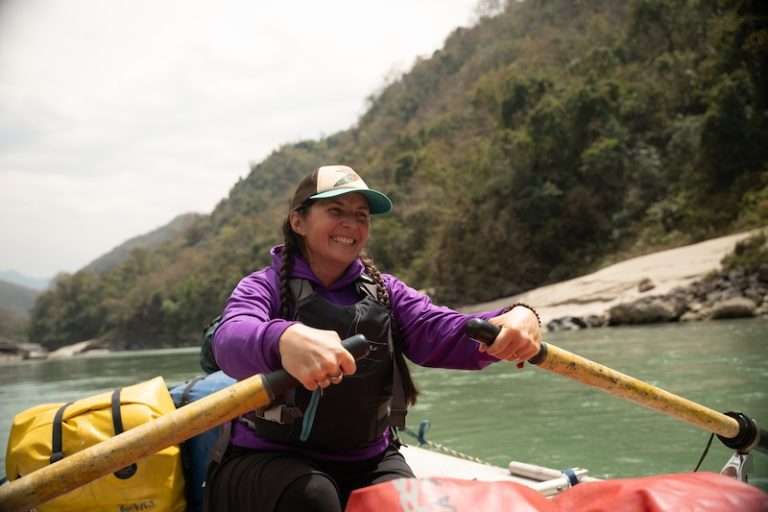
Anna: Hi, everyone, welcome back to the show. Today I’m speaking to a true explorer and adventurer, someone I’ve been wanting to get on the show for some time, because to me, his whole lifestyle embodies the discomfort zone. He’s built out a school bus that he lives in half the year while he raft guides in Colorado and West Virginia. Then he takes off with his kayak and travels to far-off places, often places that haven’t been kayaked, and goes on adventures, meeting new friends and doing first descents around the world. His name is Chris Bear, and he has a website called WhereisBear.com, which is actually written on his school bus, because you never know where he’s going to be.
We get into why adventuring is such a way of life for him, what he loves about it, being in the gray zone, getting actual feet on the ground versus listening to the stories being told about people and places, and not being boxed in by too many rules or plans. Sometimes he goes on these adventures with two weeks’ notice. So if you’re someone who feels like you always need a plan before you start something, this conversation is for you. You might discover a whole new world of getting out there without much of a plan, and how that can work out amazingly. Let’s get into it.
Anna: Chris, welcome to the show. Thanks for being here.
Chris: Thanks for having me. It took a little logistical figuring out to get us put together, but I’m glad to make this work.
Anna: Yeah, I’m excited. I think of you as a super adventurer, so I wasn’t surprised that it took some time, but I’m really excited to get into it. So when I say discomfort zone, what comes up for you?
Chris: Working a nine to five.
Anna: Yeah, totally.
Chris: You said you see me as an adventurer, but I can’t imagine doing that. That seems so discomforting.
Anna: What is uncomfortable about that thought for you?
Chris: Not being able to play outside as much as I want to. I think the office world has so many parameters, so many rules built into it. And I think that’s part of why I like whitewater. Everything is gray. We don’t have a lot of black and white rules out there. Everything is gray, and we get to go out and kind of make it up and see how we do in that situation when we get there.
Anna: Right. What I hear you saying is that you really want to be the creator of your life. Is that true?
Chris: Yeah. I’m not really making frameworks to hold my hand through this.
Anna: So can you give an example of the grayness of the rules?
Chris: With whitewater specifically, all of our actions, all of our actual paddling, there’s a reason. Lean into rocks, well, unless I want to use that wave to help turn me the other direction. Don’t reach out with your paddle this way, don’t do this, don’t do that. Everything has a reason, a specific way or a time, but sometimes we’re going to bend that rule, throw it right out the window, and do things totally differently. That goes for all of it. Even just finding our put-ins and our takeouts. Sometimes that’s private property, we can’t be there. Well, I’m going. There’s all this stuff where we just have to make it work in the situation and the time frame.
Anna: I hear what you’re saying, and I think it’s a really good point. I come from a place where I love instruction, and for a long time I taught what I had been taught. It was an epiphany when I started actually asking, what do I actually do in this situation, and why am I doing it? I’m really good at giving information and breaking things down, but I think that’s why some people don’t like the organization of instruction, especially something like the American Canoe Association, because for so long it was “you must do it this way, this is the right way to paddle.” Like you’re saying, well, okay, if I’m peeling out of an eddy, yes, I lift my upstream edge, but if I’m stern squirting, I drop my upstream edge. There’s no right or wrong way to paddle. There’s effective and ineffective, efficient and inefficient, and that depends on what your goal is.
Chris: Yeah. I think about peeling out of eddies. Sometimes I do it super inefficiently because I’m trying to go out there and not actually turn downstream, I’m just trying to go out and pause. That’s a totally different way of exiting than actually peeling out and trying to go downstream. Those are totally different styles, and there’s no right or wrong. It seems like we’re just constantly playing the gray, constantly making it up as we go downstream, constantly finding what works. What works well for you and how your physical body mechanics work, I’m a different sized person, right? I can get away with things that you can’t, and you can do things I’m not going to be able to pull off. I think it’s really cool that there are so many different styles to it. You see really good paddlers with wildly different styles, just figuring out what works well for them.
Anna: Yeah. And then how do you apply that to your life?
Chris: A bunch of my life is wrapped up with whitewater on one level or another. I’m a commercial raft guide, that’s my nine to five, and I’m doing the exact same thing in that situation, just with a different shaped boat. Even day to day, when I’m off adventuring, we’re making stuff up and changing things on a day to day basis. The bus is late, the boat doesn’t fit underneath, it doesn’t go there. Sure, there are rules, and then I have to figure out how to make that work. Hey, let’s stick it in the footwell of the bus, we could put it in there vertically, hey, we can put it over these seats, like, it’s my grandma, let’s put it on the airplane. I’m just making stuff up and coming to conclusions. It comes down to a problem-solving kind of situation. I don’t mind having a lot of problems thrown at me, and I feel like I can solve a lot of them on the fly, and that’s kind of my style.
Anna: Yeah, I could see that. The reason I think of you as such an adventurer is, I see you go off every winter and travel to different countries, seemingly on your own, solo, with your kayak in remote areas. You find locals to paddle with and explore rivers. I think that would be a discomfort zone for me personally, but I enjoy following your adventures. For folks listening who’ve never met Chris, he essentially travels around in a built-up school bus that says “Where is Bear” on it, that’s his tagline, Chris Bear. And it is true, it’s like, where is he now? Where did he go this winter? How did he get there? Who are these people he’s hanging out with? Look at these amazing rivers. To me, that would be a discomfort zone. I agree with you though, I couldn’t do the nine to five either, that’s why I work for myself and always have. So what do you love, and what drives you to take off and do these solo adventures?
Chris: I was hanging out with Grace and Hale, and Grace kind of asked me the same question, and I was like, I blame it on you, man. I remember all those LBM videos back in the day, all those things had people adventuring all over the states, and then wintertime would come and all those same characters would take off to all sorts of locations and start doing cool things in those locations. I was like, yeah, this is what the community told me I was supposed to do, and I think a lot of people do. When I was doing that at twenty four, twenty five years old, I think that made a lot of sense, and people were just like, cool. And then I got hooked on it. That’s why I work the summer seasons, so I can go travel and go to weird places and figure stuff out and see something that I don’t know.
Anna: It sounds like, is there problem-solving that comes into it too? Because if you’re going off soloing and you don’t know what’s there, that sounds like a lot of problem-solving to me. It sounds like a comfort zone for you is problem-solving, being in that gray zone.
Chris: Yeah, I definitely don’t mind that stress. I think that’s maybe where I perform well, when I have that level of stress on myself. And I think part of it is no one is looking for a perfect answer. It doesn’t have to be really pretty and tidy at the end of the day. We’re in this crazy off destination, we gotta get up to the put-in, does that mean we’re going to hitchhike today? Does that mean we find the local tuk-tuk and pay him more money than he’s made all week to drive us up there? Does that mean we just bump into the local paddlers, or spend enough time in the community that we hook up with local paddlers and get a ride up with them? None of those are perfect, they all have their perks and downfalls, but it just becomes problem-solving, you go make it happen. I think a huge part of it is just being present and putting yourself out there a little bit.
Anna: Yeah. When you go, do you have a plan already in mind, or are you really kind of winging it, like, I hear there are good rivers here, I think I’ll go check it out?
Chris: A huge portion of the time I don’t make a plan on which place I’m going until like two weeks out. It can be a couple weeks out, I’ve done it in five days before, just enough time for the plane ticket to get cheap enough to buy. Sometimes it’s literally typing waterfalls and a funny location into Google and seeing what pops up, which is utterly ridiculous. And sometimes I know there’s a community in the area or a connection there. I’ve put out those little “help wanted” things on Facebook, like, hey, I’m thinking about going to wherever, who’s been there? And then all of a sudden I get a connection, and I’m like, I know that person, that’s one degree of separation, get some beta from these people. And then once you get that, I think the huge thing is just getting feet on the ground. It’s so easy to look at these locations and be like, I don’t know what’s out there, and start looking at topography and rock structure and all that, but you don’t know if any of that’s going to work until you get there. All that stuff can kind of lie to you. Like, foot per mile is really neat to see on paper, but we were talking before we got on about the Nolichucky, that’s a relatively flat section, it’s still got some really fun rapids on it, especially nowadays. The new Nolichucky is way more fun, there’s cool rapids in there and it doesn’t have much gradient, but it really shows off. I think you can get lost in the weeds and the details, but a huge portion is just getting out there and getting feet on the ground and figuring it out.
Anna: Yeah, it’s cool what you just said too, that you’re not necessarily always going for the steepest or the raddest. It sounds like you’re really into, let’s check out what this place has to offer and find the cool spots, regardless of how rad it is. Also, when you go, you’ve gone to some really cool places, and you’re doing it really for the love of it, it seems like, for your passion. You’re not trying to get followed around with cameras and stuff, which there’s nothing wrong with that either, I produce a lot of content, it’s part of the business. But I find that interesting because you go a long way and you’re in it, and then you post your videos and photos, and it seems like it’s never for the production.
Chris: Yeah. The best case scenario for me when I produce something is that it’s a bunch of photos and videos of everybody else. I love point perspective, I think GoPros are neat, but I get bored instantaneously watching that, I hate watching it. I want to see the background, I want to see where we are, I want to see other people doing cool things. My website’s got my name in it, the whole tagline thing has my name in it, but that was just a joke, that’s what it turned into. To me, it’s all about showing off locations, showing off the paddlers in those locations. I want to hype them up nowadays. There was definitely some ego at some point in this, but at this point, I just want to go someplace pretty, go paddle with cool people, and see something I haven’t seen.
Anna: Right on. Okay, let’s do rapid fire, Chris. What’s your favorite river metaphor?
Chris: Give me an example, the cookware is failing immediately.
Anna: The cheesy ones are like “go with the flow,” “roll up and keep going.” I like “riverbanks as boundaries in life,” stuff like that.
Chris: I think I’m going to recycle and use “make it look so good that everybody else wants to do it.”
Anna: Okay, sounds good. Awesome. What’s a morning ritual that sets you up for success?
Chris: Coffee.
Anna: Good. What’s a non-negotiable self-care practice?
Chris: Being outside.
Anna: What motivates you these days?
Chris: Not knowing what’s around the corner.
Anna: What do people get wrong about you?
Chris: I don’t know. I figure people have good judgment, but maybe that I’m reckless or something. I think I take pretty calculated risks on doing risky things.
Anna: Okay, good. Throughout your life, have you felt like the underdog or favored to win?
Chris: No, I think both of those are movie clichés.
Anna: Fair, fair. Hard moves and easy water, or flooding?
Chris: I really like doing hard moves in easy water. But then I was just talking about a hundred thousand CFS, so, they’re both pretty fun.
Anna: So both. In one word, what describes your comfort zone?
Chris: Being outside. Outside.
Anna: Okay. Freedom through discipline, or “I do what I want”?
Chris: I do what I want.
Anna: In one word, what do you hope your legacy will be?
Chris: Adventure.
Anna: Well on your way, for sure. Is there anything else you want to tell our listeners, Chris?
Chris: Go have fun. Make it look so pretty that I want to go do it.
Anna: Nice, right on. Well, I appreciate you taking the time, thanks for chatting, Chris, I appreciate it.
Chris: Happy to be here.