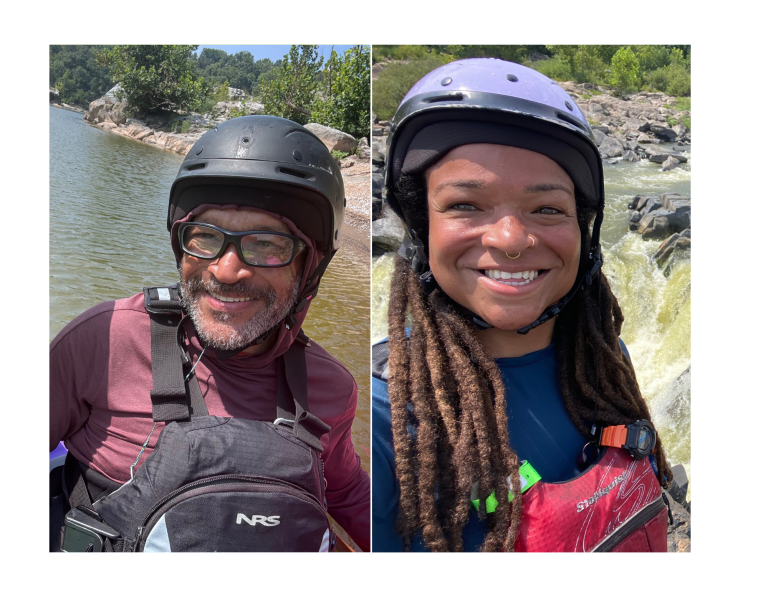
Anna: My guest today, Jeremy Ann Anderson, is a clinical Ayurvedic specialist, educator, whitewater guide, and co-founder, vice president, and programs director of Worldwide Women of Whitewater, a nonprofit dedicated to empowering women through whitewater by creating pathways into river guiding, leadership, and community. She brings more than 20 years of experience in Ayurveda, together with decades on the river, where she explores the shared lessons of nature, resilience, self-trust, and navigating the unknown. And by the way, Jeremy and I collaborated on an India trip earlier this year. That was amazing. I’m so excited to have her here. Thanks for being here, Jeremy.
Jeremy: I am very excited to be here as well. It’s nice to spend some time with you. Thanks for having me.
Anna: Yes. I’m excited to get into it with the discomfort zone, because we talked a little bit about it when we were co-leading the trip in India. So I’ll start this conversation by asking: when I say discomfort zone, what comes up for you, or what does that mean for you?
Jeremy: I think about the nervous system, predominantly. I think there is a difference between being uncomfortable because we’re growing and being overwhelmed because we’re exceeding our capacity. Learning that distinction has been a huge part of my own journey, and finding the tools that helped me come back to myself. Ayurveda has given me a language for understanding all of that, to dig into those deeper reserves of vitality and resilience and stability. And there’s also the wisdom that comes with time on water, knowing whether courage means to push harder, or knowing when to pause, regulate, listen, or make a different choice.
Anna: Yeah, for sure. There’s so much in what you just shared. First off, you said it was a journey for you to learn the difference between being overstimulated and being pushed just enough, and you talked about how Ayurveda has helped you. Can you say more about your journey to discerning for yourself where your zone of resilience is?
Jeremy: Ooh, that is an interesting question. I think it really was a long process of learning my own self and my own body, where my comfort zones are and what to do with that. It’s hard to think back to your 20s at this stage in the game, but I definitely recall my nervous system being more dominant. And I think that by taking care of yourself better, it becomes easier to listen. Through time, and taking better care of my own body and my own nervous system, and creating more resilience, it became easier to listen and understand where those edges were and what was rational. It just became easier to listen to and trust your intuition once you were healthier and more whole.
Anna: Was there a specific moment or situation where you went beyond your growth zone, and it really had you pay attention because it was painful or led to an injury? Was there a time you pushed yourself too far that was a breaking point?
Jeremy: Honestly, I can’t think of any incidents right now, and I spent some time sitting with that. There were definitely lessons I learned along the way about where my edges were, but I haven’t ended up with a crazy injury that made me think I pushed too far. I typically stop before I push myself beyond. I went back to 2010, when I was staring at Hance that one time and was just really grateful someone else was in my boat. That was the one instance where I was like, it’s a no for me today. I don’t know what it is about Hance today, but I will not be rowing it at all.
Anna: Hance on the Grand Canyon. Yeah.
Jeremy: Absolutely. And I feel like I set myself up with safety nets, and I think that’s part of helping my nervous system stay stable as well. As you know, I’m not in a kayak. Most of the time I’m in a raft, rowing. In the beginning of rowing bigger things, I would have somebody else with me who I could swap with if I wasn’t feeling it. I’ve learned lots of tools along the way to help support me, but no, nothing that comes to mind right now. I’ll probably wake up in the middle of the night with something that went just too far.
Anna: Yeah, it’s funny how that works. You mentioned safety nets, and having someone else in your raft. Are there any other safety nets that help you move through discomfort and challenge, on or off the water, from the Ayurvedic perspective or from the whitewater perspective?
Jeremy: A hundred percent. Ayurvedically, that really is about a whole system, taking care of yourself wholly. You do the fall cleanse and I do the fall cleanse. This falls into that safety net zone, because when we create rhythm with nature and take care of ourselves at the times of year when it’s best to take care of ourselves, like what we’re both doing this fall, we’re nourishing our nervous system to move into winter healthier and happier, and not depleting ourselves. And we do the same thing in the spring, to get ready and be stronger for summer. That’s just one example. Simple things like oiling your skin before you go out pacify your whole nervous system, and so does doing your breathwork techniques. There’s a song I sing at the top of every rapid that scares me. It might not be a safety net, but I put it in that bucket of all the tools we have that support us in moving outside of our comfort zone.
Anna: Hmm, I love that. And by the way, we should get into the basics of Ayurveda in a moment for listeners who may not be as familiar with it. I call mine the Reboot and Refuel reset. But I have never thought of the cleanses as safety nets, which is so great. I love that context, that they’re supportive tools, and so important for life on and off the water.
Jeremy: There’s so much work that goes into making sure we’re strong enough, mentally and physically, for what we do, as you know from the injury you just went through. All of these Ayurvedic tools are helping us be stronger and more stable and make better decisions.
Anna: Yes, I love that. Can you share, just for folks, how you would boil Ayurveda down? I’ve boiled it down on my webinars and in the information I put out, but I would love to hear your Ayurveda pitch. What is it, and why is it so powerful?
Jeremy: The short version: Ayurveda is a holistic healing system that’s rooted in India, but it’s a universal medicine. It means the science of life. It’s basically explaining to us how to know ourselves better and more deeply, how we interact with the environments we’re in, and our tendencies of imbalance, so that we can move through this time and this space as healthy as we can, with the wisdom of what’s right for our bodies and how to be in balance with the natural world: the seasons, the cycles of the day, the cycles of time, all of that. What was the other half of that question?
Anna: Why is it so powerful?
Jeremy: It allows us to be aligned with nature. It allows us to be balanced. Some people are like, what does that even mean, balanced? It just means our body is in equilibrium and alignment with nature. Happy, healthy, and whole is probably the easiest way to put it.
Anna: Mm-hmm. Which is not always easy, that feeling of happy, healthy, and whole. What I tell my clients, as someone who’s very fiery myself, is that sometimes I’ll get too bogged down in the rules of doing things right. For me, Ayurveda is a tool, a system. It’s not about doing everything right. But as you were saying earlier, it helps me trust myself to know the signs of when I’m out of balance, when I’ve gone too far. Instead of being totally clueless and wondering, why am I so tired? Why am I feeling like crap? Why am I so bloated? Now I can be like, all that dairy I’ve been eating all summer has been amazing, but it’s time to stop and go to oatmeal, because it’s the change of seasons. And then, what do you know, right after I do that, my digestion feels so much better and I have more energy. It’s a super small tweak that can make a big impact.
Jeremy: It’s amazing. Moments before this, I got a text from someone who’s in the middle of my cleanse right now, and we haven’t even started. It was just the phase where you eliminate the things that aren’t good for your system, and that’s different for everybody. She said, “It’s crazy how much better I feel in just this week. I’m sleeping better, my mind is clear, I’m not bloated, and I lost seven pounds.” We haven’t even gotten into the cleanse.
Anna: Oh my god. Yeah, that’s wild.
Jeremy: It’s amazing how much better you feel when you learn what your body needs and you listen to it. And it’s not just what you were saying about digestion, or not feeling bloated, and doing minor tweaks that make you feel better. It’s also how important sleep is to your performance on the river, and how important it is to understand your nervous system. I had never felt anxiety before one particular day. I remember the day, and it wasn’t that long ago. It was 2016, and I was about to go run Cherry Creek. I called up my friend and said, “I have this weird skin-crawling thing happening right now, and I don’t know what’s happening.” She said, “Jeremy, that’s called anxiety. Let’s talk about that.” I didn’t like it, and it was weird, but as soon as we put a name on it, I was like, right, that’s my nervous system. I just need to go do some pranayama, I need to go do some oleation, I need to eat some nourishing, grounding, warm, unctuous food, and I need to take care of myself if I’m going to go do this thing. And then everything was fine.
Anna: Yeah, awesome. For those listening, pranayama is breathwork, and oleation is applying warm oil to your skin. You’re reminding me that I have not been doing that daily this fall. Habits come and go. I used to do it every day, and it’s so grounding and soothing, especially for the fall season. So thanks.
Jeremy: Has it dried out back east yet?
Anna: Oh my gosh, it’s been so dry. At least in Western North Carolina, not everywhere, we’ve been in a terrible drought and haven’t had a lot of rain. So it really is something I want to get back to. And when you talk about moving through the discomfort zone, the things we’re talking about, making these changes and doing the cleanse, you just described how someone doing a cleanse with you has already experienced lightness and all these benefits before it even started. But let’s get into the discomfort of giving up your favorite foods, or the foods you’ve been eating, or the things you’ve been doing, like staying up late watching TV. You just get into it. I have so many clients who struggle with that as well. I always tell folks that joining something like the Reboot and Refuel reset, the cleanse, is one of the biggest mindset challenges. Showing yourself you can do hard things. To me, it’s almost harder than being at the top of a class V rapid, because we have so much attachment to our foods, to our habits, to our mindlessness. It’s wild.
Jeremy: It’s huge. I think about that a lot with first responders and people who live in the discomfort zone, because they go to the tools that take them out of it. They might go home and drink to calm their nervous system down, because they’ve been living in the discomfort zone all of the time. So when you can learn healthier techniques for dropping back down into the parasympathetic nervous system, it’s so much better for you.
Anna: Absolutely. Do you find it challenging? I always find it challenging when cleanse time comes around and I have to give up all the things that are not good for me.
Jeremy: Yes, I definitely still do. I’ve got all the books around me, like Tiny Habits and Atomic Habits, on how to help other people give up their habits, but that doesn’t make it easier for me. It’s going to be challenging for everybody. One of my favorite things that we both use is the power of community. When everybody’s doing it together, it is so much easier to feel supported in doing the hard things.
Anna: Yes, 100%. So much easier. There’s the accountability, and also the freedom to share. I always tell folks at the beginning, in the chat, let’s share the good, the bad, and the ugly. This is not a highlight reel. If you’re having a hard time, say so, because someone else is also having a hard time. And if someone’s having a great day, let’s celebrate that. It’s really, really powerful. Just like the river, which is such a good segue to talking about community, and what you and a few other powerful, amazing women have created with Worldwide Women of Whitewater: a community to support, advocate for, and amplify the voices of women in whitewater around the world who don’t have that advocacy. For instance, the training you did with the female guides in India. Only this past year, in 2026, were female guides allowed to guide on the Ganges in India.
Jeremy: They were allowed. They just didn’t have a pathway, and there was only one woman who had ever done it before. So they just weren’t there. When I went out to run an Ayurveda retreat, which to me also means go rafting, I got on the river and there were no women out there. There are 260-something permits out there and not a single female on the river. I was just like, why aren’t they here? Nobody seemed to know the answer. And I said, well, what if we run a guide school? When we did that, we got some really great women who had been wanting to get on the water and just didn’t know how. There wasn’t a visible pathway for them. Luckily, the company I go with, Red Chilies, was super open to supporting this mission. We were able to get 14 women on the water that first year, and it’s been growing ever since. We’re going into year four now. They have to do a two-year internship after the training, and they have to pass the government test. Last year they finally passed the test, and our girls were finally able to start getting paid to be river guides, which was very, very exciting.
Anna: Yeah, super exciting.
Jeremy: So that pathway is growing, and big things are happening. I enjoy getting out there and helping these women get on the water. And it’s a massive discomfort zone for them. They’re pushing through way more discomfort than we did. Yes, we had some discomfort with being women in whitewater in the US in the ’90s and earlier, and even still now, but they have some serious barriers to get past to get out on the water, and they have to be thick-skinned. Nena, a female kayaker out there, started the Ganga Girls.
Anna: Yeah, and she’s been on the podcast. If y’all are listening, you can go listen to her episode also. Go on, Jeremy.
Jeremy: The year before we got there, she created the first female community on the Ganga, the Ganga Girls, a female network of kayakers. Then the next year, when we came out and started a community of women training to be river guides, Nena was a big proponent of that. She helped out and got involved, and we have a lovely team going now. Nena was out there by herself, and Sunita before her. Those two were the main pioneers in India, and it was super challenging for them. So having community is a large part of moving through the discomfort zone, in my opinion, for sure.
Anna: Yeah. Nena’s story is amazing, y’all. If you haven’t listened to her episode, she talks about the barriers she’s had to break through, and her courage and willingness to be in the discomfort zone. And then that met the timing of you being there, seeing that, and being willing to support what they were already working on. I think that is so important. Sometimes, and I think this is true for myself too, I want to do something to help. But supporting and amplifying is so much more effective than trying to create something new.
Jeremy: Yeah, and I love that our two organizations can work together really well, because since then Nena has formed the Pravahini Foundation. Between Worldwide Women of Whitewater and the Pravahini Foundation, we can really support each other in growing women on the river in India.
Anna: Yeah. And then you’re going to the Zambezi next.
Jeremy: Yeah. We were in Costa Rica last year, the Zambezi is next month, and we’ll be back in India in March. And we’ve got Malaysia and Iceland on deck. So fun things are coming.
Anna: That’s incredible, amazing work. What I hear is that you saw a need, and then you decided to take action. Sometimes that can feel really overwhelming. It’s easy to look at things in the world and think, it’s so overwhelming, I don’t know if I can do anything, or whether what I’m doing is beneficial. What you’re modeling is one step at a time. It’s grown into this amazing thing. You’re going to many different places and you have a team, but it started with you noticing this and wanting to do something about it. So what were some of the first steps? You mentioned Red Chilies, and shout-out to Red Chilies, they are amazing. Is there anything else you want to say to listeners who might be wanting to make a change, but it feels overwhelming?
Jeremy: It comes back to community. Build the right team, and put the right people around you every step of the way. You’re not going to go kayaking with the wrong team. It’s the same thing with this build-out: convincing Red Chilies this was the move, then working with their male guides on how to work with women, then working with the government on how to support this, and creating all of the networks that need to come together to make it happen. Just like you said, it’s one step at a time. Then you’re like, this is working, what else do we need? This is working, what else do we need? And all of a sudden you realize you need to have a nonprofit. And next thing you know, a company on the Zambezi heard about us and reached out to us. And when we got to Malaysia for the World Rafting Championships, it was the women who reached out to us. So at this stage in the game, they know we’re doing it and people are finding us, which is really neat, because that community is having its own ripple effect right now.
Anna: Amazing. How are you funding these trainings and the travel and all that good stuff? Do you do fundraising?
Jeremy: The first year was fully GoFundMe. Like, hey, I have this idea, does anyone want to support me in doing this? And it covered it. Enough people came through to make it happen. Then, with the nonprofit, Jess, who was our fundraising chair for a while and is now our executive director, started putting together gala events and all sorts of fundraising in Colorado, where our nonprofit is based. Now that’s rippling out too. We don’t love the fundraising part. It’s not the most fun part of this. So we’re off in search of all the grants and donors and the things nonprofits do. But one of the coolest things that’s happened with trying to raise funds is this: we’ve always wanted to also do some domestic programming to support women in the States. So we offer accessibly priced swiftwater rescue trainings. They’re a benefit to our international programs, and also a benefit in and of themselves as a domestic program, so they support each other, which has been phenomenal. Now we can go to places and offer swiftwater rescue courses, and 100% of the funds go to our international programs. We offer them at a steeply discounted rate, really a sliding scale, so they’re accessible.
Anna: That’s cool. I have a follow-up question. If you’re discounting the courses and 100% goes to the programs, are y’all volunteering your time to teach?
Jeremy: So far, until we get more grants, it is 100% volunteered time, yeah.
Anna: Which is amazing. I really want all of us to thrive when we’re doing this work. So I hope, one, that folks taking the courses really appreciate that y’all are volunteering your time, because that’s super generous. And two, that eventually y’all can be compensated for the time you’re putting in as well.
Jeremy: Yes, me too. We definitely hope the grants are going to start coming in and this will become more and more sustainable as we move forward.
Anna: Right, exactly, because that’s sustainability. Coming back to the safety nets we talked about earlier, and I’m putting this out there as a question for you, I know that throughout my life it’s taken me a lot to start really valuing my worth. I think that’s also a pertinent conversation for all of us women in whitewater to take on, as a safety net, because we all have to pay our bills. You put it so beautifully earlier: when we take care of ourselves, we have more capacity. And part of that is getting paid what we’re worth.
Jeremy: It’s huge. I have a year-long Ayurveda mentorship program for graduates, and I have to teach them that all the time. What do you need to make to have a sustainable livelihood here? Then we have to look at what you’re charging, for sure. That’s huge for all of us.
Anna: It is, and it’s a discomfort zone too, because there are a lot of opinions, and there’s what we were taught about our value. There’s the idea that it’s selfish to want to make money, especially in industries like whitewater and Ayurveda, because there’s such a huge community aspect.
Jeremy: It really is.
Anna: But there’s nothing wrong with pricing for your value if you’ve dedicated your life to something and you have so much experience and knowledge to share. And y’all have such high value. So for anyone listening who hasn’t done a swiftwater rescue course, these ladies are putting it together, and it’s amazing.
Jeremy: Yeah, I think Elisha just had one on the Gauley that first week.
Anna: Yeah, I saw that she was doing that. That’s great. Very cool. So what has the discomfort zone taught you about yourself, Jeremy?
Jeremy: Ooh, interesting. I was thinking about this moments ago, with the discomfort zone and creating and running a nonprofit. There’s a ton of discomfort that comes with just learning how to do it and moving through every single phase of it. What have I learned about myself? That taking a step back, and not just pushing, is probably one of the biggest things I’ve learned over time. In my 20s it was probably just push, push, push without a whole lot of thought involved, if I’m really being honest. With time comes the capacity to step back and assess the bigger picture, and that wasn’t always easy for me. And giving yourself space to learn and grow, and having grace that we’re all learning and growing. We can’t always do everything great the first time. Some of the discomfort zone is, wow, I’m not good at that, or I need to work on this. Giving yourself space and grace for growth is important. We’re all in some phase of our evolutionary process. If we just allow that space and grace, we can all keep growing and evolving.
Anna: Yeah, well said. Jeremy, do you have any questions for me?
Jeremy: I actually do. It’s nothing big, but when you asked at what point I pushed my discomfort zone too far and learned a lesson, have you shared with your audience what that might have been for you?
Anna: I’ve shared about how I rehabbed my back injury recently on the podcast. But there were several times. This was in the early to mid 2000s, when I was competing a lot and paddling really hard stuff. I came from some river running background, but it all happened so fast. I was raft guiding so I could paddle all the time, focused on playboating, did some river running, and then I was sponsored. Next thing you knew, I was paddling a lot of class V out west with the best creek boaters in the world. I didn’t have a nice progression of skills, hard moves in easy water, until I got there, and that’s part of why I do what I do. At one point I was a bit burnt out. We were just go, go, go, and I was hanging out with lots of people who paddled hard stuff. I remember being on a creek in Washington State, a class V river, and I flipped over in a class III/IV rapid and hit my shoulder and my head. I rolled up and I just said, “I’m walking off. I’m done. I’m not doing this.” My now husband, my boyfriend at the time, was like, why, what are you doing? At the time he didn’t understand it at all. I said, “I just don’t want to do it.” Luckily, it was only a couple of rapids in, and I dragged my boat to the car, bawling my eyes out the whole time because I was so overwhelmed. Talk about pushing. Physically I was tired, I’d flipped over in a dumb spot, and I’d hit my head and shoulder. And from the nervous system perspective, I had just pushed too hard. I didn’t have the capacity to be on that hard class V, pushing, pushing, pushing, as you said, and it ended in a breakdown. I cried all the way to the car, dropped my boat, changed, got in the car, started reading my book, and realized I was so happy, sitting there in the car reading my book in the beautiful woods. So that’s one example, and I don’t regret it at all. I was so happy. After that, I didn’t want to push myself out of my zone of resilience like that again. And I still did. Like you said, it takes time. There were a few more instances like that until finally I started saying, preemptively, “No, I’m not doing that. It’s not for me today. I’m too tired, I’m overwhelmed, or I’m burnt out. I need a break.”
Jeremy: And I love that not only do you teach that, but it gets through to your crew. Being with your crew in India, I watched so many of them say, “Not today, I’m going to be in a raft,” or “I can do this today, but I’m not going to do it tomorrow.” They all really know in their bodies what they want to do each day and where their comfort zone is. That was impressive to watch.
Anna: That’s awesome. Thanks for that reflection. When you have that awareness, you’re willing to create that space for other people, and I know you do this as well. It’s a safe space to say, “Not today,” and no one’s going to judge you. I remember my boyfriend at the time had his arms crossed in his kayak. He’s a great guy, obviously. I’ve been with him for 20-plus years. But at the time, it just didn’t compute for him why I felt that way, and that’s okay. So it’s nice to be able to create a space where that doesn’t happen.
Anna: Before rapid fire, there’s one more question I want to ask you. Did someone teach or guide you on how to face discomfort in your life?
Jeremy: My family taught me a lot about life and resilience as a whole, but not whitewater. Nobody in my family is remotely interested in whitewater. That was something I found myself. But over the years, so many people have taught me so much. My favorite lesson, though, was from a woman named Carol in Colorado. We were in the Grand Canyon, above Lava, and I think I was talking about being afraid. She said, “Jeremy, you don’t have to be afraid of Lava. Lava does all of the work for you. There’s so much gradient. You don’t need any speed. You just have to trust yourself, trust the river, and let the river take you.” Lava was like church to her. It was this beautiful idea that as long as you’re set up at the top, the river does the rest. I learned more about it later on the Gauley, where it was really about how it’s all in your setup, in the first wave you touch. If you’re set up for that, you’re set up for the rest. But it was from Carol that I really realized you can relax into it. I had never had that “you can relax into it” feeling before, and it completely shifted how I approached those things. I remember the first time I was down there, in 2001, the guys were telling us, “You need so much speed, you have to be faster than the river, you have to be strong and fast,” all these crazy ideas about how to get through big rapids. Hers was the exact opposite. And she was in a raft that was delaminating as we went downstream, falling apart underneath her, because it was her friend’s boat, called the River Lady, and she really wanted to take it down. She was just making it down that river. She showed me that it really was: set it up and let the river do the work. For me, it’s a combination of really relaxing into it and the other feminine aspect, which I call meditating with the river. Adding that to Carol’s lesson has been a huge shift for me. I think it’s dharana, not pratyahara, that pointed focus they teach in the eightfold path of yoga. When you’re less concerned about muscling it and you can get into the dance of it, you enter the state that the extreme sports world calls the flow state. In the yoga world, it’s just part of yoga, where you’re in the moment with that pointed focus. You can allow yourself to relax, get into that parasympathetic state, and flow with the river. That’s a huge lesson, I think, for anybody learning, not just women: we can come into this in a state of calm instead of a state of amped-up nervous systems, and it really helps a lot.
Anna: I love that. Thanks for sharing. That’s really great. All right, are you ready for rapid fire?
Jeremy: I think so. Let’s go.
Anna: Okay. What is your favorite river metaphor for life?
Jeremy: Oh man. There are so many river metaphors for life. I think I use them all. Shout-out to Barry Kruse and his book Leading Steep. He talks all about how class V is a metaphor for life in every different way. Maybe we can come back to that one. Let me think about it.
Anna: Yeah, we can come back to it. It’s all good. What’s a morning ritual that sets you up for success?
Jeremy: Light in the eyes. It’s super easy when you’re on a river because you’re waking up on the river, but even at home, just getting up, going outside, and getting sunlight in my eyes is my number one for staying in tune with circadian rhythms, which keeps you in flow for sure.
Anna: Awesome. What’s a non-negotiable self-care practice?
Jeremy: Time in nature.
Anna: Mm-hmm, it’s a good one. What motivates you these days?
Jeremy: Watching people realize that they are capable of more than they thought.
Anna: That’s awesome. What do people get wrong about you?
Jeremy: This is funny. I don’t have an immediate answer about other people, and I don’t know what they get wrong about me. But my mom thinks I do scary things, and I don’t think I do scary things at all.
Anna: That’s awesome. Throughout the course of your life, have you felt like the underdog or the favored to win?
Jeremy: Both. It depends on the circumstance.
Anna: Right on. Hard moves in easy water, or flooding?
Jeremy: Hard moves in easy water, all day long.
Anna: What’s one word that describes your comfort zone?
Jeremy: That takes me back to nature. Being fully immersed in nature is my comfort zone.
Anna: Love that. Freedom through discipline, or I do what I want?
Jeremy: Ooh. It used to be “I do what I want.” Now it’s freedom through discipline. That’s been a big shift in my life.
Anna: Don’t you think Ayurveda has a lot to do with that freedom through discipline? I feel the same way, and Ayurveda was a big piece of that.
Jeremy: So much. I never even liked the word “routine” when I was young. I had to call it “rhythm” just to handle it. And now I love, love routine. That’s what discipline is. It’s putting the steps in place that create balance and structure and pacified nervous systems.
Anna: Right on. In one word, what do you hope your legacy will be?
Jeremy: Connection.
Anna: Love that. Well, you’re well on your way. And I appreciate you, not only for being here, but also for helping connect me with India, the waters of India, and all of those amazing people: Nena, Pinky, Sahdev, Manish, the folks at Red Chilies, all of them. I really appreciate what you do and who you are in the world, Jeremy.
Jeremy: That’s a good team. Thank you. It was such a pleasure to be over there with you and get to have that experience with you. It’s so fun. I recommend it to everyone.
Anna: Yes. I acknowledge you so much for going every year. You’re going three times this year. Talk about circadian rhythm, with the time change. I do want to go back, but I need some time in between.
Jeremy: It’s a journey, definitely a journey. I’ve got some tools in the toolbox now that make it much, much easier. When I can balance it right and do the journey right, it’s really good for my system. It’s a beneficial trip for sure.
Anna: That’s awesome. Is there anything else you want to tell our listeners?
Jeremy: Sure. One of the biggest things I’ve learned through practicing Ayurveda, working with other people, and taking people rafting is that for me, it’s all the same. It’s hard to make people understand that practicing Ayurveda and whitewater are the same. Anna understands this. We’re living in a time when we’re increasingly disconnected from our bodies, from nature, and from our intuition. I think the invitation is that we need to come home to ourselves, to understanding ourselves better as the individuals we are. That’s the thread that connects my work, whether I’m sitting with someone in Ayurveda, teaching practitioners, or taking people down a river. The river has taught me how to meet uncertainty. Ayurveda has taught me how to listen to my body. And the women I’ve had the privilege of being in community with have taught me the power of doing hard things together. We don’t have to eliminate fear as it comes up, and we don’t have to constantly push ourselves out of our comfort zones. We can simply learn to listen deeply enough to our inner wisdom to know when it’s time to step forward, when it’s time to pause, and when it’s time to say no, walk back out to the car, and read our book. The river reminds us who we are. Nature, when we can really tune in, teaches us how to listen. And community reminds us that we don’t have to do it alone.
Anna: Love that so much. Thank you so much for sharing that. So well said. Thanks for sharing your wisdom. On the show page on my website, I’ll have links to Worldwide Women of Whitewater, to Jeremy’s website, and to her Instagram, so you’ll be able to connect with her. Thanks for being here, Jeremy. I appreciate you.
Jeremy: Thank you so much. This has been an absolute pleasure.